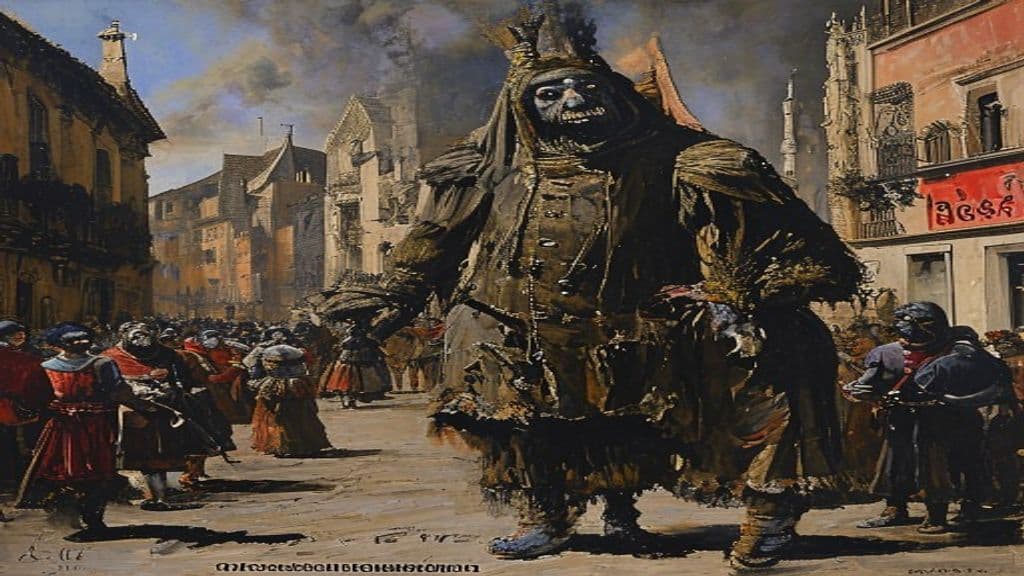
Sources do not provide a mythic creation narrative for the Gegants of Mataró. Documentary material locates them within the civic-traditional repertoire of Catalan festivals and in the program of Les Santes (the city’s largest festival, held annually from 25 to 29 July), indicating a civic and performative origin as municipal festival effigies rather than an origin as autonomous supernatural beings.
The provided sources identify the Gegants as large parade figures that arrive in public spaces (for example, the caption noting "Els Gegants de Mataró arriben a plaça Santa Maria"). The sources do not supply specific visual details such as exact size, costume, construction materials, or sculptural style; what is documented is their movement into and presence within festival plazas and processions.
The documented role of the Gegants is performative and processional: they participate in Les Santes events, appearing in public squares and parades alongside other festival elements (comedy shows, live music, fireworks, correfocs). Sources present them as effigies incorporated into civic celebration with no attribution of autonomous agency or supernatural powers.
Gefjun
Gefjun is a named goddess in Old Norse myth attested in the Poetic Edda, the Prose Edda, Heimskringla, and skaldic poetry; she is associated with ploughing and an origin-myth for the Danish island of Zealand, with certain legendary kings, with virginity, and with foreknowledge in the surviving medieval sources.
Gegant Gerió
Gegant Gerió is a named processional giant (gegant) associated with Girona. The figure is a civic/ritual effigy used in public processions and ceremonies rather than an independent supernatural being.
Gegant Negre (Cervera)
The name "Gegant Negre (Cervera)" combines Catalan elements meaning "Black Giant" and a toponym (Cervera), but the supplied sources do not document a coherent traditional supernatural being by that exact name. Available evidence shows the "gegant" motif appearing in contemporary Catalan-language literary and science‑fiction texts as a poetic or apocalyptic image rather than as an ethnographic, ritualized entity tied to Cervera.
Geganta Sagrerina
The Geganta Sagrerina is a processional giant (geganta) associated with the la Sagrera neighborhood of Barcelona. The available source identifies it as a civic/folkloric effigy used in public processions rather than a supernatural being.
Gegantons Xavier i Laia Cartulinus
A named pair of processional giants (gegantons) associated with the municipality of Arenys de Mar. They are civic, performative figures used in local processions and popular festivities rather than supernatural beings.
Gegantons de Cervera
The Gegantons de Cervera are processional giants (gegantons) associated with the town of Cervera in Catalonia. They function as civic, performative effigies carried in public processions and festivals rather than as autonomous supernatural beings.
Gegants Elm i Carmeta
Gegants Elm i Carmeta are a pair of processional giants (gegants) used in public processions in Arenys de Mar. They function as large anthropomorphic effigies carried in civic festivals and represent performative, communal identity rather than supernatural beings.
Gegants Fantasmes
A Catalan-language phrase that functions both as a label for processional giants (gegants) associated with Ververa and as a metaphor in contemporary cultural and political discourse combining the ideas of monumental power (giants) and recurring anxieties or spectres (fantasmes). It is not documented in the supplied sources as a discrete folkloric spirit with myths or rituals.
Gegants Roc i Maria
Gegants Roc i Maria are a pair of Catalan procession giants (gegants) — large wearable figures animated by people during municipal festivals and saint’s day processions. They are civic/festival artifacts associated in the sources with Catalan towns (Wikidata links Roc i Maria to Arenys de Mar) and with festa major traditions such as the Sant Roc celebrations.
Gegants Vells de la Casa de Caritat
A pair (or set) of traditional Catalan 'gegants' (giant festival effigies) associated with the Casa de Caritat institution in Barcelona, presented and animated as part of the city's Carnival processions and civic festivities.
Gegants d'Olot
Gegants d'Olot are large anthropomorphic processional giants used in public festivals and processions in the town of Olot, Catalonia. They function as civic/festival effigies within Catalan popular tradition rather than as supernatural beings.
Gegants de Calonge
Gegants de Calonge are processional giants — large anthropomorphic effigies — associated with the town of Calonge and used in public processions and festivals. The figures function as ceremonial objects/personifications representing characters or local identity rather than as autonomous supernatural beings.
Community Record
- [1]Les Santes. "Les Santes is the largest festival in the city of Mataró, Spain. It is celebrated every year from the 25th to the 29th of July. The festivities include comedy shows, live music, fireworks and typical features present in catalan festivals, such as correfocs and 'gegants'." — Wikipediawiki
- [2]Desvetllament bellugos [Les Santes 2018]. "Els Gegants de Mataró arriben a plaça Santa Maria." — archive video captionother