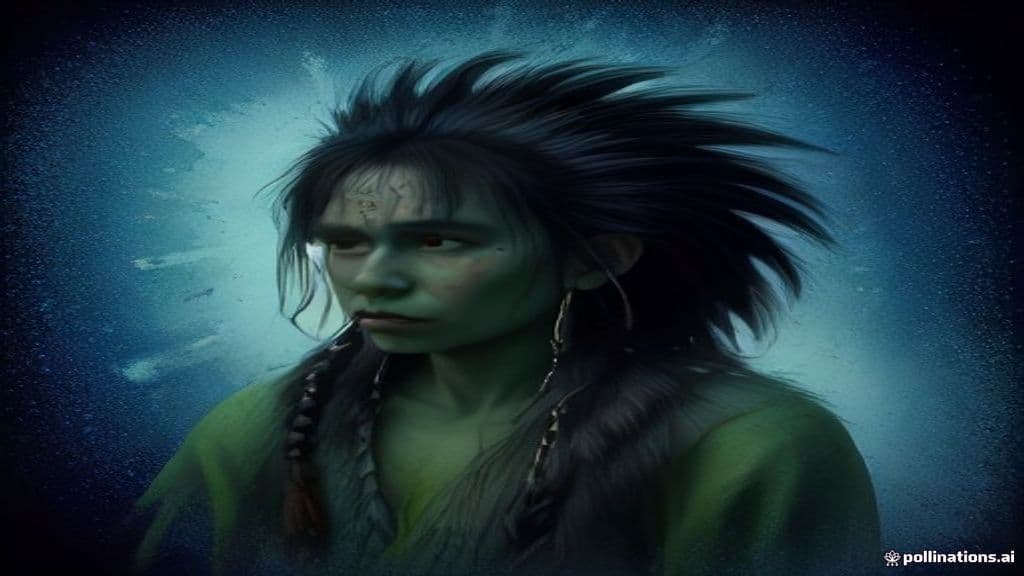
Within Algonquian cosmologies Gitche Manitou denotes the 'Great Spirit' or Great Mystery. Linguistically composed of a root meaning 'great' or 'venerable' (Gitche/Gichi/Kitchi/Kihci/Gizhe) and manitou (spirit, mystery, or deity), the term functions either as the name of a supreme creator who is the giver of life or as the designation for the overarching connectivity of many individual manitous. After European contact, Christian missionaries often used Gitche Manitou or cognate terms as translation-equivalents for the Christian God, and post-contact usage sometimes applied masculine pronouns.
Traditional sources emphasize that Gitche Manitou was rarely personified and is commonly described as an impersonal or abstract Creator Deity; there is no consistent canonical anthropomorphic description in the cited materials. In later literary and popular accounts (e.g., Longfellow's Song of Hiawatha) Gitche Manitou is rendered in more personified form, and some post-contact usages present the spirit with masculine pronouns.
As the supreme spiritual principle or Great Spirit, Gitche Manitou is described as the source or collective of the many manitous and in modern Anishinaabe usage as the Creator of all things and the Giver of Life. The manitou framework implies pervasive spiritual agency present in plants, stones, animals (and, in post-contact accounts, artifacts), with Gitche Manitou representing the greater spiritual connectivity or precedence among manitous. Gitche Manitou functions primarily as a cosmological principle and object of reverence; some sacred places (notably Michilimackinac / Mackinac Island) were regarded as associated with the Great Spirit and destinations for communal rituals or pilgrimages.
Weaknesses
None recorded.
Wards
- ritualPlacement of spirit images near doorways (Anishinaabe protective practice)
Community Record
- [1]Gitche Manitou - Wikipedia. Wikipedia: 'Gitche Manitou (Gitchi Manitou, Kitchi Manitou, etc.) means 'Great Spirit'...'; 'In more recent Anishinaabe culture... Great Spirit, the Creator of all things and the Giver of Life'; 'Historically, Anishinaabe people believed in a variety of spirits, whose images were placed near doorways for protection'; 'According to Anishinaabeg tradition, Michilimackinac... was the home of Gitche Manitou' ; 'Hobomok... deemed more approachable than Gitche Manitou.'wiki
- [2]Manitou - Wikipedia. Wikipedia: 'Manitou is a common Algonquian term for spirit, mystery, or deity'; describes manitou as a pervasive life/spirit-force present in all things and notes many individual manitous as parts of an interconnected whole.wiki
- [3]Wikidata: Gitche Manitou. Wikidata entry for Gitche Manitou (identifying term and language variants).other
- [4]Archive item: Circle of Life (Native American Music). Archive listing demonstrating modern cultural uses and circulation of terms related to Gitche Manitou in music collections.other
- [5]Archive: Monoteísmo Primordial #4 - Gitche Manitou. Archive listing showing modern/interpretive uses of the term.other
- [6]Manitou (Native American god) - Marvun App. Summary material correlating manitou concepts with Gitche Manitou as great spirit terminology.other
- [7]Godchecker: GITCHE MANITOU. Popular reference summarizing Gitche Manitou as Algonquin/Ojibwe supreme god and noting literary reception.folk
- [8]Book listing: Gitche' Manitou - BlueInk Review / iUniverse entries. Listings showing contemporary literary treatments and uses of the name (demonstrating post-contact and popular circulation).other