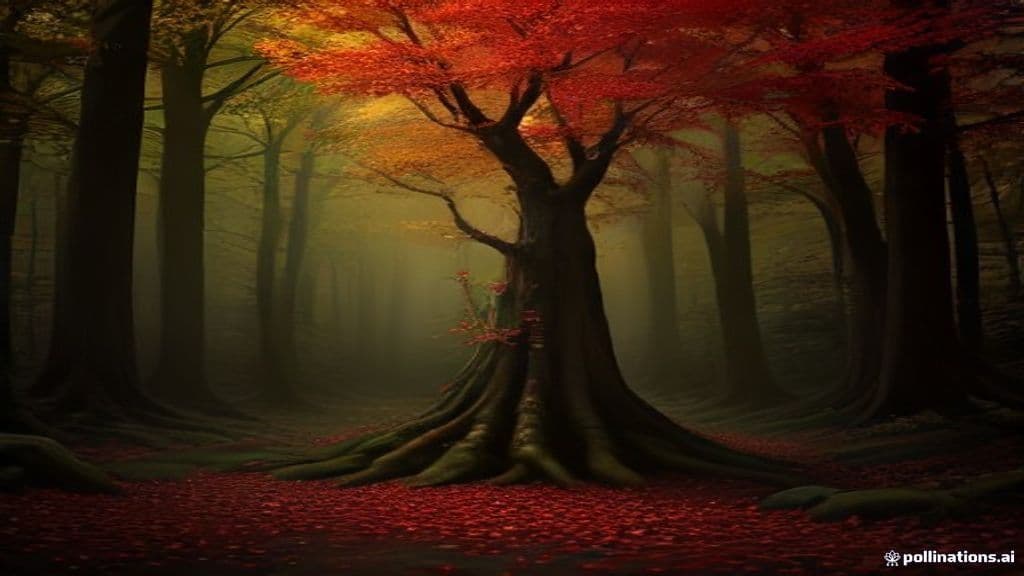
The provided sources do not record a distinct cosmogonic or birth narrative for Glasir. In the Poetic Edda (Grímnismál) and the Prose Edda (Skáldskaparmál) Glasir is attested as an established feature of Asgardian topography, standing before the doors of Valhalla; the name also appears as the place-name Glasislundr in Helgakviða Hjörvarðssonar.
Attested alternately as a single tree and as a grove (Glasir / Glasislundr), Glasir is repeatedly described in the cited sources as bearing foliage of red gold—phrases used include that its leafage is "all red gold" and that it stands "with golden leaf before Sigtyr's halls." The Prose Edda and Grímnismál call it exceptionally beautiful (summarized as "the most beautiful among gods and men" in modern summaries), and its visual identity in the sources is primarily the golden, gleaming leaves.
No animate powers or agency are attributed to Glasir in the provided texts. Its principal "ability" in the literature is poetic: its name and golden leaves are used as a kenning or source-term for gold in skaldic and Eddic verse. Narrative action occurs at the place named Glasislundr (for example, Helgakviða Hjörvarðssonar opens there and includes a talking bird that bargains for a sacrifice), but the tree/grove itself is not described in the supplied sources as speaking, moving, attacking, or performing magic.
Community Record
- [1]Glasir. Wikipedia: Glasir (summary of Old Norse attestations including Prose Edda and Poetic Edda)wiki
- [2]The Poetic Edda: Grímnismál (stanzas referencing Glasir). Grímnismál (Poetic Edda) as reproduced on GermanicMythology — passages identifying Glasir/Glasislundr and its golden foliageliterary
- [3]The Poetic Edda: Grímnismál (additional stanzas). Grímnismál (Poetic Edda) — related passages on Glasir/Glasislundrliterary
- [4]Glasir (Wikidata). Wikidata entry summarizing Glasirother