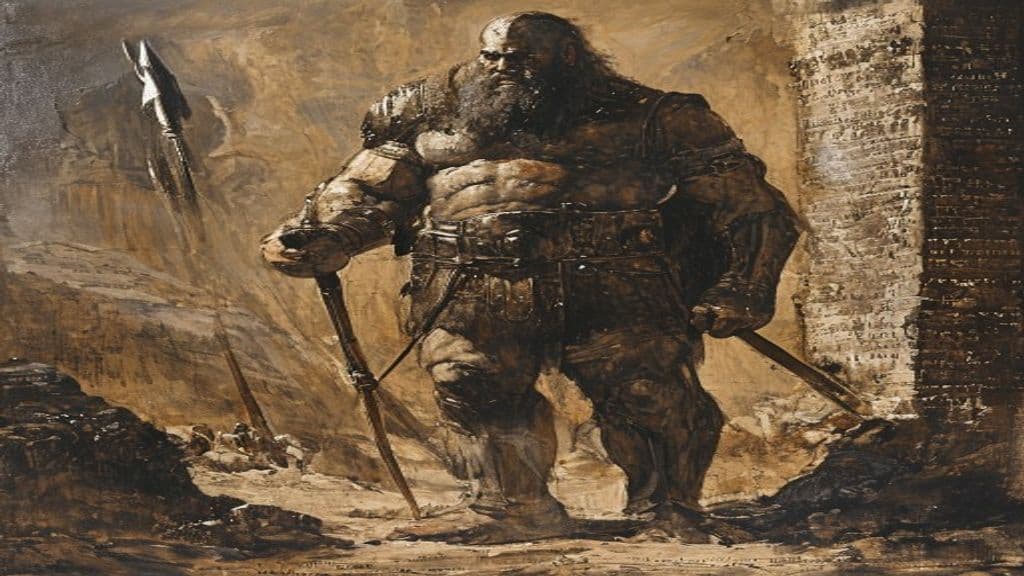
Within the Biblical narrative frame preserved in the supplied sources, Goliath appears as a prominent Philistine warrior from Gath who serves as the Philistine champion in the pitched encounter with Israel during the reign of Saul. The story is embedded in the Deuteronomistic historical composition in which episodes such as the single combat with Goliath are used to evaluate leadership, divine favour, and the rise of David. Variant textual traditions and later commentators also preserve related references (for example, the problematic attribution in 2 Samuel 21:19 and the explanation in 1 Chronicles 20:5).
Goliath is described in the sources as of 'giant stature' and presented wearing armour and bearing heavy weaponry (a spear/javelin is explicitly mentioned in the narrative). Manuscript traditions diverge on his exact height: the Dead Sea Scrolls, Josephus, and major Septuagint manuscripts read 'four cubits and a span' (commonly rendered about 2.06 m / 6 ft 9 in), while the Masoretic Text reads 'six cubits and a span' (about 2.97 m / 9 ft 9 in). The figure is framed as an extraordinary, heavily armed warrior rather than a supernatural monster in the supplied material.
In the supplied accounts Goliath's primary role and 'ability' is martial and intimidating: he issues a repeated public challenge to Israel (coming out 'morning and evening for forty days') and functions as the Philistine champion whose presence demoralizes the Israelite forces. The narrative records no supernatural powers; his threat is physical, social, and symbolic. The decisive narrative action is that David strikes him with a sling-stone to the forehead, causing Goliath to fall and subsequently be beheaded.
Weaknesses
- othervulnerability to missile strike (narrative detail: stone to forehead)
Wards
- conditionmilitary counter (provide a champion and weapons)
- conditiontrust in divine deliverance (narrative response rather than ritual)
Goldemar
Goldemar is a named figure in medieval German tradition attested both as a dwarf‑king in a thirteenth‑century Middle High German poem and as a later popular household or subterranean sprite associated with Hardenstein castle. The poem presents him as a leader of dwarfs in a mountain and an antagonist in the Dietrich cycle; separate folk accounts cast him as an intimate house‑spirit who plays the harp and influences household fortune.
Golden Bough (Aeneid)
The Golden Bough is a supernatural object in Roman mythology that facilitates Aeneas's passage into the Underworld, requiring his divine favor. (Note: 1. Power tier: Primordial - This appears too high given the description of the Golden Bough facilitating Aeneas's passage into the Underworld with divine favor, but not having any further cosmic or cr)
Golden Woman (Zolotaya baba / Zlata baba)
A prominent sacred image attested in early modern European accounts of northeastern Europe / northwestern Siberia, described as a large female-form idol or a rock resembling an old woman. Recorded functions include obligatory offerings by passersby and, in some reports, use as an oracle or in local sorcery.
Golden‑Nosed White‑Haired Mouse Spirit
A cultivated mouse spirit (金鼻白毛老鼠精, Jīnbí Báimáo Lǎoshǔ Jīng) appearing in the 16th‑century novel Journey to the West. She cultivated at Vulture Peak, stole and consumed the Buddha's fragrant flowers and candles, disguises herself to deceive humans, kills several monks, and attempts to force Tang Sanzang into marriage to obtain his yang and attain the rank of Taiyi Golden Immorta (太乙金仙) before being exposed and captured by heavenly officers.
Goldhorn (Zlatorog)
A legendary white chamois buck or Alpine ibex from Slovene (Carinthian) mountain folklore, identified by golden horns and associated with hidden mountain treasure and magical alpine flowers. Best known from a late‑Romantic written version first published by Karl Deschmann (Karel Dežman) in 1868 and later popularized in verse, opera and film.
Golem (Jewish tradition)
An animated anthropomorphic being formed from inanimate earth (typically clay or mud) and brought to life by a human practitioner through the ritual use of Hebrew letters or divine names. In Jewish narrative and mystical contexts the golem functions as servant or protector created by rabbis, Baal Shem figures, or Kabbalists, but stories repeatedly warn that it can grow uncontrollable and must be deactivated by altering its animating inscription.
Goll mac Morna
A human warrior of the Fenian Cycle of Irish mythology, Goll mac Morna (Áed mac Morna / Áed mac Fidga) is an uneasy ally and sometime rival of Fionn mac Cumhail who killed Fionn's father Cumhal, took the leadership of the fianna, and later yielded to Fionn; he appears in episodes of single combat, factional conflict, and etiological place-name tales.
Gollum (Sméagol)
Gollum is a singular, sentient figure from J. R. R. Tolkien’s Middle-earth: a Stoor Hobbit named Sméagol who was long corrupted and physically altered by possession of the One Ring, becoming an ambivalent, furtive, cave-dwelling creature whose divided personality and obsessive attachment to the Ring play a decisive role in the Ring’s fate.
Gonggong
Gonggong is a legendary prehistoric Chinese figure, portrayed in literary and mythic sources as a powerful water-associated being whose destructive act damaged the cosmic supports of the heavens and caused great floods; his story functions as an etiological myth explaining river directions and certain celestial observations.
Gonggong
Gonggong is a name listed in a general compilation of water-associated mythic figures. The single provided source groups Gonggong among water deities but supplies no specific narrative, attributes, or rituals for this figure.
Good Witch of the North (Baum)
A benevolent, regional witch and ruler of the Gillikin Country in L. Frank Baum's Land of Oz who appears briefly in The Wonderful Wizard of Oz (1900) to aid Dorothy with counsel and limited magic. Later stage and film adaptations renamed or conflated her (Locasta/Locusta/Tattypoo; film conflation with Glinda) altering popular memory of the character.
Goose Wife
A bird‑woman figure from Inuit and other Arctic oral traditions who alternates between human and avian form by removing or donning a feathered skin; she may become a human wife when her skin is taken and later return to the bird realm by reclaiming or fashioning feathers.
Community Record
- [1]Goliath - Wikipedia. Wikipedia contributors. 'Goliath.' Wikipedia, The Free Encyclopedia.wiki
- [2]Goliath - Biblical Cyclopedia. Biblical Cyclopedia. 'Goliath.'other
- [3]Goliath (ArMA manual title and other modern usages) and assorted modern usages noted in supplied corpus. ArMA: 'Goliath' manual title and other modern reuses cited in the research notes.other