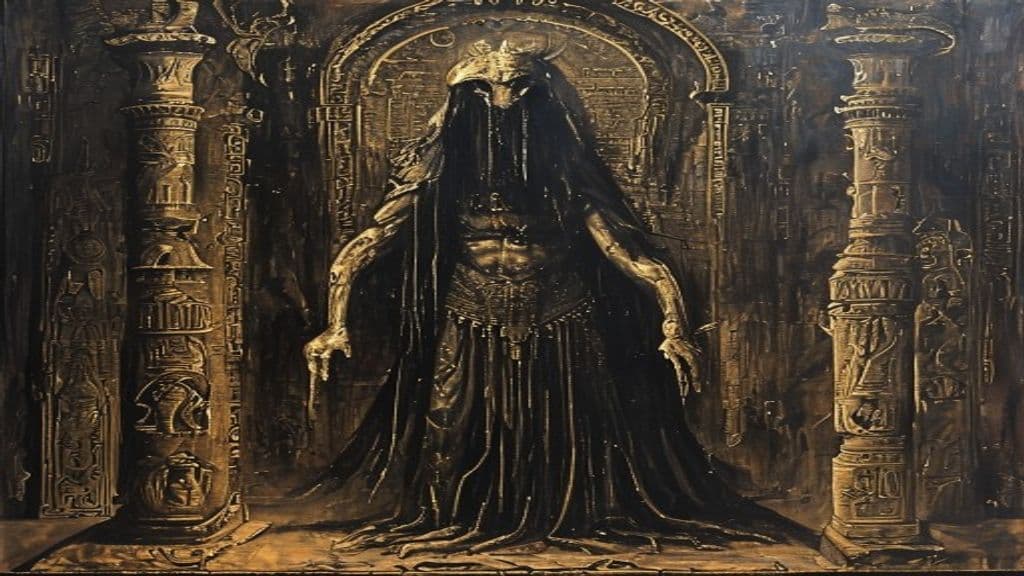
Ningirsu's name is likely derived from the Sumerian phrase 'ni-gir-su', meaning 'Lord of the City'. He was worshipped as a divine presence associated with the city of Lagash and its temple, Eninnu.
No physical description of Ningirsu is provided in the Gudea cylinders.
As the patron deity of Lagash, Ningirsu granted prosperity and fertility to the land. He was said to have appeared to Gudea in a dream, guiding him through the construction of the temple Eninnu.

Enlil
Enlil is a principal deity of ancient Mesopotamia, originally preeminent in the Sumerian pantheon as a supreme lord who orders the world by separating heaven (An) from earth (Ki). His principal cult center was the E-kur temple at Nippur, and his cult practices focused on daily offerings and priestly care of his cult statue; mythic traditions portray him as both benefactor and punisher in the administration of cosmic and social order.

Enki (Ea)
Enki, also known by the Akkadian form Ea, is a major Mesopotamian deity associated with wisdom, crafts, magic and incantations, and the freshwater deep called the Abzû. Centered at the cult-city Eridu (temple E‑Abzû), he functions in myths as a crafty counsellor, culture‑hero and creator figure who aids humans and orders aspects of the world.
Ninduluma
Ninduluma (also attested as Ninildu in some sources) is a Mesopotamian deity associated with carpentry and the carpenters' craft, attested in offering lists and literary texts and primarily worshiped in or near the city of Zabalam.
Nine-tailed Fox
A long-lived fox-spirit figure from Chinese myth (九尾狐) that appears across East Asia (e.g., kitsune, kumiho). Associated with age-linked transformation, shapeshifting into humans, ambiguous morality (trickster/seducer or occasionally honorable), and in some doctrinal sources a celestial/ritual role with talismans and jiao rites.
Ninegal
Ninegal (Sumerian Ninegalla; Akkadian Belet Ekalli / Belet-Ekallim) is a Mesopotamian tutelary goddess whose domain is the palace. Attested from the Early Dynastic period through the first millennium BCE, she functioned in cult as the divine guarantor of palace integrity and the sovereignty of rulers, and in some literary contexts appears as an epithet or manifestation of Inanna.
Ningal
Ningal (Sumerian dNIN.GAL, "Great Queen") is a Mesopotamian goddess, chiefly known as the consort of the moon god Nanna/Sin and the tutelary goddess of the city of Ur. She appears across Mesopotamian periods in god-lists, hymns and laments where she functions as wife, mother (commonly attested as mother of Inanna and Utu), mourner of the city, and local protective presence.
Ningen
A modern Japanese internet-originated aquatic humanoid cryptid said to inhabit the Southern Ocean and Antarctic ice margins, described in online posts and popular media since the mid-2000s as a large whale-like or mermaid-like creature with humanlike facial features and limb-like appendages.
Ningikuga
Ningikuga is a Mesopotamian goddess attested in god-lists and hymnic texts. Her name is glossed as “lady of the pure reed,” and textual traditions treat her variously as an independent divine name, as a spouse of Enki in one list, as the mother of Ningal in poetic compositions, and as a manifestation-name applied to other major goddesses in isolated hymnic contexts.
Ningishzida
Ningishzida is an ancient Mesopotamian deity associated with vegetation (especially grass), snakes, and the underworld, attested from the Early Dynastic III period through later Mesopotamian eras. He appears in temple cults, hymns, mythic texts (including underworld contexts), and royal building inscriptions, and in some traditions has a martial/victory aspect.
Ningublaga
Ningublaga is a Mesopotamian deity associated primarily with cattle and with the moon god Nanna/Sin. He functions as a temple-lord and pastoral overseer, an apotropaic figure invoked in incantations, and an astral deity forming one half of the ‘Little Twins’ constellation with Alammuš.
Ninhursag
Ninhursag is a principal Sumerian mother/earth/mountain goddess—literally 'lady of the sacred mountain'—associated with fertility, birth, creation, and the living earth; she appears across multiple Sumerian myths and served cultic and tutelary roles in Early Mesopotamian religion.
Ninimma
Ninimma is a Mesopotamian goddess attested especially at Nippur, functioning within Enlil’s court as a divine scribe/librarian, a court nurse and birth-assistant, and from the Middle Babylonian period also invoked in healing and curse-breaking rites.
Ninisina
Ninisina is a Sumerian/Mesopotamian tutelary goddess of the city of Isin, chiefly known as a divine physician and midwife who protects the city, legitimizes its rulers, and is invoked to expel harmful supernatural agents.
Ninkasi
Ninkasi is the Mesopotamian divine personification and cultic goddess of beer, associated with the production, consumption and social/ritual effects of beer. She appears in god lists, hymns (notably the Hymn to Ninkasi) and administrative and ritual contexts from the Early Dynastic through later Mesopotamian periods.
Community Record
- [1]Wikipediawiki