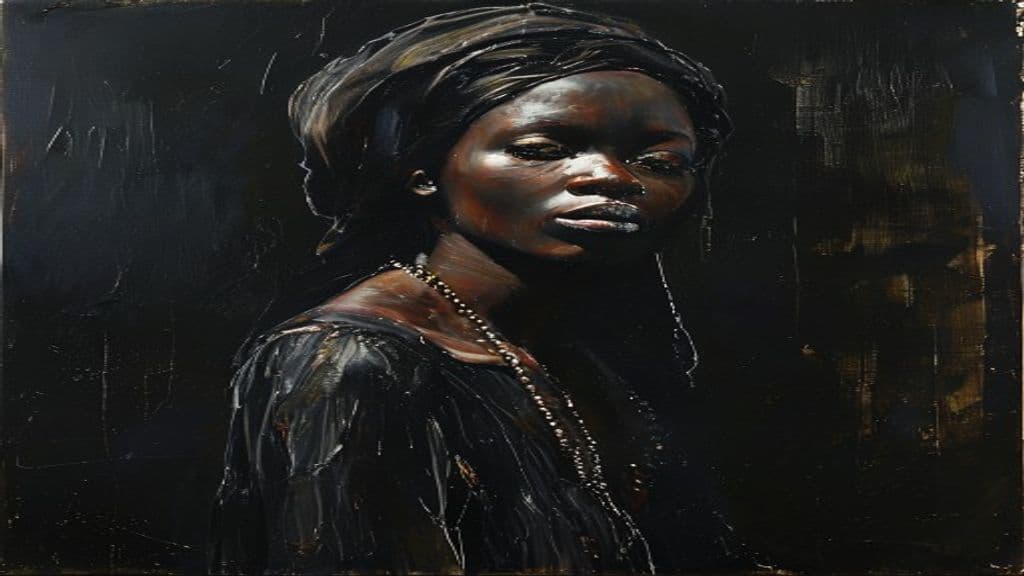
No mythological origin story is recorded in the cited source. Guegue appears in contemporary rumor and media controversies rather than within an established traditional origin narrative; the term rose into public attention through mentions in songs and subsequent accusations in the 1990s and notably in a 2017 controversy around a Congolese singer/pastor.
The provided source contains no description of a physical appearance. Discussion of Guegue focuses on alleged invocation and social effects rather than corporeal depiction.
Reported in media and rumor as a 'supernatural seducer' associated with sexual seduction and corrupting social influence. Allegations include that public figures have invoked the spirit via phrases in songs or sermons and that the spirit can inhabit or be 'removed' from a person, as claimed by a Congolese prophet in relation to a 2017 controversy. The account emphasizes Guegue's role as an explanatory agent in moral panics rather than detailed supernatural mechanics.
Weaknesses
None recorded.
Wards
- ritualremoval/exorcism by a spiritual practitioner (as reported)
- otherpublic denial by the accused individual (as reported social response)
Guardian angel
A guardian angel is a class of heavenly ministering spirit assigned to a particular person, group, or nation to watch over, guide, intercede for, and protect that charge. Found across Judaic, Christian, Zoroastrian, and later esoteric sources, the guardian angel functions as an intermediary carrying out divine behests and as a personal tutelary presence.
Guardian of the Gate
A title used in L. Frank Baum’s The Wonderful Wizard of Oz for the civic sentry who controls access to the Emerald City; the phrase is also reused independently in modern fantasy and gaming to name protectors of liminal thresholds (underworld gates, planar portals) but these uses are distinct from Baum’s fictional office.
Guardians of the Directions (Dikpāla / Lokapāla)
A class of deities or divine offices that guard and sacralize spatial directions in South Asian and some Southeast Asian religious cosmologies. Appearing in Hinduism, Jainism and Vajrayāna Buddhism (and in regional systems such as Meitei and Javanese/Balinese traditions), they are represented in temple architecture and invoked as protectors of sacred space and the dharma.
Gubran
Gubran is an uthra (a heavenly guardian or angelic being) in Mandaeism, attested in the Mandaean Book of John and the Right Ginza as a named celestial agent who participates in a rebellion with Nbaṭ and is appointed to watch over the north and the city of Ur. He is associated with a female consort named Guban and rides a heavenly steed called Paraheil.
Gudrun / Kriemhild
Gudrun (Old Norse Guðrún) — called Kriemhild in the Middle High German tradition — is a legendary human heroine/anti-heroine of Germanic epic cycles whose marriages, rivalries, and acts of vengeance drive the ruin of royal houses in the Norse and Continental (Nibelungenlied) traditions.
Gudula (Saint Gudula of Brabant)
Gudula is a Merovingian-era Christian saint venerated in the Low Countries and parts of Germany, remembered as a pious noblewoman noted for charity, devotion, and a localized relic cult centered on Moorsel and Brussels. In iconography she is often shown bearing a lantern or candle in a hagiographic motif where a demon attempts to extinguish her light.
Gugalanna
Gugalanna is a named figure in Sumerian religion associated with the Mesopotamian underworld, attested as the first husband of Ereshkigal and as the deceased whose funeral occasion motivates the poem Inanna's Descent into the Underworld. Modern scholarship sometimes links the name to administrative titles or equates the figure with Ennugi or with the Bull of Heaven motif from the Gilgamesh cycle, though these identifications are interpretive.
Gui (wandering ghost)
Gui (鬼), often rendered 'wandering ghost' or you hun ye gui (wandering spirits), are human-derived spirits in Chinese/Taoist popular religion that remain unsettled after death—commonly through violent or unhappy death or neglect by descendants—and are addressed through ancestor rites, Ghost Festival observances, and specialist ritual interventions.
Guinevere
Guinevere is a named human royal figure in the Arthurian literary tradition: an early-medieval princess who becomes Queen of Britain as the wife of King Arthur. In medieval and later romance she functions as a central human agent whose relationships (notably with Arthur, Lancelot, and Mordred) and narrative experiences (abduction, adultery, rescue) drive major plot consequences for the kingdom.
Guiron le Courtois
Guiron le Courtois is a literary knight-errant from the Old French Arthurian prose-romance tradition, central to the Palamedes/Guiron compilation of the 13th century and later manuscript and printed continuations. He functions in the narrative cosmos as an exemplar of courtly conduct whose adventures, loyalties, and lineage are narrated within the wider Round Table milieu.
Gul (Ghoul)
A folkloric Persian/Turkic monstrous being (Persian غول, Turkish ğul) described in etymological and lexical sources as an 'imaginary sylvan demon' that devours men and animals; the term also entered European languages and later literary usage as 'ghoul'/'goule'.
Gul-e-Siyah (Black Flower)
No documented information about a supernatural entity named Gul-e-Siyah (Black Flower) appears in the supplied source materials. The provided archives and media synopsis do not mention a Persian lesser female ghost or any being by this name; thus no verified descriptive or ritual material can be supplied from these sources.
Community Record
- [1]Guegue (siren) — Wikipedia. Wikipedia contributors, 'Guegue (siren)', Wikipedia, The Free Encyclopedia.wiki