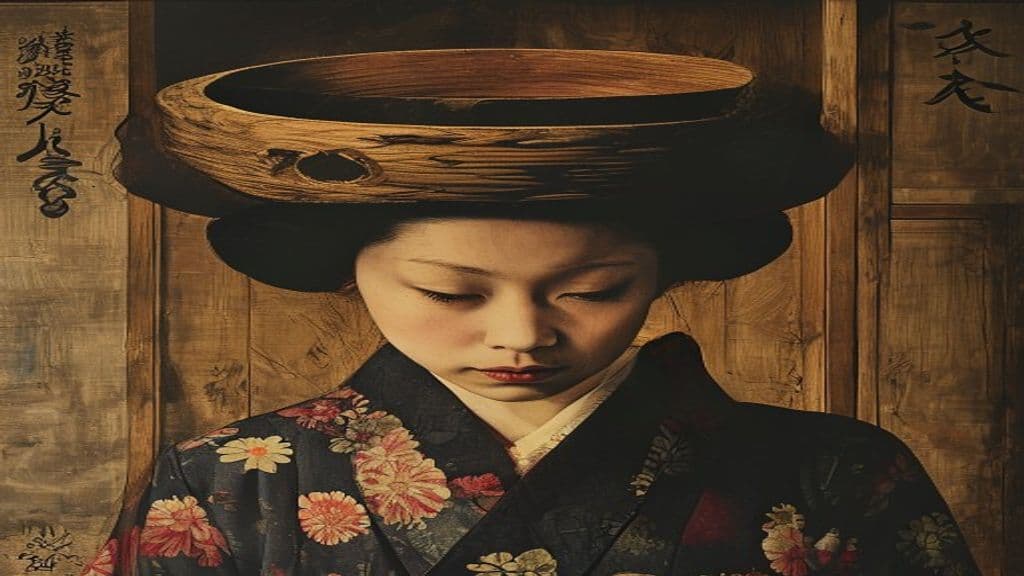
The tale of Hachikazuki was first written down in the Muromachi period (14th–16th centuries) and later circulated in early modern popular print: a widely illustrated akahon edition for children was published by Urokogataya in the mid-Edo period (c. 1735–1745). Folklorists have documented regional variants from prefectures including Saitama, Hyōgo, and Tokushima. Scholars classify the tale within the Japanese Cinderella (Persecuted Heroine) cycle; Hiroko Ikeda indexed it as type 510C in her Japanese tale index, and analysts such as Marian Roalfe Cox and Chieko Irie Mulhern discuss its relation to ATU 510 variants and to literary influences on Japanese persecuted-heroine narratives.
The defining visual motif is a wooden bowl (hachi) worn on the girl's head that conceals her beauty. Variant openings describe the mother on her deathbed instructing the daughter always to wear a wooden bowl to hide her beauty, or the girl being born with a bowl on her head. In versions where the bowl is removed after marriage it either reveals her great beauty or is found to contain jewels or breaks into precious gems. Beyond the bowl, sources give little consistent physical description of the heroine.
Sources attribute no supernatural powers to Hachikazuki; she is a mortal heroine whose actions and fate drive the plot. Narratively, the bowl functions as a concealment device and token of identity: she obeys a maternal injunction or lives with the bowl from birth, flees a cruel stepmother, accepts menial work in a lord's mansion, is glimpsed and loved by the lord's son, participates in a bride-selection insisting the bowl remain on her head, and after marriage the bowl is removed or broken to reveal beauty or treasure. The tale treats the bowl as a plot device rather than as a source of magical agency in the cited sources.
Weaknesses
- conditionNarrative vulnerability to mistreatment (stepmother, menial servitude)
- otherDependence on the bowl's concealment as protection of identity
Wards
None recorded.
Gütel
A variable household and folk spirit from German regional belief-forms that appears as a domestic sprite, hay-loft manikin, little earth-being, or the soul of an unbaptized child; its character ranges from helpful household attendant to mischievous or harmful tormenter depending on locality.
Gādhi
A sage in Hinduism, father of Vishvamitra and associated with ancient knowledge. (Note: 1. Power tier: Primordial (not Ancient) - as there are no supernatural abilities attributed to Gādhi. 2. Appearance: add information about Gādhi's physical appearance or description in Hindu texts. 3.)
Gāyatrī
Gāyatrī is the personified form of the Gāyatrī Mantra in Vedic–Puranic Hindu tradition: simultaneously a 24‑syllable Vedic metre, the hymn composed in that metre, and a goddess—often titled Vedamātā, the mother of the Vedas—who embodies sacred Vedic speech and knowledge.
HMS Friday
HMS Friday is an urban myth — a contemporary maritime legend that purports to tell of a Royal Navy ship deliberately commissioned and sailed on Fridays to disprove the superstition that beginning a voyage on a Friday is unlucky. The story is false: there was never a Royal Navy ship named HMS Friday, and the tale functions as a folkloric cautionary anecdote rather than a historical event.
Haagenti
Haagenti is a named spirit from the grimoire tradition (the Lesser Key of Solomon/Ars Goetia) described as a high-ranking infernal president who instructs humans and effects alchemical transmutations; modern fantasy and gaming sources adapt and reimagine him in varied ways.
Haashchʼééshzhiní (Black God)
A creator deity in Navajo folklore responsible for placing the stars and possessing supernatural powers. (Note: 1. Power tier should be Primordial, but this needs clarification as it's not explicitly stated in the sources. 2. Abilities section only mentions placing stars and inventing the fire drill. The source)
Hachiman
Hachiman is a long‑venerated syncretic Japanese tutelary deity whose identity spans Shinto kami worship and Buddhist practice. Traditionally associated with the deified spirit of Emperor Ōjin, Hachiman functions as a protector of warriors (notably the Minamoto and samurai), Buddhist temples, the imperial house, and the nation, and appears in both native shrine cults and as the Buddhist 'Great Bodhisattva Hachiman.'
Hadad (Haddu / Adad / Iškur)
Hadad is the ancient Near Eastern storm and rain deity attested across Levantine and Mesopotamian traditions (Ugaritic Haddu, Akkadian Adad, Sumerian Iškur). He is a high-ranking weather-lord associated with rain, thunder, fertility of fields, and a dual capacity to nourish crops and to unleash destructive storms; he plays central roles in temple cult, royal ideology, and mythic battles (notably the Ugaritic Baal Cycle).
Hadad the Edomite
Hadad the Edomite is a human political figure in the Hebrew Bible described as a surviving member of the Edomite royal house who fled to Egypt, was elevated at Pharaoh's court, and later returned to oppose King Solomon; the narrative frames him as one of the adversaries the LORD "raised up" against Solomon after Solomon's apostasy.
Hades
In ancient Greek religion and mythology, Hades is the god who rules the subterranean realm of the dead and presides over all things beneath the earth, including subterranean riches. He is a son of Cronus and Rhea and one of the generation of Olympian gods, allotted the underworld after the Titanomachy.
Hadit
Hadit is a central Thelemic principle representing the individualized, interior divine point — the 'secret seed' and inner flame of each person and star — presented in The Book of the Law as the microcosmic complement to the cosmic Nuit.
Hadraniel
Hadraniel is an angelic gatekeeper in Jewish mystical and rabbinic traditions, assigned to the second gate of heaven and depicted as an awe‑inspiring, gigantic being who mediates access to divine revelation. He appears in narratives such as Moses’ heavenly ascent and Zoharic material concerning the Book of Raziel, and is sometimes placed differently in other mystical lists (e.g., as subordinate to Jehuel in some Gnostic listings).
Community Record
- [1]Hachikazuki. Wikipedia, 'Hachikazuki' entrywiki
- [2]Wikidata: Q11649831. Wikidata item for Hachikazukiother