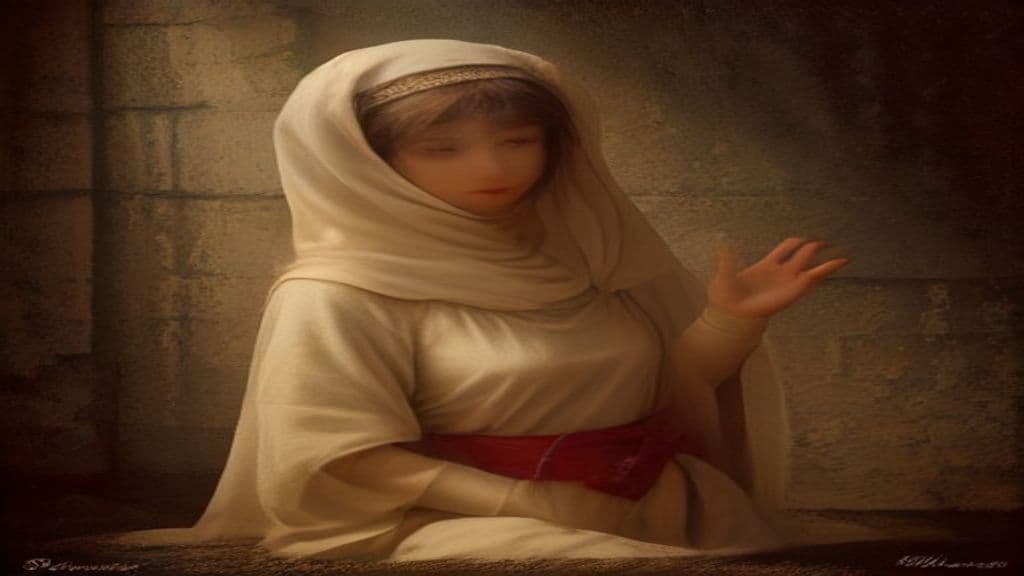
In the Genesis narrative Hagar is introduced as an Egyptian woman serving Sarai (Hebrew: שִׁפְחָה) who is given to Abram so that Abram might sire offspring through her. When Hagar becomes pregnant she reacts with contempt toward Sarai and flees into the desert. At a spring an 'angel of the LORD' appears, instructs her to return and submit to her mistress, promises that her offspring will be numerous, and instructs her to name her son Ishmael. After Isaac's birth and weaning, conflicts lead Sarai to demand Hagar's and Ishmael's expulsion; Abraham sends them away with bread and water into the wilderness of Beersheba. They exhaust their supply and, in despair, Hagar weeps; God hears Ishmael, the angel opens Hagar's eyes to a well of water, and they are preserved; later Ishmael marries an Egyptian woman and settles in the Desert of Paran. Rabbinic midrash (e.g., Genesis Rabbah) and medieval commentators offer variant origin details—some depict her as Pharaoh's daughter or equate her with Keturah—positions that are disputed among commentators.
The supplied sources offer no detailed physical description of Hagar. Biblical and Islamic summaries emphasize her social role and actions (Egyptian handmaid/servant or concubine, mother of Ishmael) rather than corporeal traits. Later commentarial traditions discuss her origin and status (for example, rabbinic texts that portray her as having come from Pharaoh's household) but do not provide consistent physical description in the cited materials.
Hagar is presented as a mortal woman whose notable capacities are social and practical: she bears Ishmael for Abram, flees and survives in the desert through initiative (including the episode of running between Safa and Marwah in Islamic tradition), receives and responds to divine/angelic communication, names God 'El Roi' ('the God who sees') in Genesis after an encounter with the divine messenger, and acts as mother and progenitor. The traditions attribute no innate supernatural powers to Hagar herself; miraculous survival in her narrative is mediated by God or angelic intervention rather than by Hagar possessing extraordinary abilities.
Weaknesses
- conditionsocial vulnerability — dependent servant/concubine status
- conditionexposure to desert deprivation (threat of thirst and abandonment)
Wards
None recorded.
Community Record
- [1]Hagar — Wikipedia (summary of Genesis and Islamic traditions). Wikipedia: Hagar (summary of Genesis narrative, rabbinic commentary, and Islamic traditional accounts)wiki
- [2]Hagar — Wikidata entry. Wikidata: Hagar (cataloging entry noting descriptors such as 'biblical character, Egyptian handmaid of Sarah, wife of Abraham')other
- [3]Was Hagar Abraham's second wife or his pilegesh? (Judaism.StackExchange). Judaism.StackExchange discussion on Hagar's legal/social status and whether she functioned as a wife or concubine (pilegesh).other
- [4]Why did Sarai & Abram have the slave Hagar? (Judaism.StackExchange). Judaism.StackExchange Q&A addressing questions about Hagar's presence in Abram's household and related legal/social readings.other
- [5]Was Hagar Abraham's wife? (Answering-Islam). Answering-Islam overview discussing Genesis 16:3 and Islamic interpretive positions on Hagar's status.other
- [6]Comparative Index to Islam: HAGAR. Answering-Islam: summary of Islamic traditional material about Hājar, Safa–Marwah running, and Zamzam.other
- [7]Genesis 16 (Sarai and Hagar) — archived text. Archival reproduction of Genesis 16 narrative used as source for the biblical episodes cited.other