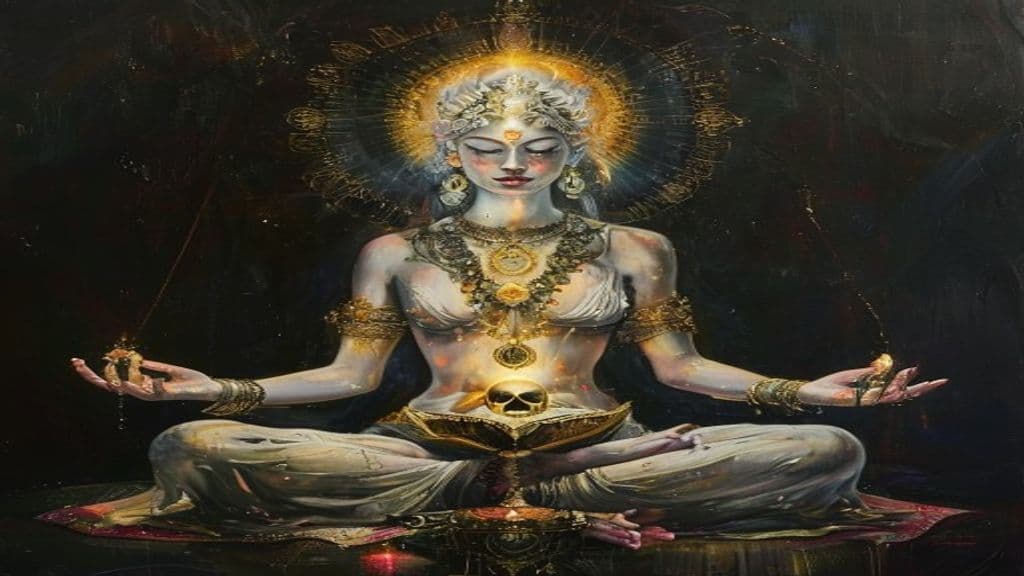
Hakini is described in the Shadchakra Nirupana as the presiding goddess of the Ajna chakra — the two-petalled lotus between the eyebrows that corresponds to the pineal region and the seat of intuitive perception. The Ajna centre is where the three primary energy channels of the subtle body (ida, pingala, and sushumna) converge, making it the most complex and consequential point in the Kundalini system.
In Shaiva tantric texts she is described as a direct attendant of Shiva in his form as the inner teacher — the guru principle made into a deity. When a practitioner's meditation reaches the Ajna level, Hakini is the guardian who either permits or denies passage toward higher states of consciousness.
Hakini is white as the full moon — luminous, cool, and potentially blinding in the way of reflected light. She has six faces, each bearing a different expression corresponding to the six aspects of mind she governs. She has four arms: holding a skull, a drum (damaru), a rosary, and a book.
The book is significant — she is described as the holder of all knowledge accumulated across lives. Her six faces are seated on the six petals of the Ajna lotus, which is often depicted as two large petals divided into three sections each, representing the polarity of perception that she reconciles.
Hakini governs third-eye perception: clairvoyance, accurate dream interpretation, the ability to discern reality from illusion, and contact with the subtle world beyond ordinary sense perception. She also holds memory of past lives and grants access to this to practitioners who approach her correctly.
When her domain is disturbed — through impure practice, arrogance, or the misuse of developing intuitive faculty — she manifests as her shadow form: persistent delusion, inability to distinguish inner experience from outer reality, recurring disturbing visions, and the specific affliction of feeling observed by an invisible presence.
Weaknesses
- mantraSeed syllable OM (ॐ) — bija of the Ajna chakra
Wards
- ritualGuru-bhakti — devotion to an embodied teacher who has already passed through this level
- substanceSandal paste applied between the eyebrows before meditation
Community Record
- [1]Shadchakra Nirupana — Ajna chakra description. Avalon, A. (trans.). (1919). The Serpent Power. Ganesh & Co., Madras.academic
- [2]Chakra goddesses in the Shaiva Agama. Padoux, A. (1990). Vac: The Concept of the Word in Selected Hindu Tantras. SUNY Press.academic