
Accounts vary by locality and genre. In the Shōrin-ji engi (Kōun-an, Sakai, Izumi Province) a white fox arrived at the temple and was taken in by a devout priest who regularly venerated the Inari dai-myōjin; the priest interpreted the fox's presence as a gift from Inari and fostered it. Other versions place the figure in different temples (e.g., Shōraku-ji of Ōmi) or transform the motif into a Hyaku monogatari tale in which an ancient fox, seeking to secure safety for its remaining offspring, assumes the identity of the priest Hakuzōsu — in that variant the fox even murders the real priest to preserve the disguise and lives on as priest for decades until later killed by a dog at a festival.
Varies by account. The Shōrin-ji engi explicitly describes a three-legged white fox that darted from an altar and curled before the priest. In narrative and theatrical variants the creature commonly appears in perfect human guise as a Buddhist priest or as the hunter's uncle, typically implied to be robed in priestly attire; other tales include a temporary transformation into a 'brave warrior.' Specific anthropomorphic facial or clothing details beyond the role of 'priest/uncle' are generally not given in the sources.
Hakuzōsu exemplifies kitsune attributes recorded in the sources: shapeshifting into convincing human forms (notably a priest/uncle, sometimes a warrior), deception and impersonation to influence human behavior (for example lecturing a hunter against killing foxes), and agency in local human affairs such as bringing alms to a temple or warding off bandits in the Shōrin-ji account. In some variants the fox uses lethal violence (the Hyaku monogatari version where the fox kills the priest to maintain its disguise) and in other tales is exposed and thwarted (detection by the hunter, being killed by a dog).
Weaknesses
- othermay be exposed by its fox cry or by attentive suspicion (tale-specific)
- othervulnerable to being killed by dogs or villagers in narrative resolutions (variant-specific)
Wards
None recorded.
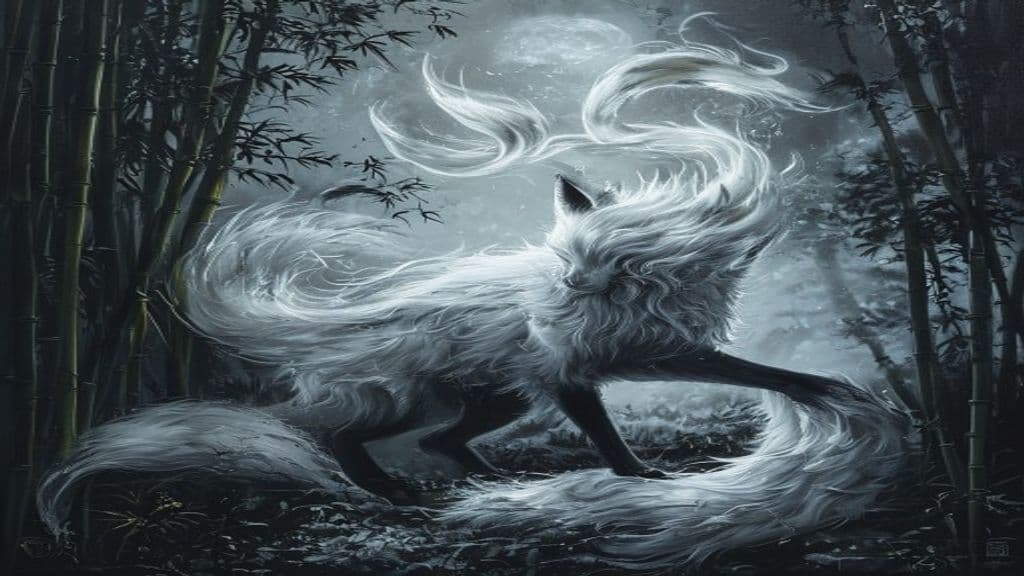
Kitsune
Fox spirits of Japanese mythology — intelligent, long-lived beings who gain additional tails (up to nine) as they age and grow in power. They serve as messengers of the god Inari and as powerful tricksters.
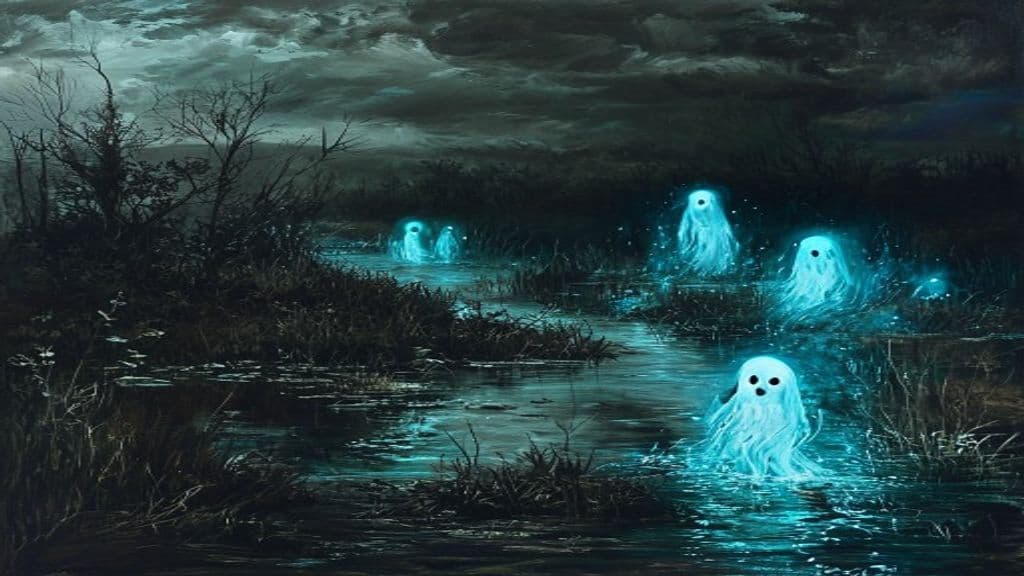
Will-o'-the-Wisp
A wandering light seen over marshy ground at night, leading travellers astray into bogs and fens. Possibly a spirit, possibly the soul of the unbaptised dead, possibly the devil himself.
Abumi-guchi
A Japanese yōkai classed as a tsukumogami: an animated stirrup (abumi) depicted in Sekien Toriyama's Gazu Hyakki Tsurezure Bukuro. Traditional accounts say it is formed from a stirrup that belonged to a soldier who fell in battle and that it waits where the stirrup lies for its dead owner to return.
Abura-sumashi
A yōkai spirit from the Amakusa region of Kumamoto Prefecture, Japan, said to inhabit mountain passes. Traditionally explained as the ghost of a person who stole oil, it appears to surprise travelers and is represented in modern media with a straw-coat body and a potato- or stone-like head.
Akaname
Akaname is a Japanese yōkai associated with baths, bathtubs, toilets, and other places where scum and filth accumulate. Traditionally depicted as a child-like creature that licks grime, it functions in folklore as a cautionary figure tied to cleanliness; a few narrative variants cast it as dangerously predatory.
Akateko
Akateko (赤手児, lit. 'red child's hand') is a yōkai from Japanese folklore commonly told as a small, red, disembodied child's hand that appears from trees—especially the Japanese honey locust—and startles travelers; in some regional variants it is accompanied by a specter of a young woman or manifests as paired foot- or leg-like apparitions. Accounts vary between mostly harmless trickster apparition and a violent variant that attacks humans.
Akubōzu
Akubōzu (灰坊主, Akubōzu) is a household yōkai from parts of Akita and Iwate Prefectures in northern Japan said to live in the ashes of the hearth. Sources say they appear when people (notably children) play with or dig in hearth/furnace ash; the figure is cited as part of a broader Tōhoku motif warning against disturbing ash.
Akuma
Akuma (悪魔/あくま) in Japanese sources is an evil spirit, devil, or demon associated with misfortune and mental disturbance. The term appears in Buddhist texts and Heian-period literature and was later used to translate the Christian figure of Satan, as well as the Buddhist Mara.
Akurojin-no-hi
Akurojin-no-hi (悪路神の火, "fire of the god of the bad road") is a flamelike ghost from the folklore of Mie Prefecture, Japan. It is reported to appear on rainy nights; those who encounter it and do not run away are said to become gravely ill. The phenomenon is sparsely documented and is usually compared to will-o'-the-wisp type ghost-lights.
Amabie
Amabie is a mid-19th-century Japanese yogenjū-type wondrous creature attested in kawaraban and related pamphlet culture that emerges from the sea (in canonical accounts) to prophesy about harvests and epidemics and prescribes that its image be drawn and shown to the sick as a protective measure.
Amanojaku
Amanojaku (天邪鬼 / あまのじゃく) is a Japanese yōkai-type being portrayed as a contrarian, heart-reading trickster. Treated in different contexts as a small ogre (ko-oni), a wicked demon (jaki) in Buddhist iconography, and a folkloric spirit that provokes human vice, it appears across regional tales with variable roles from malicious kidnapper to household oddity.
Amefurikozō
Amefurikozō (雨降小僧 or 雨降り小僧) is an Edo-period yōkai figure depicted in classical illustrated and popular print culture as a youthful attendant associated with rain. Classical sources (notably Sekien Toriyama's Konjaku Gazu Zoku Hyakki) present it as a kozō-type servant linked by captional wordplay to a rain deity; later popular literature elaborates its rain-producing role and playful mischief on rainy nights.
Ameonna
Ameonna (雨女, "rain woman") is a figure in Japanese folklore treated as a yōkai associated with rain. Sources depict her both as a rain-calling supernatural being (sometimes helpful in drought) and as a folk label for an unlucky person whom rain seems to follow; a key pictorial source is Toriyama Sekien's Konjaku Hyakki Shūi.
Amorōnagu
Amorōnagu (Amorōnagu / 天降女子) is a tennyo or celestial maiden figure in the folklore of Amami Ōshima (Kagoshima Prefecture, Japan). Attested sources describe her as a heavenly woman who bathes in pools and waterfalls in ravines on the island.
Community Record
- [1]Hakuzōsu — Wikipedia. Wikipedia article 'Hakuzōsu' (summarizing Shōrin-ji engi, kyōgen Tsurigitsune, and Hyaku monogatari variants)wiki
- [2]Wikidata: Hakuzōsu. Wikidata entry for Hakuzōsuother
- [3]Shōrin-ji engi summary (as cited in article). Summary: Shōrin-ji (Kōun-an) account describing a three-legged white fox arriving at the altar, interpreted as a gift from Inari and fostered by the priest.folk
- [4]Kyōgen play 'Tsurigitsune' (motif summary). Summary of the kyōgen play motif in which a hunter is visited by his uncle the priest Hakuzōsu who lectures against killing foxes; the hunter later hears the fox cry and realizes the deception.literary
- [5]Hyaku monogatari variant summary. Summary of a Hyaku monogatari variant in which an ancient fox assumes the priest's identity, kills the real priest to preserve the disguise, lives as priest for fifty years, and is later killed by a dog at a village festival.folk
- [6]Tsuba with the fox Hakuzōsu (museum object). Museum collection entry showing cultural depiction of Hakuzōsu in decorative art.other