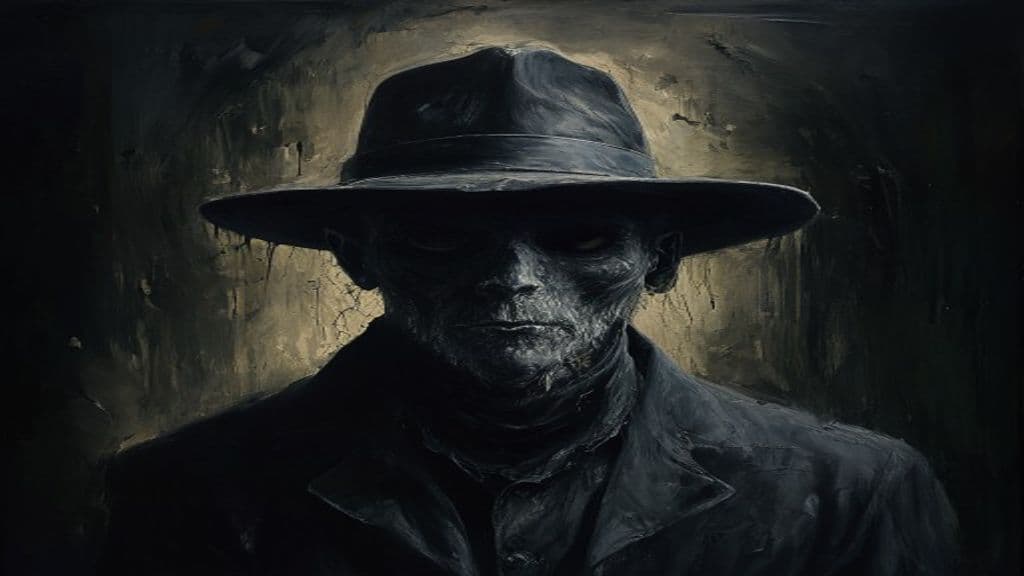
The Hat Man does not have a recorded premodern mythological origin in the supplied sources. According to the Wikipedia excerpt provided, the phenomenon belongs to the broader modern category of 'shadow persons' and is a popular subject in paranormal and supernatural circles (Wikipedia). The supplied material treats the Hat Man as a modern, popularly labeled instance within contemporary testimonial and online communities rather than as a figure emerging from a specific traditional cosmology; no traditional origin narrative, founding myth, or ancestral tale is documented in the provided sources (Wikipedia). A short Wikidata note further situates reports of a 'shadowy figure' in a contemporary clinical or pharmacological context—specifically mentioning an appearance after consumption of Benadryl (diphenhydramine)—which supports the interpretation that the modern framing of the Hat Man mixes paranormal testimony with physiological explanations (Wikidata).
The supplied sources describe the Hat Man only as a type of 'shadow person' or 'shadowy figure.' Wikipedia defines shadow persons as "beings resembling animate human shadows," and the Wikidata note uses the term 'shadowy figure' (Wikipedia; Wikidata). The provided documents do not supply consistent premodern descriptors, nor do they document a specific hat style, facial features, height, or clothing; accordingly, the epithet 'Hat Man' appears in these sources as a modern label within the shadow-person category rather than as evidence of a consistent, detailed hat-bearing appearance in the supplied texts (Wikipedia; Wikidata).
The supplied material does not ascribe a detailed catalogue of supernatural powers to the Hat Man. Wikipedia notes that shadow persons are "sometimes interpreted as the presence of a spirit," indicating that witnesses or commentators sometimes treat such figures as spiritual presences but does not list active abilities (Wikipedia). The Wikidata excerpt links a 'shadowy figure' to episodes following consumption of Benadryl, suggesting that at least some modern reports associate the experience with drug- or sleep-related altered states rather than with an independently documented set of powers (Wikidata). No authoritative descriptions of actions such as harming, moving objects, or granting favors are provided in the supplied sources.
Shadow person
A contemporary popular‑paranormal motif describing animate human‑shaped silhouettes or ‘black mass’ figures, often reported in contexts of sleep paralysis, low light, or substance‑induced delirium. Accounts range from experiential memorates and forum testimony to skeptical clinical explanations that treat sightings as hallucinations.
Harpy
In Greek and Roman myth, a harpy is a hybrid bird-human creature and personification of storm-winds that acts as an agent of divine punishment — snatching food, fouling victuals, and carrying off or tormenting wrongdoers, sometimes delivering them to chthonic justice.
Harsomtus
Harsomtus (also Harsomptus, Somtus) is an ancient Egyptian child-deity associated with fertility, birth and the solar-primordial creative principle. Worshiped in local temple contexts (notably Dendera and Edfu) and venerated in mammisi (birth-houses), he functions as a youthful or infant form of the Horus/Ra divine line and is integrated into regional triads and family-group theology.
Harut and Marut
A pair of figures named in the Qur'an (Surah 2:102) and elaborated in classical Islamic exegesis as heavenly beings associated with Babylon and the transmission of sorcery; their status (angels, kings, or men) and culpability are debated across commentaries. They function etiologically to explain the origin of illicit magic and as exemplars of divine testing or temptation.
Hashihime
Hashihime (橋姫, "Bridge Maiden/Princess") is a Japanese literary and folkloric figure variously depicted as a poetic emblem of lonely waiting at bridges and, in later tales and drama, as a woman who through ritual transforms into a violent, bridge-associated vengeful spirit.
Hashmal
In the supplied Jewish textual materials, Hashmal (Hebrew חַשְׁמַל; pl. Hashmallim) appears both as a luminous element in Ezekiel's prophetic theophany and as the name of an angelic rank in later Jewish angelology, described in secondary sources as administrative officers of Heaven.
Hasshaku-sama
Hasshaku-sama (八尺様) is a contemporary Japanese urban-legend figure depicted as a very tall, pale womanlike spirit associated with isolated rural zones; circulating since the late 2000s in internet folklore, she is said to target children and young people and is warded in stories by sealed rooms, talismans, salt, and boundary Jizō statues.
Hata no Kawakatsu
Hata no Kawakatsu (秦河勝 / Hada no Kōkatsu) is a semi-legendary Asuka-period courtier and leader of the Hata clan attested in classical chronicles. In the Nihon Shoki he appears as a high-ranking official who received a Buddha image from Prince Shōtoku, founded Hachioka-dera (Kōryū-ji), escorted foreign envoys, and suppressed the popular cult of Tokoyo-no-Kami. Later medieval traditions expand his biography with legendary accretions (e.g., claimed descent or identification with Qin imperial lineage, enshrinement as Ōsake Daimyōjin, and association with performing-arts ancestry).
Hathor
Hathor (Ancient Egyptian ḥwt-ḥr, 'House of Horus') is a major polyvalent goddess of ancient Egypt associated with the sky, maternal and royal motherhood, music, joy, fertility, and the Eye of Ra; she appears in multiple local manifestations and assisted the deceased into the afterlife.
Hatif
Hatif (Arabic: هَاتِف, hātif) is an auditory phenomenon in Arabic and Bedouin traditions described as a voice heard without discovering the body that made it. Sources record multiple, sometimes conflicting explanations: an unseen communicator such as a jinn, the voice of the dead near graves, or a psychological hallucination arising from loneliness.
Hatme
A highly fragmentary attestation: one metadata entry (Wikidata) labels Hatme as a "Spirit of the Prophet Muhammad," while the remainder of the provided corpus uses the lexeme "hatme/hatme yapmak" in non-ethnographic contexts (ritual-event names, building names, course tags, forum posts). No corroborating ethnographic description of a folkloric being is present in the supplied materials.
Hauhet
Hauhet is the feminine personification of endlessness or eternity in the Egyptian Ogdoad of Hermopolis (Khmun). She functions as the feminine counterpart to the male deity Heh and represents the boundless, pre-creation watery chaos (Nu) rather than acting as a localized, interventionist deity.
Community Record
- [1]Shadow person. Wikipedia, 'Shadow person' — defines shadow persons as 'beings resembling animate human shadows' and notes the topic is popular in paranormal circles.wiki
- [2]The Hat Man (Wikidata entry). Wikidata entry for 'The Hat Man' — notes a 'shadowy figure seen after consumption of Benadryl.'other
- [3]Archive: Doreen Molders - LWL Museum für Archäologie. Archived item listed in prompt; excerpted materials did not contribute additional factual content about the Hat Man in the supplied selection.other
- [4]Archive: Das Spiel, das nicht genannt werden darf. Archived item listed in prompt; excerpted materials did not contribute additional factual content about the Hat Man in the supplied selection.other
- [5]Archive: Vic's Basement Episode 139. Archived item listed in prompt; excerpted materials did not contribute additional factual content about the Hat Man in the supplied selection.other