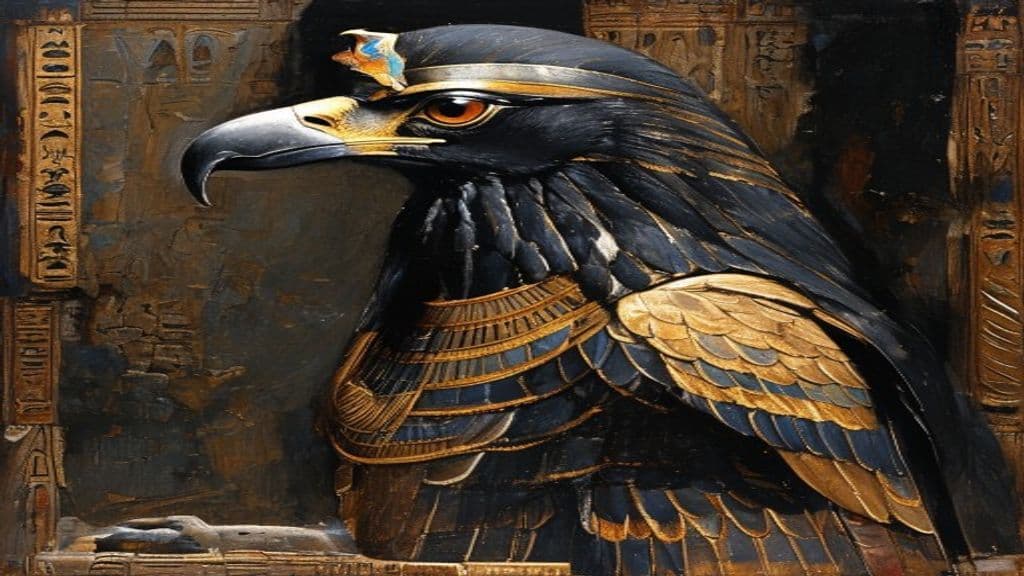
The supplied materials do not record a separate mythic origin for Her-sema-tawy as an independent being. Instead, Her-sema-tawy is attested in modern summaries and catalogues as a named form or epithet of Horus; Mythlok glosses the epithet as "Horus who unites the Two Lands," linking the name to the ideological role of unification of Upper and Lower Egypt, while Wikidata classifies Her-sema-tawy explicitly as a form of Horus and Wikipedia explains that Horus appears in many different recorded forms that are treated as distinct by Egyptologists (Wikipedia; Wikidata; Mythlok).
No unique iconography for Her-sema-tawy is documented in the supplied sources. Because Her-sema-tawy is a form of Horus, the closest available descriptions are those of Horus: Horus is most often depicted as a falcon or as a man with a falcon head (Wikipedia). The sources do not provide specific visual attributes or distinguishing regalia unique to the Her-sema-tawy epithet.
The sources identify Her-sema-tawy as an aspect of Horus emphasizing the political function of uniting the Two Lands and legitimizing kingship. More generally, Horus is described as a major deity whose functions include kingship, protection, healing, the sun and the sky; the supplied materials indicate Her-sema-tawy participates in Horus' broader association with royal authority and state unity rather than introducing distinct supernatural powers of its own (Wikipedia; Mythlok; Wikidata).

Aani
Aani (ancient Egyptian jꜥnr) is the lexical term for the baboon in ancient Egyptian language and functions in religious contexts as an animal icon and theophoric epithet. Attested repeatedly in Egyptian texts and images, the baboon image is used to represent or denote aspects of gods such as Thoth, Hapy, Khonsu, and Osiris rather than implying the animal itself is an independent deity.
Aker
Aker is an ancient Egyptian personification of the horizon and an earth and underworld deity who is described in surviving summaries as guardian of the eastern (Bakhu) and western (Manu) horizons, marking liminal boundaries between day and night and between the living world and the netherworld.
Akhty
Akhty (also read Netjer-akhty) is an ancient Egyptian deity identified with the northern bald ibis and linked to the akh (the transfigured, luminous human spirit). Attested from early 2nd dynasty inscriptions and in Old Kingdom personal names and priestly titles, Akhty was associated with the evening horizon and believed to guide the setting sun and carry the deceased's spirit into the night sky.
Amaunet (Amunet)
Amaunet (also spelled Amunet, Amonet) is a primordial female deity of ancient Egyptian religion, attested from early religious texts and represented as the feminine counterpart and consort of the god Amun. She is presented in sources as a pre-creation or primeval principle associated with hiddenness; Thebes is recorded as a principal center of her cult into the late dynastic and Ptolemaic periods.
Amenhotep, son of Hapu
Amenhotep, son of Hapu was a historically attested 18th‑Dynasty official who was posthumously venerated and integrated into Egyptian temple cult as a deified, local healing intercessor. His cult appears in Thebes and resurges in the Ptolemaic period, represented in votive reliefs, chapels, and statues.
Ammit
Ammit is an ancient Egyptian funerary guardian-demon of the Duat who stands at the Hall of Two Truths during the weighing of the heart. Feared and not worshipped, she awaits the verdict and consumes hearts judged impure, thereby preventing the deceased from joining the blessed dead.
Ammut
Ammut is an ancient Egyptian chimeric creature associated with the Judgment of the Dead; traditionally described as a composite of lion, hippopotamus, and crocodile, she is said to consume the souls or the symbolic heart of those judged unworthy, preventing admission to the afterlife. Modern artistic and speculative retellings recast Ammut as a large scavenging semi‑aquatic animal whose corpse‑consuming habits inspired funerary beliefs.
Amset (Imsety)
Amset (Egyptian Imsety) is one of the four sons of Horus in ancient Egyptian mortuary religion, a named funerary guardian commonly associated with protection of the liver and represented as the human-headed canopic-jar lid in mummification and afterlife iconography.
Amun
Amun is a major ancient Egyptian deity whose name (imn) means 'the hidden one.' Originating as a local Theban tutelary god, he rose to national prominence and was syncretized with the sun‑god Ra (Amun‑Ra), becoming a transcendent, self‑created creator and king of the gods closely tied to royal legitimation and personal petitionary religion.
Amun-Re
Amun-Re is a major ancient Egyptian state deity formed by syncretism of Amun with the sun-god Re. Attested from the Old Kingdom and rising to prominence as the patron god of Thebes by the 11th Dynasty, Amun-Re is closely tied to pharaonic kingship, temple cult, and oracular activity (notably at Siwa).
Amunet
Amunet (jmnt) is a primordial Egyptian goddess originally one of the female members of the Ogdoad of Hermopolis whose name means ‘The Hidden One.’ In later Theban religion she became a localized consort and cult companion of Amun, serving protective and liturgical roles in royal coronation, Sed festivals, temple liturgies, and funerary invocations.
Ancient Egyptian corkscrew-horned sheep
An extinct ovicaprine form identified in modern scholarship as Ovis longipes palaeoaegyptiacus and depicted in early pharaonic art; its distinctive loosely spiralling horns were adopted as the horn-type for several ram-headed Egyptian deities and persisted in iconography after the animal vanished from the record.
Community Record
- [1]Horus. Wikipedia, article 'Horus' (describing Horus' functions, depictions, and the existence of multiple forms of Horus).wiki
- [2]Her-sema-tawy (Wikidata entry). Wikidata entry classifying Her-sema-tawy as a 'form of Horus'.other
- [3]Harsomtus : The Child God - Mythlok. Mythlok (secondary source) glossing the epithet Her-Sema-Tawy as meaning 'Horus who unites the Two Lands' and interpreting its political symbolism.other
- [4]Horus Facts for Kids. Kids Kiddle summary of Horus (general background information consistent with other summaries).other
- [5]Nekhbet an Ancient Egyptian Vulture Goddess and Tutelary Deity. Damien Marie AtHope discussion noting Nekhbet's role as one of the patron deities tied to the unified state, cited here to contextualize Her-sema-tawy's political/royal associations.other
- [6]The Enigma of the Dendera Lamps. Supplementary web source included in the provided materials (no direct unique information on Her-sema-tawy in supplied notes).other
- [7]Gods And Goddesses Of Wealth - Wealth Quint. Supplementary web summary included in the provided materials (general reference to deities; no direct unique information on Her-sema-tawy in supplied notes).other