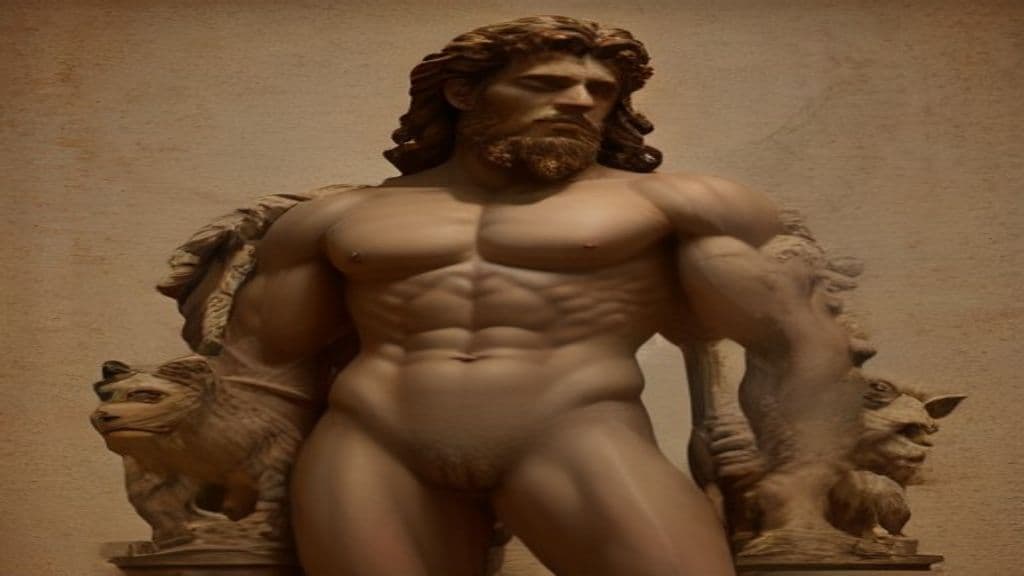
In Roman tradition Hercules is the reception of the Greek Heracles: born of Jupiter (Zeus) and the mortal Alcmena and thus occupying a liminal, semi-divine status. The Latin name and cultic forms were transmitted into Roman contexts via Etruscan forms such as Heracle, Hercle, and Herceler, after which local Italic cults and epithets (e.g., Hercules Salarius) attached site-specific functions and meanings to the figure.
Iconographically Hercules is commonly depicted as a powerful, muscular warrior wearing the lion skin, often carrying a club and occasionally shown with attributes such as the apples of the Hesperides. Regional variants occur: an abstracted "Rorschach Hercules" represents the lion skin as a geometric motif in local Italic art; a beardless "Hercules in assault" warrior type also appears in votive statuettes. Literary tradition also preserves infant episodes (e.g., strangling serpents) that depict him as a supernaturally strong infant in narrative sources.
Sources emphasize prodigious physical strength and a repertoire of far-ranging adventures (the labours cycle) as the core of Hercules' powers. In Roman cult he functions as a protector and champion—venerated as a guardian figure in sanctuaries and invoked in votive contexts—and is associated in some local contexts with martial, agrarian, and wayfaring functions (scholars note possible associations such as Hercules Salarius). His divine parentage and later divinization complicate his status: treated both as a hero figure in cult and as possessing divine qualities, with varying accounts about the exact degree of immortality or full Olympian status.
Weaknesses
- conditionvulnerability to divine hostility (Juno/Hera's enmity and induced madness)
- otherambiguous mortality/divinization boundary (narrative tradition records episodes of suffering, madness, and eventual divinization; sources vary on full immortality)
Wards
- ritualvotive dedication of statuettes and offerings
- mantrainvocatory oaths/exclamations (Roman speech forms)
Community Record
- [1]Hercules — Wikipedia. Wikipedia: Hercules (summary of literary, archaeological, and historical scholarship on the Roman Hercules, his Etruscan transmission, cultic evidence, and iconography).wiki
- [2]Hercules — Wikidata. Wikidata entry identifying Hercules (including astronomical counterpart reference).wiki
- [3]The Twelve Labours of Hercules, Son of Jupiter & Alcmena — Project Gutenberg. Project Gutenberg: text edition referencing the labours cycle and literary tradition of Heracles/Hercules.literary
- [4]Hercules — NovaRoma. NovaRoma: discussion of Hercules' cult popularity in Italy and cultic context (votive practices and regional sanctuaries).other