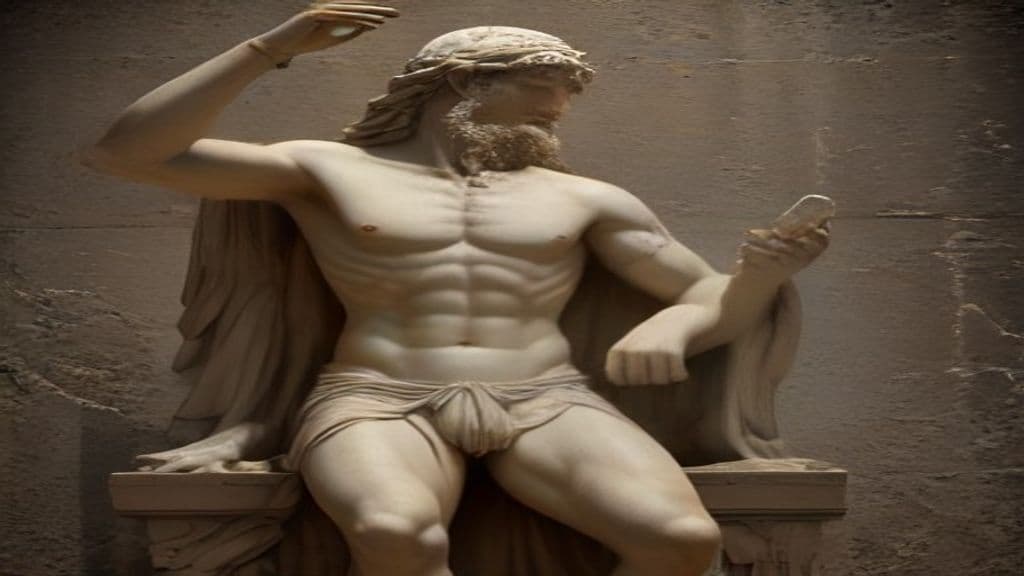
Hermes appears in Greek myth as an Olympian deity whose name is recorded in Mycenaean Linear B and is commonly derived from Greek ἕρμα ('stone heap'), linking him to stone markers and boundaries. Scholarly accounts indicate his cult was established in remote regions of Greece and may have origins in rural/nature-associated worship (farmers, shepherds), but the precise prehistoric origin remains uncertain. Later Hellenistic syncretism identified Hermes with the Egyptian god Thoth, producing the legendary Hermes Trismegistus; comparative proposals linking him to other Near Eastern mediatory deities are scholarly hypotheses rather than universally established ancient claims.
Iconography varies by period: Homeric description portrays Hermes as a youth with the first down on his upper lip; archaic representations often show a matured, bearded traveler/herdsman; Classical and Hellenistic art typically depict him as a young, athletic, beardless man. Recurrent attributes used to identify him include the petasos (traveler's hat, sometimes winged), talaria (winged sandals), winged helmet or hair ornaments, the caduceus (staff with two intertwined snakes), satchel/pouch, and animal/symbolic associations such as rooster, tortoise, palm, and goat.
Hermes is described as able to move quickly and freely between mortal and divine realms, functioning as messenger and emissary of the gods and as a psychopomp who conducts souls to the afterlife. He is patron and protector of travelers, heralds, merchants, orators, and thieves, embodying mediation, reconciliation, and boundary-crossing. Mythic narratives (e.g., the Homeric Hymn to Hermes) portray him as a cunning or 'divine trickster.' Scholarly interpretations also attribute shamanic or divinatory aspects and roles connected to ritual mediation and contacts with other planes; the Hellenistic Hermes Trismegistus associates him with writing, wisdom, and esoteric knowledge.
Weaknesses
- otherClassical sources do not record specific mythic weaknesses or vulnerabilities for Hermes
Wards
- otherHermai (stone heaps/stone markers) — cultic boundary, roadside, and grave markers associated with Hermes; archaeological and linguistic evidence links these objects to his function though specific ritual uses are not detailed in the supplied sources
Community Record
- [1]Hermes. Wikipedia: Hermeswiki
- [2]Hermes (Wikidata). Wikidata: Hermesother
- [3]Hermes Trismegistus. Wikipedia: Hermes Trismegistus (syncretism with Thoth; Hermetic tradition)wiki
- [4]Hermes and Hermeticism (Gnosis Archive). Hermes and Hermeticism — discussion of Hermetic tradition and syncretismother
- [5]Hermes the Interpreter, by George Santayana. Literary essay on Hermesliterary
- [6]Hermes Trismegistus, by Henry Wadsworth Longfellow. Literary treatment of Hermes Trismegistusliterary
- [7]Hermes (Olympian god) — Marvunapp summary. Summary of Hermes' mythic roles and attributesother