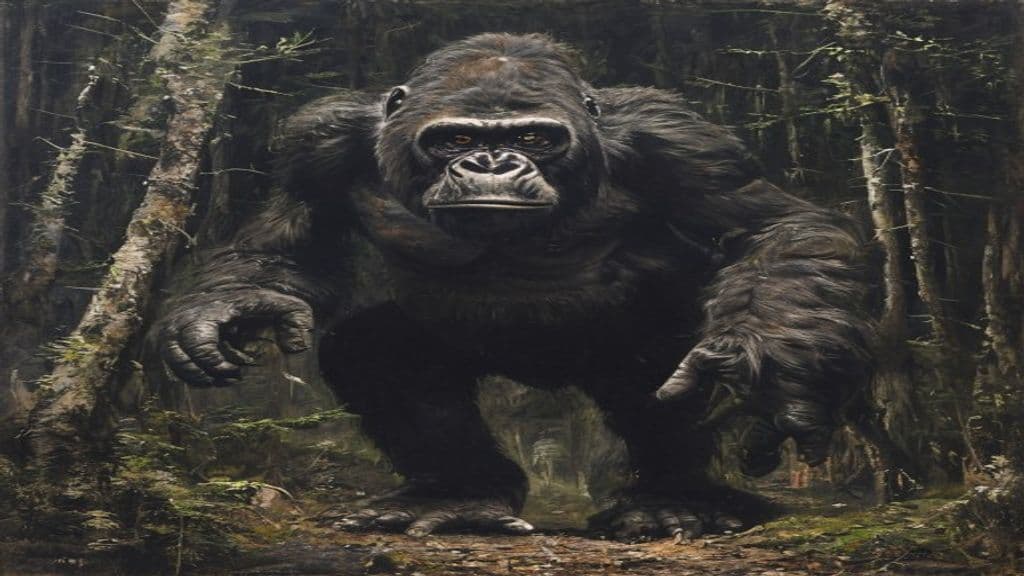
The supplied sources do not record a traditional mythic origin for the Hibagon. Modern reports and popular summaries offer speculative identifications — e.g., an escaped or isolated primate, a "wild man," or (in one speculative commentary) an individual altered by exposure to atomic radiation — but these appear as modern hypotheses in reportage rather than as an indigenous origin narrative or cosmological account.
Eyewitness descriptions in the available sources vary. A commonly quoted description calls it a "black baked creature with white clay hands and large white feet, standing about five feet tall." Other reports describe a gorilla-like, bristly-bodied humanoid with a large nose and "deep glaring eyes." A 1972 report described the creature as having a chocolate-brown face and being covered with brown hair; footprints reported by local Boy Scouts were said to be about 25 cm long and 15 cm wide. These variations suggest inconsistent eyewitness accounts rather than a single fixed appearance in the documented material.
The sources document no supernatural powers. Reported behavior is furtive and evasive: at least one account records the creature fleeing from armed residents and not acting hostilely. Explanatory theories offered by commentators (e.g., primate, "wild man," or radiation-altered individual) are presented as speculation rather than evidence of special abilities. Given the absence of documented supernatural capacities and its portrayal as an elusive animal-like humanoid, sources support placement at a 'lesser' power tier.
Weaknesses
- otherNo documented weaknesses
Wards
- otherNo documented wards or traditional protective measures

Chuchunya (Yeti / Abominable Snowman)
A large, hairy, humanoid creature reported in modern legend and cryptozoology as inhabiting the Himalayan mountains; presented in contemporary sources as a mythical humanoid or cryptid rather than a well‑documented indigenous cosmological being. Much alleged evidence consists of anecdotal sightings, disputed recordings, photographs, and footprint casts, some of which have been judged hoaxes.
Cryptid
A contemporary classificatory label for animals or other beings whose present existence is disputed or unsubstantiated by mainstream science; used in folklore, eyewitness reports, and popular culture. The term functions as a category rather than a single mythic being and is central to the subculture of cryptozoology and to popular media treatments.
Igopogo
Igopogo is a modern Canadian lake‑monster legend said to dwell in Lake Simcoe, Ontario. Presented in popular folklore and cryptozoological sources, it is a place‑bound mysterious aquatic creature variously reported by witnesses, invoked in local media, and represented in civic art.
Mogollon Monster
A regionally anchored American folkloric cryptid reported along Arizona's Mogollon Rim, described as a large, bipedal, hairy humanoid whose accounts function as wilderness cautionary tales and local popular‑culture legend.
Phantom kangaroo
A modern folkloric and cryptozoological label applied to reports of kangaroos, wallabies, or their tracks appearing in places outside their native range. Accounts range from documented feral/introduced populations and escaped captive animals to sensational, apparitional, or misidentified sightings discussed in urban‑legend and Fortean contexts.
Hesione
Hesione is a mortal Trojan princess in Greek myth who was exposed to a sea‑monster as an oracularly required sacrifice for her father Laomedon’s offense against the gods; rescued by Heracles, she is given in marriage to Telamon, ransoms her brother with her veil (after which he is called Priam), and in later tradition becomes a diplomatic pawn whose non‑return is cited among factors leading to Paris's taking of Helen.
Hesperides
The Hesperides are a group of Greek mythic nymphs who tend the sacred garden of Hera at the western edge of the world. Associated with evening and the west, they guard trees bearing golden apples and are linked in myth to major episodes such as Heracles' eleventh labour and the origin of the Apple of Discord.
Hesperus
Hesperus is the Greek personification of the Evening Star—the planet Venus as seen after sunset. Treated in mythic genealogies as a child of Dawn and related to other celestial personifications, Hesperus figures in literary and philosophical discussion about the identity of the evening and morning appearances of Venus.
Heyókȟa (Heyoka)
A sacred contrarian figure and ceremonial role in Lakota and Dakota (Sioux) traditions, the heyókȟa functions as a sanctioned 'sacred clown' whose deliberate inversion of social norms, satire, and ritualized shame help heal emotional pain and test communal values. Cosmologically the role is tied to visions of the thunder beings (Wakíŋyaŋ) and is sometimes represented in myth as a thunder or lightning spirit.
Hibil (Hibil Ziwa)
Hibil Ziwa is a luminous uthra (lightworld being) in Mandaean religion who serves as a salvific agent. Created by Manda d‑Hayyi, he is sent into the World of Darkness to confront and bind hostile powers, retrieve dangerous elements, and secure the return of souls to the World of Light; he is also reflected as a human archetype cognate with Abel.
Hiderigami (Hanba)
Hiderigami (Japanese) / Hanba (Chinese, 旱魃) is a drought‑associated supernatural being in East Asian tradition. Treated variously as a goddess, spirit/ghost, monster, and later vampire‑like or shape‑changing entity, it is chiefly known for causing severe drought and drying up waters in affected places.
Hidimba
Hiḍimba is a powerful demon king in the Indic epic Mahābhārata who dwells in the forest, preys on humans (including cannibalistic behavior), and is slain in single combat by the Pandava Bhīma. In regional tradition the cultic attention shifts to his sister Hiḍimbī (Hiḍimbā Devī) and their son Ghaṭotkaccha, whose shrines and festival roles are prominent in Himachal Pradesh.
Community Record
- [1]Hibagon — Wikipedia. Wikipedia contributors. "Hibagon." Wikipedia, The Free Encyclopedia.wiki
- [2]Wikidata: Hibagon (Q3273047). Wikidata entry Q3273047 for Hibagon.other
- [3]Vengeance of the Hibagon (book entry). Trimble, Martin (book listing/archive). "Vengeance of the Hibagon." Archive.org item.literary
- [4]High Speed Hangover 210 (radio/playlist reference). High Speed Hangover 210 archive reference mentioning Hibagon in playlist/notes.other