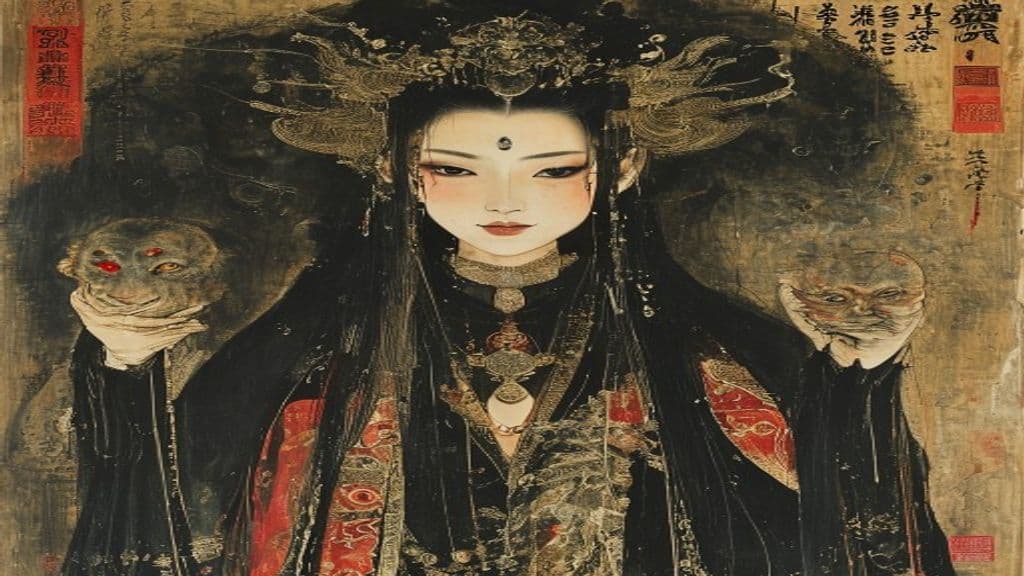
In Chinese primeval narratives the figure linked to drought emerges from the mythic battles of culture‑heroes: after conflicts involving Chiyou and Huang Di a goddess named Ba (later called hanba) is associated with that martial sequence and, in some accounts, with the loss of godly power and subsequent association with dry regions. Mythic cosmology contrasts hanba with rainbringing beings such as Yinglong (a dragon associated with floods); traditions report that hanba remained in the north, a region traditionally prone to drought. In later Chinese imperial legend an episode during Emperor Zhenzong's reign recounts a hanba striking Yanchi and removing its water, an event that provoked ritual/official responses including consultation of a Celestial Master and the deployment of the culture‑hero Guan Yu as a repelling agent.
Descriptions vary across time and tradition. Early Chinese accounts present hanba in a goddess form, often as a woman in black. Later medieval and early modern sources shift the image toward ghostly and then vampire‑like traits; late Qing accounts add claims of shape‑changing into a hou (monkey‑like creature). Edo‑period Japanese citations (via the Wakan Sansai Zue quoting Bencao Gangmu) describe a small creature 60–90 centimeters long with eyes on the top of its head and moving quickly like the wind. Toriyama Sekien's Illustrated One Hundred Demons labels the creature 魃/旱母 and depicts an artistic variant as a one‑armed, one‑eyed beast—an Edo pictorial rendering rather than a single canonical bodily form.
Primary reported agency is meteorological: sources attribute to hanba the ability to cause severe drought and to 'take' or dry up water from places (the Emperor Zhenzong account states a hanba struck and took the water of Yanchi). It is described as moving swiftly 'like the wind' in some texts. Over time folkloric descriptions incorporate vampiric and shape‑changing characteristics (including late claims of transformation into a hou), and narratives record human attempts to repel or defeat it—ranging from ritual specialists dispatching culture‑hero figures to communal calendrical supplication for rain.
Weaknesses
- otherhistorical remedies and ritual responses (appeal to ritual specialists, enlistment of protective culture‑heroes)
Wards
- ritualAppeals to Celestial Masters and deployment of Guan Yu (imperial episode)
- ritualCommunal prayers on Guan Yu's day (13th day of the fifth month) for banishment of demons and for rain
- ritualSymbolic actions invoking opposing forces (driving it away with sunshine, flood, and tigers)
Hesione
Hesione is a mortal Trojan princess in Greek myth who was exposed to a sea‑monster as an oracularly required sacrifice for her father Laomedon’s offense against the gods; rescued by Heracles, she is given in marriage to Telamon, ransoms her brother with her veil (after which he is called Priam), and in later tradition becomes a diplomatic pawn whose non‑return is cited among factors leading to Paris's taking of Helen.
Hesperides
The Hesperides are a group of Greek mythic nymphs who tend the sacred garden of Hera at the western edge of the world. Associated with evening and the west, they guard trees bearing golden apples and are linked in myth to major episodes such as Heracles' eleventh labour and the origin of the Apple of Discord.
Hesperus
Hesperus is the Greek personification of the Evening Star—the planet Venus as seen after sunset. Treated in mythic genealogies as a child of Dawn and related to other celestial personifications, Hesperus figures in literary and philosophical discussion about the identity of the evening and morning appearances of Venus.
Heyókȟa (Heyoka)
A sacred contrarian figure and ceremonial role in Lakota and Dakota (Sioux) traditions, the heyókȟa functions as a sanctioned 'sacred clown' whose deliberate inversion of social norms, satire, and ritualized shame help heal emotional pain and test communal values. Cosmologically the role is tied to visions of the thunder beings (Wakíŋyaŋ) and is sometimes represented in myth as a thunder or lightning spirit.
Hibagon
The Hibagon is a regional cryptid reported around Mount Hiba in Hiroshima Prefecture, Japan, described as a large, bipedal, hairy humanoid. Reported since the 1970s, it is presented in sources as a local analogue to North American Bigfoot and the Himalayan Yeti and treated primarily as a cryptozoological/folkloric curiosity rather than a being embedded in traditional religious cosmology.
Hibil (Hibil Ziwa)
Hibil Ziwa is a luminous uthra (lightworld being) in Mandaean religion who serves as a salvific agent. Created by Manda d‑Hayyi, he is sent into the World of Darkness to confront and bind hostile powers, retrieve dangerous elements, and secure the return of souls to the World of Light; he is also reflected as a human archetype cognate with Abel.
Hidimba
Hiḍimba is a powerful demon king in the Indic epic Mahābhārata who dwells in the forest, preys on humans (including cannibalistic behavior), and is slain in single combat by the Pandava Bhīma. In regional tradition the cultic attention shifts to his sister Hiḍimbī (Hiḍimbā Devī) and their son Ghaṭotkaccha, whose shrines and festival roles are prominent in Himachal Pradesh.
Hidimbi (Hiḍimbī / Haḍimbā)
Hiḍimbī (Hiḍimbā) is a rākṣasī (female rakshasa) figure in the Mahābhārata who encounters Bhīma, changes form to a beautiful maiden, marries him and bears Ghaṭotkaca. In Himalayan (Himachal Pradesh) regional religion the figure is worshipped as the local goddess Haḍimbā, patron of a temple in Manali; scholarship treats the cult as older than or independent of its epic identification.
Hiiden Hirvi
Mythical moose from Finnish tradition that must be hunted by skiing. (Note: - Power tier: Greater (given its classification as a mythical entity that requires special skills to hunt, it's likely more powerful than a Minor Spirit) - Weaknesses: specify what the source material)
Hiisi
A term in Finnic mythologies referring to both sacred localities and associated mythological entities. (Note: - Power tier: Downgrade to Lesser (local spirit) as there's no indication of Primordial-level power. - Summary: Update to clarify that Hiisi refers both to sacred locations and associated entities, bu)
Hikairo
Hikairo is attested in the provided sources as a personal and group name within Māori contexts (used for individuals and iwi/hapū identifiers such as Ngāti Hikairo), rather than as a documented supernatural being. References show historical and contemporary usages tied to leadership, ceremonial roles, and local guardianship projects.
Hildeburh
Hildeburh is a human literary character in the Old English heroic-material cycle (the Finnsburg episode as preserved in Beowulf and related fragmentary material). In the narrative she functions as a freothuwebbe or 'peace-weaver'—a marriage-link between royal houses—whose story exemplifies marriage-as-peace-weaving, kin-feud, and funerary response after battle.
Community Record
- [1]Hiderigami - Wikipedia. Wikipedia: Hiderigamiwiki
- [2]Konjaku Gazu Zoku Hyakki - Toriyama Sekien (entry context). Wikipedia: Konjaku Gazu Zoku Hyakki (Toriyama Sekien)wiki
- [3]Hiderigami | yokai.com. yokai.com entry on Hiderigamiother
- [4]Non‑Alien Creatures Wiki: Hiderigami. Non‑Alien Creatures Fandom: Hiderigamiwiki
- [5]Wakan Sansai Zue (quoting Bencao Gangmu) — cited in Edo period materials. Wakan Sansai Zue (Edo encyclopedia) quotation of Bencao Gangmu as cited in secondary sourcesliterary