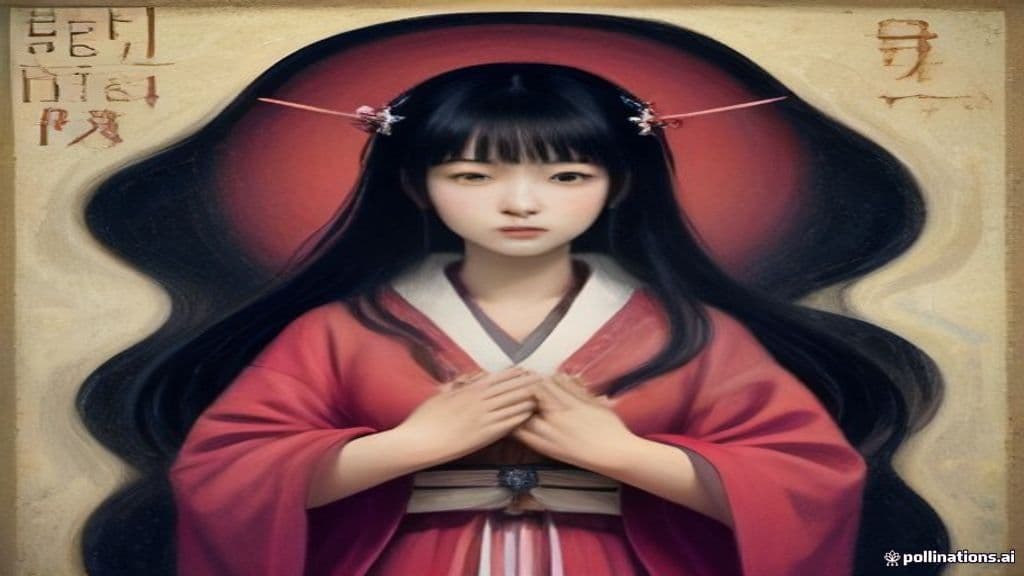
The term Arahitogami (現人神) first appears in classical Japanese literature; the supplied source cites its occurrence in the Nihon Shoki as words attributed to Yamato Takeru: “I am the son of an arahitogami.” Beyond this attestation the provided materials do not supply a fuller mythic origin narrative. The attestation in an early chronicle situates the concept historically within the development of Japanese rulership and Shinto vocabulary, where particular humans (for example rulers or revered ancestors) could be identified or described as kami in human form.
The sources do not provide iconographic or descriptive physical details. The lexical definition supplied — a kami who is a human being — implies that hitogami are understood as embodied humans (historical persons or living figures) rather than purely otherworldly apparitions; however, no specific clothing, features, or standard iconography are attested in the provided texts.
The available sources define hitogami as a kind of kami identified with a human being but do not enumerate particular supernatural powers, behaviors, or standard functions. The term thus marks a classificatory relation (human ↔ kami) rather than a catalogue of abilities in the supplied material.
Community Record
- [1]Arahitogami (Wikipedia). Wikipedia: Arahitogami. ‘Arahitogami (現人神) is a Japanese word, meaning a kami who is a human being. It first appeared in the Nihon Shoki as the words of Yamato Takeru saying: "I am the son of an arahitogami."’wiki
- [2]Wikidata: Hitogami. Wikidata entry Q11376147 summarised as 'type of divine being in Shinto.'wiki