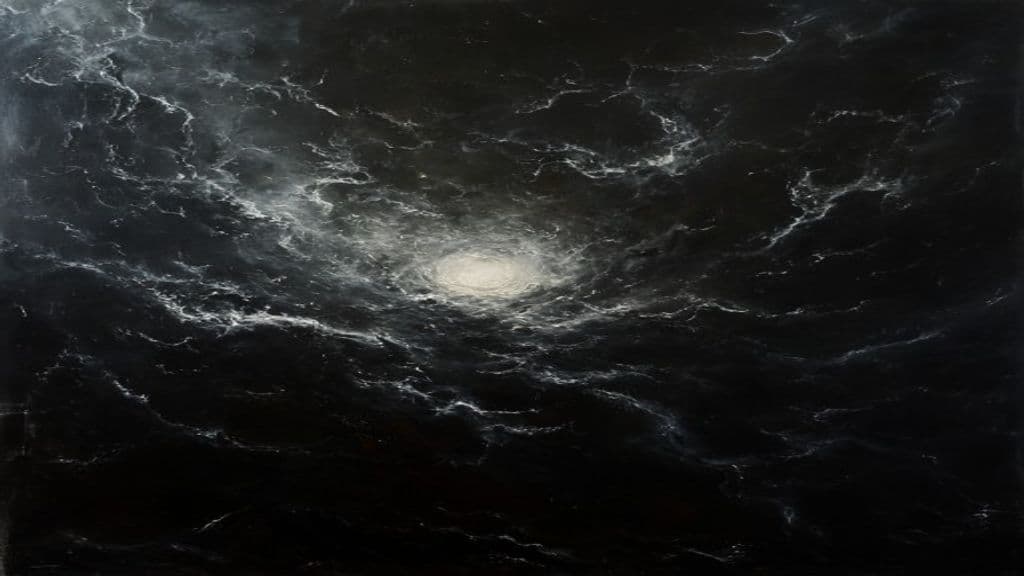
Hundun appears in several Daoist texts, most famously in Zhuangzi. In one parable, Hundun is the deity of the center — unlike the deities of the north and south who had seven orifices, Hundun had none. The other deities tried to benefit him by boring the seven holes (for sight, hearing, smell, taste); when they finished the seventh hole, Hundun died. The parable encapsulates Daoist philosophy: imposing differentiation and order on primordial wholeness destroys it. Hundun also refers to the undifferentiated state before creation.
In personified form: a featureless being with no face, no distinguishing characteristics — pure undifferentiated potential. Sometimes described as a yellow sack or shapeless mass. Cannot be described or defined, as definition itself violates its nature.
As primordial chaos, Hundun contains the potential for all things. It cannot be opposed because it has no defined form to oppose. Contact with it dissolves differentiation — identities and distinctions blur and merge. Its 'death' (through the boring of holes) created the differentiated world; its return would end it.
Weaknesses
- conditionCannot be opposed — it contains all oppositions within itself
Wards
- conditionMaintaining distinction and form — the very act of differentiation is antithetical to Hundun
Báigǔ Jīng
The White Bone Demon of Journey to the West — a skeletal demoness who shapeshifts into innocent humans three times to attempt to capture and devour the monk Tripitaka.
Chi (螭)
Chi (螭) is attested in the provided sources only as an entry on a general disambiguation page identifying 螭 as "a dragon" within a Chinese lexical/mythological listing. No further mythological, ritual, or descriptive information about this entity is present in the supplied materials.
Dawn deities
A cross-cultural category of divine figures associated with dawn, morning, or the morning star; these figures personify the transition from night to day and may be integrated into local pantheons or syncretized with solar deities in some traditions.
Dragon (Long)
Long (龍, "dragon") is a pervasive cultural and artistic motif that appears in Taoist sacred-geographical contexts, Chinese literature, and modern exhibitions; the provided sources treat it as part of the broader mythic imagery present around Taoist sites and ritual scenes rather than as a single, consistently described doctrinal entity.
Huli jing (Fox spirit)
Huli jing (狐狸精), commonly rendered in English as "fox spirit," are shapeshifting supernatural beings from Chinese folklore and mythology. Classified among the broader class of yāoguài, they are morally ambivalent figures that may be benevolent, malevolent, or trickster-like depending on the tale and context.
Jade
Jade is a material and cultural concept referring to two distinct groups of ornamental rocks—nephrite and jadeite—valued across many societies (not a supernatural being). It has deep historical, ritual, and symbolic significance especially in East Asia and Mesoamerica, and carries folk associations with health and social status.
Jiangshi (hopping corpse)
A jiangshi (jiāngshī, 僵尸) is a reanimated human corpse in Chinese popular belief and media that moves with a stiff, hopping gait and is commonly depicted in modern sources as subject to control or containment by Taoist priests using talismans and ritual implements. The contemporary image is heavily shaped by Hong Kong cinema, which standardizes visual motifs (Qing robes, yellow fulu, glutinous rice) and priestly intervention.
Liminal deity (category)
A scholarly category of gods and divine figures whose proper sphere is thresholds, borders, and transitions — places and moments where one state gives way to another. The term aggregates culturally specific deities (e.g., Janus, Hecate, Charon, Cheng'huang, Menshen, Jangseung, Bes) that function as guardians, psychopomps, or mediators at crossings of space, time, or condition.
Moon Rabbit (Maya Tradition)
A mythical figure associated with lunar mythology, said to pound elixir or medicine for mortals and occasionally foodstuffs. (Note: 1. Power tier: Downgrade to Ancient, as while it's associated with lunar mythology, its abilities are not cosmic in scope. 2. Abilities: Add that the contents of the mortar differ among cultural tradi)
Qilin
A legendary hooved chimerical creature of Chinese literary tradition (麒麟, qílín) whose appearances in classical accounts function as auspicious omens tied to the birth, arrival, or death of sages and illustrious rulers. The creature is part of a broader East Asian set of correspondents (Japanese kirin, Korean girin) and was historically conflated with the real giraffe in Ming-dynasty court encounters.
Högne
Högne is a legendary human king of Östergötland attested in Old Norse sources (Heimskringla, the Volsunga saga, and the Poetic Edda). He appears in cycles of dynastic conflict, marriage-alliance narratives, and blood-feud where he fights, raids, and is ultimately slain in battle in some versions.
Húrin
Húrin is a mortal Man of the House of Hador in J. R. R. Tolkien’s First Age legendarium: a preeminent warrior famed for his endurance and tragic fate after capture by Morgoth, whose long captivity and the curse on his kin shape major events in Beleriand.
Community Record
- [1]Zhuangzi. Zhuangzi. Inner Chapters, ch. 7 ('Fit for Emperors and Kings'). c. 4th century BCE. Translated by Watson, Burton. Columbia University Press, 1968.literary
- [2]Chaos and Order. Girardot, N.J. 1983. Myth and Meaning in Early Taoism: The Theme of Chaos (hun-tun). University of California Press.academic