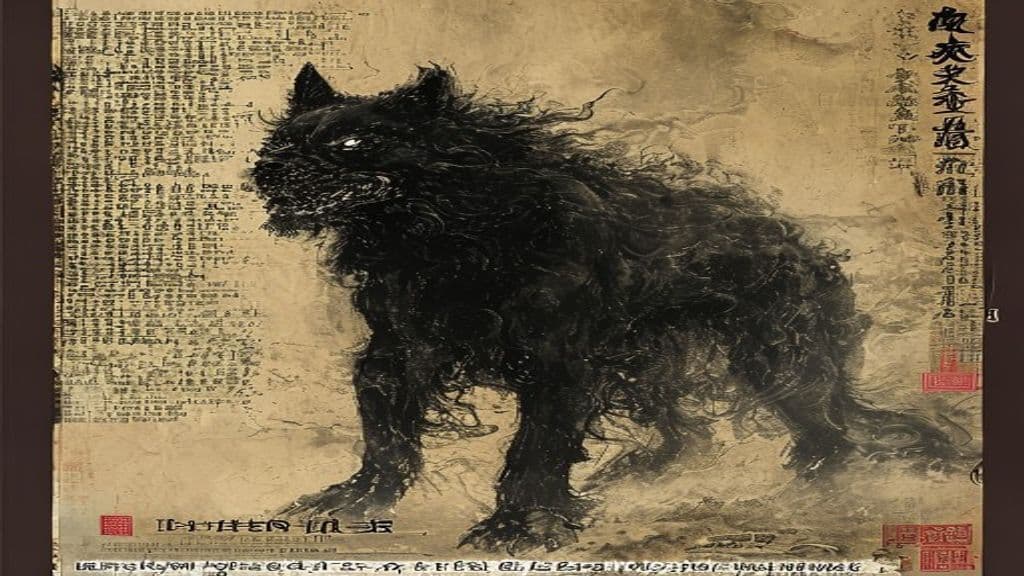
Classical and later summaries place the Huodou in southern regions of the mythic geography. A passage cited from the Shanhaijing describes peoples and beasts in the south who 'eat fire' and locates them near Hei Kunlun (Black Kunlun), and later commentaries (Ming Chiya) and modern summaries identify the Huodou with those fire-eating beasts. Some modern summaries characterize the motif as arising among minority groups of southern China and suggest it may reflect a demonized tribal symbol, but the primary textual attestations are brief statements in the Shanhaijing and Ming-era citation rather than a full narrative origin.
Source passages describe the Huodou as having the body of a black dog. The Shanhaijing passage notes 'fire-eating beasts' in the south and an account in the Ming work Chiya (as cited) states 'the Huodou looks like a dog,' while modern summaries render the creature as 'a large black dog that can emit flames from its mouth.' No further standardized morphological details are recorded in the cited material.
Across the cited sources the Huodou is said to 'eat fire' (Shanhaijing), and a Ming citation in Chiya states it 'eats fire and spits fire.' Modern summaries assert it 'can emit flames from its mouth' and report that 'fire would break out wherever the Huodou went,' so classical treatment frames it as intimately associated with fire, either by ingesting and expelling flames or by appearing as an omen that accompanies conflagration. The sources do not provide technical mechanisms or extended descriptions beyond these phrases.
Weaknesses
- othernot recorded in sources
Wards
- othernot recorded in sources
Hun and Po
Hun (魂) and po (魄) are complementary soul-aspects in classical Chinese thought: hun is the more ethereal, yang-associated component that departs the body after death, while po is the more corporeal, yin-associated component tied to physiological and lunar-linked functions and which remains with the corpse.
Hundings
A legendary tribe or clan in Germanic tradition, known for their conflict with the Wulfings. (Note: * Power tier should be Ancient (deity-level) is too high; given the lack of supernatural powers and behaviors associated with the Hundings. * The article incorrectly states that no physical descriptio)
Hundred‑Eyed Demon Lord
A powerful non‑human spirit figure from the 16th‑century Chinese novel Journey to the West (Chapter 73). Presented in the story as a centipede spirit who disguises himself as a Daoist abbot, reveals a hundred glowing eyes beneath his ribs that emit a blinding golden light, and serves poisoned tea to the pilgrims before being subdued by the bodhisattva Pilanpo.
Hungry Spirit of Mahāmāyā
A proposed label for a 'hungry spirit' (preta) associated with the name Mahāmāyā mentioned in some modern queries; the supplied sources do not document any such named entity. The materials provided only place the general notion of postmortem experiential states within Tibetan bardo literature and do not describe a Mahāmāyā preta.
Hungry Tiger
The Hungry Tiger is a fictional anthropomorphic tiger character created by L. Frank Baum for his Oz books, first appearing in Ozma of Oz. Presented within the enchanted Land of Oz as a speaking, feeling animal-person, he served as comic relief in Baum's work and was later expanded into a protagonist by subsequent Oz authors and continuators.
Hungry ghost (E gui)
Listed in a compiled catalogue of supernatural beings from Chinese folk culture and contemporary literature, 'hungry ghost (E gui)' appears as an itemized class of supernatural being in the provided sources. The supplied materials contain the name but do not give further descriptive or ritual detail.
Huoshu (火鼠)
The huoshu or huo shu (火鼠), literally "fire rat" or "fire mouse," is attested in modern reference works as a fantastical beast in Chinese tradition. Available cited references (Wikipedia and Wikidata) provide only this lexical identification and classification; no further descriptive, narrative, or ritual material is supplied in those sources.
Huracán (Hunraqan / U Kʼux Kaj)
Huracán (Mayan: Hunraqan), often rendered in Kʼicheʼ as U Kʼux Kaj ('Heart of Sky'), is a Kʼicheʼ Maya creator deity associated with wind, storm, fire, and lightning. He takes part in the cosmogonic attempts to create humanity and is the agent of the Great Flood who calls land up from the waters.
Hursag
In Mesopotamian tradition, Hursag refers to a geographical feature, specifically a mountain or hill. (Note: - Power tier: Hursag is a geographical feature, not a being with primordial power; correct tier to be Lesser (local spirit) or Minor Spirit (weak), as it's a natural landform. - Abilities: Remove stat)
Hutena and Hutellura
Hurrian divine female figures associated with fate and with birth/midwifery. Frequently attested as part of the court of the goddess Ḫepat (Hebat), they appear in ritual offering lists and in mythic narratives as attendants who determine destiny and assist at births.
Huītzilōpōchtli
Huītzilōpōchtli is the principal Aztec (Nahua) solar and war deity, patron of the Mexica and Tenochtitlan. In Aztec cosmology he is a cosmic warrior whose continued vigor is sustained by ritual nourishment—notably human blood and hearts—administered in formal festivals and sacrifices.
Hušbišag
Hušbišag (Hushbishag) is a Mesopotamian netherworld goddess attested as a member of the underworld household; she is named as the wife of Namtar and mother of Hemdikug and is described in one literary passage as a 'handmaid of the dark gods' who may welcome the dead.
Community Record
- [1]Huodou — Wikipedia. Wikipedia: 'It is described as having the appearance of a large black dog that can emit flames from its mouth... Fire would break out wherever the Huodou went, so the ancients saw it as a sign of fire and often an ominous symbol.'wiki
- [2]Shanhaijing (as cited). Shanhaijing excerpt (as cited in secondary sources): 'There are people and beasts in the south who eat fire. Their country is near Hei Kunlun (Black Kunlun). People there can eat coals, and fire-eating beasts are also known as Calamities.'literary
- [3]Chiya (Ming dynasty) citation (as cited). Chiya (Ming) (as cited in secondary sources): 'the Huodou looks like a dog, it eats fire and spits fire, it is ominous.'literary
- [4]Wikidata: Huodou. Wikidata entry for Huodou (cross-reference to summary data).other