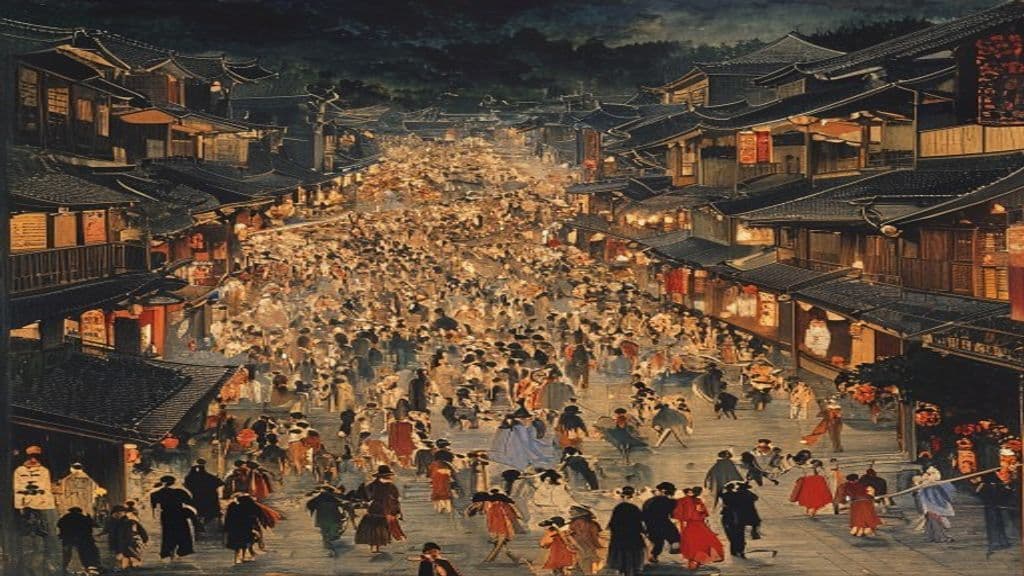
Hyakki Yagyō is not a single originating myth but a long‑standing motif attested across medieval tale collections and later visual arts. The phenomenon appears in classical narratives such as Konjaku Monogatarishū and Uji Shūi Monogatari and is represented in Muromachi–Edo picture scrolls (e.g., Hyakki Yagyō Zu) and later printed yōkai encyclopedias. Over more than a thousand years the motif developed as a way to depict and catalogue many kinds of nocturnal supernatural activity rather than to record a single creation story.
As a phenomenon Hyakki Yagyō is described and depicted as a procession moving through streets at night. Visual sources vary: some handscrolls and prints show a parade of diverse yōkai in formation, while other accounts emphasize disorder or riotous movement. Participants are generically described as yōkai and other supernatural creatures (with some sources mentioning oni among them), and visual/cultural examples include animated ritual implements (a monk's fly whisk, boots, a Buddhist gong) and individuated monsters catalogued in Hyakki picture‑encyclopedias by artists such as Toriyama Sekien and Utagawa Yoshiiku.
Accounts emphasize collective, public movement and danger to humans: encountering the procession is reported to result in death or being spirited away in some tales. Variant legends attribute leadership (e.g., the yōkai Nurarihyon is named as a leader in a later legend). Sources also report that yōkai may recognize or react to human signs in specific stories (for example, a Konjaku Monogatarishū tale describing yōkai avoiding a man because of his garment marking). Ritual specialists (onmyōji) and their exorcism scrolls are consistently presented as effective countermeasures in tradition.
Weaknesses
- conditionRemaining indoors on specific nights associated with the Chinese zodiac (Shūgaishō)
- otherResistance by powerful onmyōji (only an onmyōji clan head is said to pass certain versions of the parade unharmed, per tradition)
Wards
- mantraProtective chant recorded in Shūgaishō: "KA-TA-SHI-HA-YA, E-KA-SE-NI-KU-RI-NI, TA-ME-RU-SA-KE, TE-E-HI, A-SHI-E-HI, WA-RE-SHI-KO-NI-KE-RI" (カタシハヤ, エカセニクリニ, タメルサケ, テエヒ, アシエヒ, ワレシコニケリ)
- ritualExorcism scrolls (handwritten by onmyōji) used as protection against the procession
Abumi-guchi
A Japanese yōkai classed as a tsukumogami: an animated stirrup (abumi) depicted in Sekien Toriyama's Gazu Hyakki Tsurezure Bukuro. Traditional accounts say it is formed from a stirrup that belonged to a soldier who fell in battle and that it waits where the stirrup lies for its dead owner to return.
Abura-sumashi
A yōkai spirit from the Amakusa region of Kumamoto Prefecture, Japan, said to inhabit mountain passes. Traditionally explained as the ghost of a person who stole oil, it appears to surprise travelers and is represented in modern media with a straw-coat body and a potato- or stone-like head.
Akaname
Akaname is a Japanese yōkai associated with baths, bathtubs, toilets, and other places where scum and filth accumulate. Traditionally depicted as a child-like creature that licks grime, it functions in folklore as a cautionary figure tied to cleanliness; a few narrative variants cast it as dangerously predatory.
Akateko
Akateko (赤手児, lit. 'red child's hand') is a yōkai from Japanese folklore commonly told as a small, red, disembodied child's hand that appears from trees—especially the Japanese honey locust—and startles travelers; in some regional variants it is accompanied by a specter of a young woman or manifests as paired foot- or leg-like apparitions. Accounts vary between mostly harmless trickster apparition and a violent variant that attacks humans.
Akubōzu
Akubōzu (灰坊主, Akubōzu) is a household yōkai from parts of Akita and Iwate Prefectures in northern Japan said to live in the ashes of the hearth. Sources say they appear when people (notably children) play with or dig in hearth/furnace ash; the figure is cited as part of a broader Tōhoku motif warning against disturbing ash.
Akuma
Akuma (悪魔/あくま) in Japanese sources is an evil spirit, devil, or demon associated with misfortune and mental disturbance. The term appears in Buddhist texts and Heian-period literature and was later used to translate the Christian figure of Satan, as well as the Buddhist Mara.
Akurojin-no-hi
Akurojin-no-hi (悪路神の火, "fire of the god of the bad road") is a flamelike ghost from the folklore of Mie Prefecture, Japan. It is reported to appear on rainy nights; those who encounter it and do not run away are said to become gravely ill. The phenomenon is sparsely documented and is usually compared to will-o'-the-wisp type ghost-lights.
Amabie
Amabie is a mid-19th-century Japanese yogenjū-type wondrous creature attested in kawaraban and related pamphlet culture that emerges from the sea (in canonical accounts) to prophesy about harvests and epidemics and prescribes that its image be drawn and shown to the sick as a protective measure.
Amanojaku
Amanojaku (天邪鬼 / あまのじゃく) is a Japanese yōkai-type being portrayed as a contrarian, heart-reading trickster. Treated in different contexts as a small ogre (ko-oni), a wicked demon (jaki) in Buddhist iconography, and a folkloric spirit that provokes human vice, it appears across regional tales with variable roles from malicious kidnapper to household oddity.
Amanozako
Amanozako is a Japanese divine/monstrous figure described in classical summaries as a furious, contrarian kami produced from the ferocious aspect (ara-mitama) of the storm-god Susanoo; later glosses present her as an ancestor-figure for ill-tempered yōkai such as tengu and amanojaku.
Amefurikozō
Amefurikozō (雨降小僧 or 雨降り小僧) is an Edo-period yōkai figure depicted in classical illustrated and popular print culture as a youthful attendant associated with rain. Classical sources (notably Sekien Toriyama's Konjaku Gazu Zoku Hyakki) present it as a kozō-type servant linked by captional wordplay to a rain deity; later popular literature elaborates its rain-producing role and playful mischief on rainy nights.
Ameonna
Ameonna (雨女, "rain woman") is a figure in Japanese folklore treated as a yōkai associated with rain. Sources depict her both as a rain-calling supernatural being (sometimes helpful in drought) and as a folk label for an unlucky person whom rain seems to follow; a key pictorial source is Toriyama Sekien's Konjaku Hyakki Shūi.
Community Record
- [1]Hyakki Yagyō. Wikipedia: Hyakki Yagyō — article summarizing the idiom, tales, protective measures, and artistic representations.wiki
- [2]Hyakki Yagyō (Wikidata). Wikidata entry describing the concept as a mass parade of supernatural creatures.other
- [3]Archive item: ritual implements as monsters (Hyakki imagery). Archive: notes that ritual implements such as a monk’s fly whisk, boots, and a Buddhist gong become monsters; used to illustrate variability of parade participants in visual culture.other
- [4]Image/archive references to Hyakki Yagyō scrolls and artworks. Archive materials and references that attest to Hyakki Yagyō handscrolls and the motif's appearance in visual culture (Muromachi–Edo scrolls referenced in source notes).other