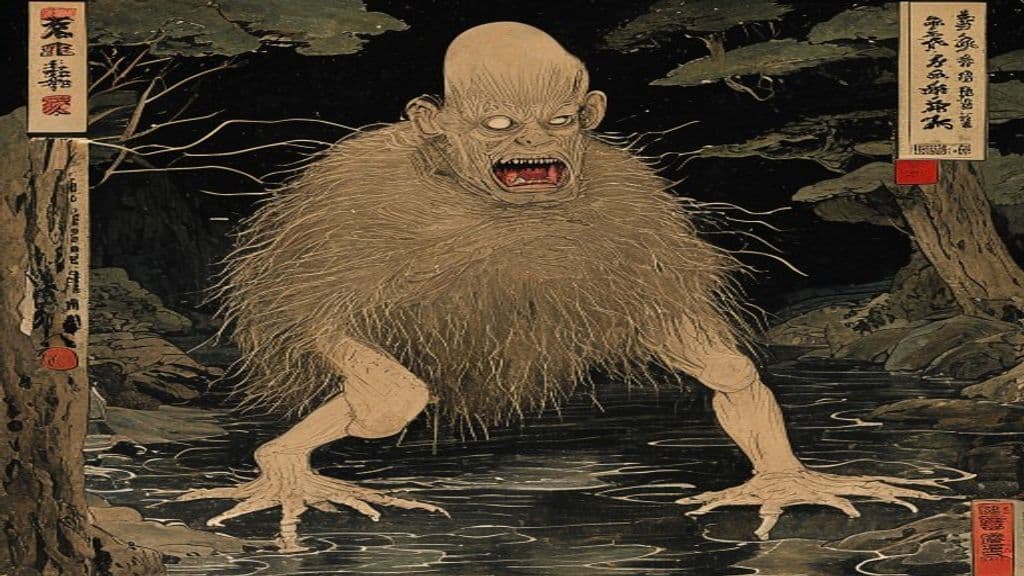
Sources record multiple intertwined origin strands. One tradition connects Hyōsube to shrine-construction myths in which magician-made dolls were animated to build a shrine and afterward dumped into a river; these discarded animate dolls become river-dwelling Hyōsube. Other accounts link the name and cult to shrine-deity names (兵主神 / Hyōzu, Binzhushen) and to historical shrine networks, suggesting an intersection of an enshrined war/food deity's cultic memory with local river-yōkai narratives. Regional tales also preserve a pact story (linked to Sugawara no Michizane motifs) in which a saved water-being promises not to harm certain descendants — a narrative used at local shrines to manage human–Hyōsube relations.
Described in folklore and Edo-period yōkai illustration traditions as child-sized with an extremely hairy body and a bald head, bearing sharp teeth and long claws. Visual depictions (Toriyama Sekien and related bakemono-e sources) often show hyōsube in humorous or grotesque postures; folkloric reports emphasize greasy floating hair and a foul smell after they soak in household baths.
Hyōsube are said to inhabit underwater caves and rivers and to come ashore at night. They are strongly associated with eating eggplants (a folkloric opposition to kappa's cucumbers) and with sneaking into private baths to bathe, after which tubs are left with floating greasy hair and a stench; some stories claim animals (horses) that touch such fouled bathwater may die. They are presented as causing disease in some tales: observers of Hyōsube or those who interact incorrectly with them can later develop unexplained fevers or fatal ailments. One secondary source (Satō Arifumi’s Ichiban Kuwashii Nihon Yōkai Zukan, cited in modern summaries) records a claim that if a Hyōsube laughs and a human laughs in response the human will contract a fatal fever — the same commentary notes scholars have suggested that particular laughing-death detail may be a later literary invention. Hyōsube are regularly described as companions or cousins of kappa and are often grouped with river yōkai.
Weaknesses
- otherNo canonical material weakness recorded in supplied sources
Wards
- ritualEggplant offering (spear-through-eggplant upright in field)
- mantraShrine pledge-phrase invoking the promise to Sugawara's descendants ('Hyōsube, forget not the promise, the one who stands at this river is a child of the old Sugawara')
Abumi-guchi
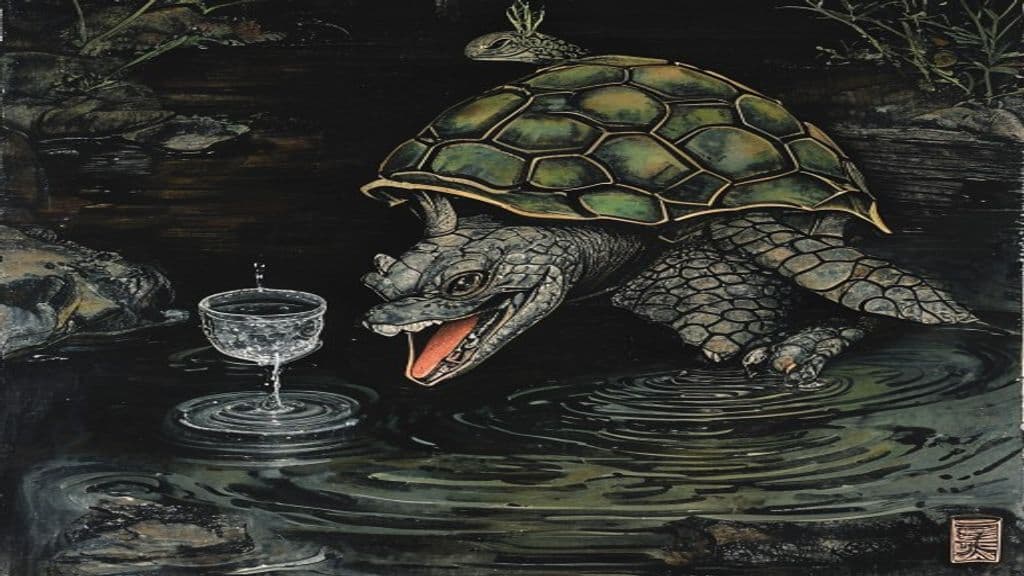
A Japanese yōkai classed as a tsukumogami: an animated stirrup (abumi) depicted in Sekien Toriyama's Gazu Hyakki Tsurezure Bukuro. Traditional accounts say it is formed from a stirrup that belonged to a soldier who fell in battle and that it waits where the stirrup lies for its dead owner to return.
Abura-sumashi
A yōkai spirit from the Amakusa region of Kumamoto Prefecture, Japan, said to inhabit mountain passes. Traditionally explained as the ghost of a person who stole oil, it appears to surprise travelers and is represented in modern media with a straw-coat body and a potato- or stone-like head.
Akaname
Akaname is a Japanese yōkai associated with baths, bathtubs, toilets, and other places where scum and filth accumulate. Traditionally depicted as a child-like creature that licks grime, it functions in folklore as a cautionary figure tied to cleanliness; a few narrative variants cast it as dangerously predatory.
Akateko
Akateko (赤手児, lit. 'red child's hand') is a yōkai from Japanese folklore commonly told as a small, red, disembodied child's hand that appears from trees—especially the Japanese honey locust—and startles travelers; in some regional variants it is accompanied by a specter of a young woman or manifests as paired foot- or leg-like apparitions. Accounts vary between mostly harmless trickster apparition and a violent variant that attacks humans.
Akubōzu
Akubōzu (灰坊主, Akubōzu) is a household yōkai from parts of Akita and Iwate Prefectures in northern Japan said to live in the ashes of the hearth. Sources say they appear when people (notably children) play with or dig in hearth/furnace ash; the figure is cited as part of a broader Tōhoku motif warning against disturbing ash.
Akuma
Akuma (悪魔/あくま) in Japanese sources is an evil spirit, devil, or demon associated with misfortune and mental disturbance. The term appears in Buddhist texts and Heian-period literature and was later used to translate the Christian figure of Satan, as well as the Buddhist Mara.
Akurojin-no-hi
Akurojin-no-hi (悪路神の火, "fire of the god of the bad road") is a flamelike ghost from the folklore of Mie Prefecture, Japan. It is reported to appear on rainy nights; those who encounter it and do not run away are said to become gravely ill. The phenomenon is sparsely documented and is usually compared to will-o'-the-wisp type ghost-lights.
Amabie
Amabie is a mid-19th-century Japanese yogenjū-type wondrous creature attested in kawaraban and related pamphlet culture that emerges from the sea (in canonical accounts) to prophesy about harvests and epidemics and prescribes that its image be drawn and shown to the sick as a protective measure.
Amanojaku
Amanojaku (天邪鬼 / あまのじゃく) is a Japanese yōkai-type being portrayed as a contrarian, heart-reading trickster. Treated in different contexts as a small ogre (ko-oni), a wicked demon (jaki) in Buddhist iconography, and a folkloric spirit that provokes human vice, it appears across regional tales with variable roles from malicious kidnapper to household oddity.
Amefurikozō
Amefurikozō (雨降小僧 or 雨降り小僧) is an Edo-period yōkai figure depicted in classical illustrated and popular print culture as a youthful attendant associated with rain. Classical sources (notably Sekien Toriyama's Konjaku Gazu Zoku Hyakki) present it as a kozō-type servant linked by captional wordplay to a rain deity; later popular literature elaborates its rain-producing role and playful mischief on rainy nights.
Ameonna
Ameonna (雨女, "rain woman") is a figure in Japanese folklore treated as a yōkai associated with rain. Sources depict her both as a rain-calling supernatural being (sometimes helpful in drought) and as a folk label for an unlucky person whom rain seems to follow; a key pictorial source is Toriyama Sekien's Konjaku Hyakki Shūi.
Amorōnagu
Amorōnagu (Amorōnagu / 天降女子) is a tennyo or celestial maiden figure in the folklore of Amami Ōshima (Kagoshima Prefecture, Japan). Attested sources describe her as a heavenly woman who bathes in pools and waterfalls in ravines on the island.
Community Record
- [1]Hyōsube. Wikipedia: Hyōsube (consulted material on characteristics, eggplant offering, bath behavior, origin narrative, regional names, shrine pledge phrase)wiki
- [2]The Night Parade Of One Hundred Demons: A Field Guide To Japanese Yokai. Field-guide style compendium listing Hyōsube among river and wild yōkai (used for grouping/genre confirmation)folk
- [3]Hyōsube | Monster Wiki. Fandom/Monster Wiki summary echoing folkloric outline (used cautiously to corroborate popular-summary details)wiki
- [4]Bakemono no e (Edo-period yōkai illustration traditions / Toriyama Sekien references). Reference to Edo-period visual traditions and depictions of Hyōsube-like yōkai used to support appearance descriptionsother