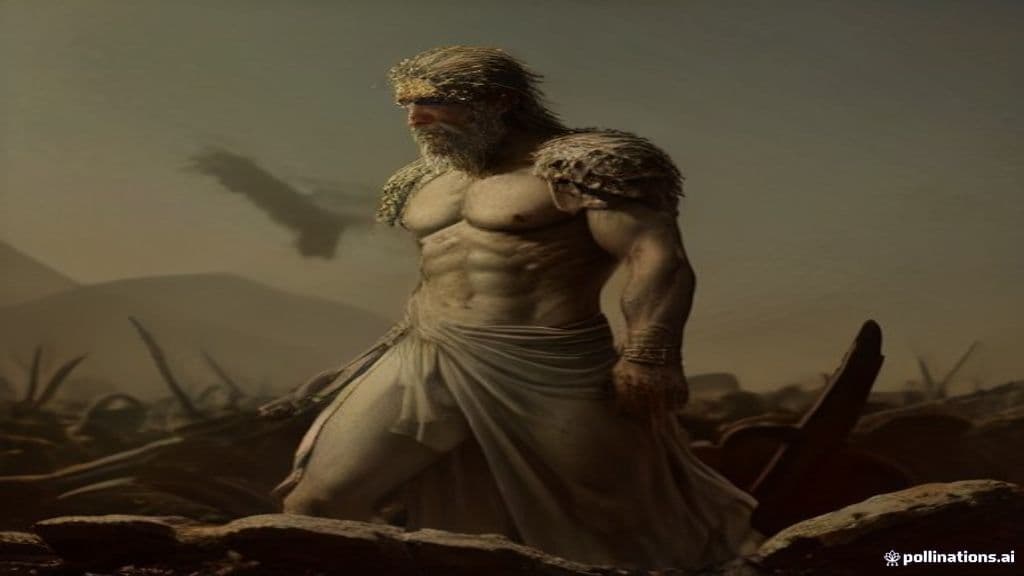
In Homeric tradition Idomeneus is presented as a son of Deucalion and ruler of Crete who led eighty ships of Cretans to the Trojan War. Homeric passages treat him as a living aristocratic/royal agent of the heroic age rather than as an otherworldly being. Post‑Homeric traditions (summarized in later mythographies) add an episode in which, during a storm on his homeward voyage, he vowed to Poseidon to sacrifice whatever he should meet first on landing; these later accounts link him to the familiar mythic theme of a leader's vow to a god and its consequences, but the vow narrative is explicitly post‑Homeric in the sources provided.
Homeric sources do not supply sustained physical description beyond Idomeneus' role as a fierce warrior‑king and battlefield commander. He is portrayed in the Iliad as a resolute and furious fighter, occupying command of the Cretan contingent (described as arriving in eighty black ships in later summaries). Later artistic adaptations (for example Mozart's opera Idomeneo, re di Creta) present him as a dramatic character, but these do not alter the sparse Homeric physical portrayal and are later reception rather than canonical epic description.
Idomeneus' primary attributes in the sources are martial prowess and leadership. The Iliad repeatedly emphasizes his continued fury in battle and his efforts to strike down Trojans or die defending the Achaeans. He is named among the principal Achaean commanders, associated with comrades such as Ajax and with Meriones as his charioteer/brother‑in‑arms. Later reception treats him as a dramatic protagonist and the personal name appears in epistolary contexts (e.g., letters of Seneca and Epicurus) though those uses may reflect homonymous historical individuals rather than the mythic king.
Weaknesses
- othermortal vulnerability (no supernatural powers)
- conditionpost‑Homeric vow consequences (vow to Poseidon leading to disaster) — attested only in later tradition
Wards
None recorded.
Community Record
- [1]Idomeneus (Wikipedia). Wikipedia, entry 'Idomeneus (son of Deucalion)'wiki
- [2]The Iliad, Book XIII (MIT Classics / Internet Classics Archive). Homer, Iliad (translation) — Book XIII, MIT Classics / Internet Classics Archiveliterary
- [3]Idomeneus – in ancient sources (Attalus.org). Attalus.org, 'Idomeneus – in ancient sources' (collected ancient references)other
- [4]Idomeneus – MYTH INDEX, Greek Mythology. MythIndex summary (notes Homeric return and post‑Homeric vow to Poseidon)folk
- [5]Idomeneo, re di Creta (Mozart) — Archive.org listing. Archive.org, 'Idomeneo, re di Creta, K. 366' (opera and related materials)other
- [6]On the Renown which my Writings will Bring you, by Seneca (letter addressed to Idomeneus). Seneca, letter (addressed to an Idomeneus) — modern online editionliterary
- [7]Ancient Testimonia about Epicurus (Idomeneus of Lampsacus references). Collection of ancient testimonia concerning Epicurus, includes references to correspondences addressed to an Idomeneusother
- [8]Iliad — Attalus / other transcripts. The Iliad (various online transcripts and translations referencing Idomeneus' martial role)literary