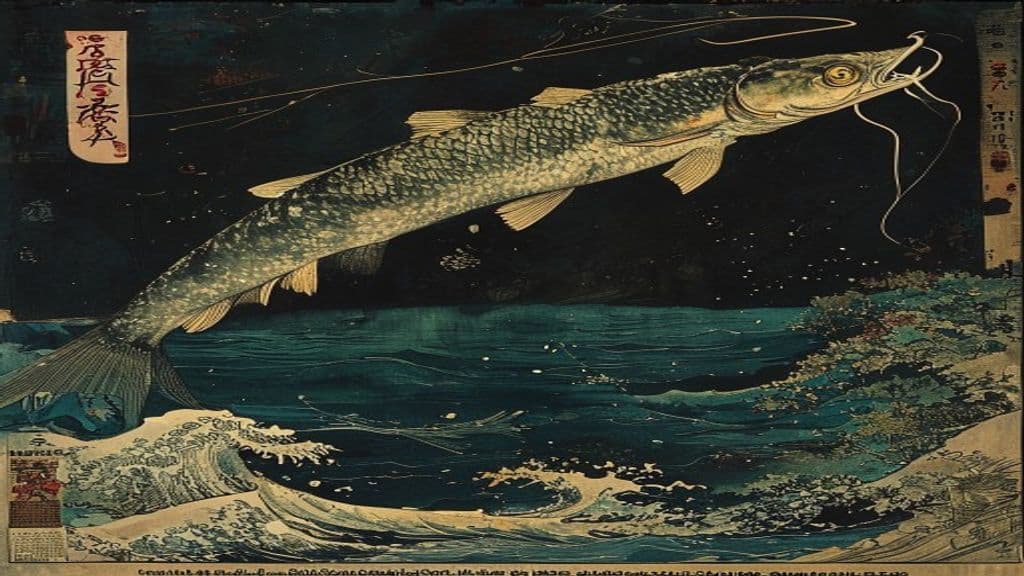
Attested Edo-period anecdote collections present the ikuchi/ikuji as a class of uncanny sea phenomenon rather than a myth with a single origin myth. Tankai (Tsumura Sōan, 1795) and Mimibukuro (Negishi Yasumori, completed 1814) report it as an extremely long marine creature encountered at night on sea lanes. Sekien’s Konjaku Hyakki Shūi illustrates a similar long sea-being under the caption ayakashi, linking the depiction to the broader category of strange sea phenomena. Some modern commentators and comparative readings of Sekien note that ayakashi lore can include the idea that certain sea-phenomena are formed from the souls of drowned humans, but the Edo anecdotes cited (Tankai, Mimibukuro) do not assert a definitive drowned-soul origin for the ikuchi itself; that explanatory motif belongs to ayakashi lore more generally and appears as an interpretive strand in later analyses.
Descriptions vary by source but consistently emphasize extreme length. Tankai describes an "extremely long fish" dwelling in deep waters off Hitachi that is "not very thick" but spans many units of length and is seen only at night. Mimibukuro (as ikuji) reports an eel-like coloration and immeasurable length, adding a local informant’s claim from Hachijō-jima that small local forms resemble eyeless, mouthless eels forming circular loops. Sekien’s illustrated entry shows an enormously long sea creature slithering over a ship for days; some modern readers interpret the image as a single tendril or tentacle, but the Edo textual accounts present the being as a very long slithering animal rather than explicitly as a single appendage.
Across the Edo accounts the ikuchi/ikuji is reported to emerge or rear from the sea at night and slither over a ship’s hull, bow, or deck. Tankai reports the passage can take "1 or 2 koku" to complete (a substantial duration), while Mimibukuro and Sekien describe it as continuing to squirm on a ship for "2, 3 days." As it passes it deposits very large quantities of viscous oil or bodily fluid—said in Tankai to have the consistency of funori (a gummy seaweed substance)—which slickens decks and can make walking impossible. Crews are recorded franticly bailing or dumping the oil to prevent the ship from taking on the substance and (if not removed) possibly sinking. Mimibukuro also reports the creature sometimes becoming snagged on the bow. The sources do not ascribe articulated malicious intent beyond these physical interactions.
Weaknesses
- conditionphysical removal of oil (bail/dump)
- conditionscrubbing and cleansing of the ship after contact
Wards
- otherNo recorded magical wards in cited sources

Sea serpent
A large serpentine marine creature attested across many mythologies and sailors' reports. It functions both as a cosmological adversary of storm/sky deities in ancient myth cycles and as a localized monstrous threat in coastal and seafaring folklore and eyewitness accounts.

Kraken
A legendary enormous sea monster from northern European (particularly Norwegian) maritime tradition, conceived as a deep‑water, tentacled hazard blamed for pulling down ships; later writers and naturalists often equated it with very large cephalopods (giant squid) or with other medieval sea‑monster names such as the hafgufa.
Community Record
- [1]Tankai (summary of Tankai account as recorded in research notes). Tankai summary as reported in provided research notes (Tsumura Sōan, 1795) describing ikuchi as extremely long fish off Hitachi, nocturnal, depositing funori-like oil and requiring bailing and scrubbing.literary
- [2]Mimibukuro (Negishi Yasumori, completed 1814) summary. Mimibukuro summary as reported in provided research notes describing ikuji in western/southern seas, eel-like color, immeasurable length, snagging on the bow, and local Hachijō-jima reports of small eyeless loop-forms.literary
- [3]Konjaku Hyakki Shūi (Sekien) — ayakashi illustration. Sekien illustration and caption ('ayakashi') as discussed in provided research notes: shows an enormously long sea creature slithering over a ship for days, depositing oil and forcing crews to bail.literary
- [4]Wikipedia: Ikuchi. Modern encyclopedia summary compiling Edo-period attestations (used as a source URL in the provided materials).wiki
- [5]Wikidata: Ikuchi. Wikidata entry referenced in provided materials.other
- [6]Ikuchi (archive resource referenced in materials). Archive resource listed among provided source URLs (included in research notes).other