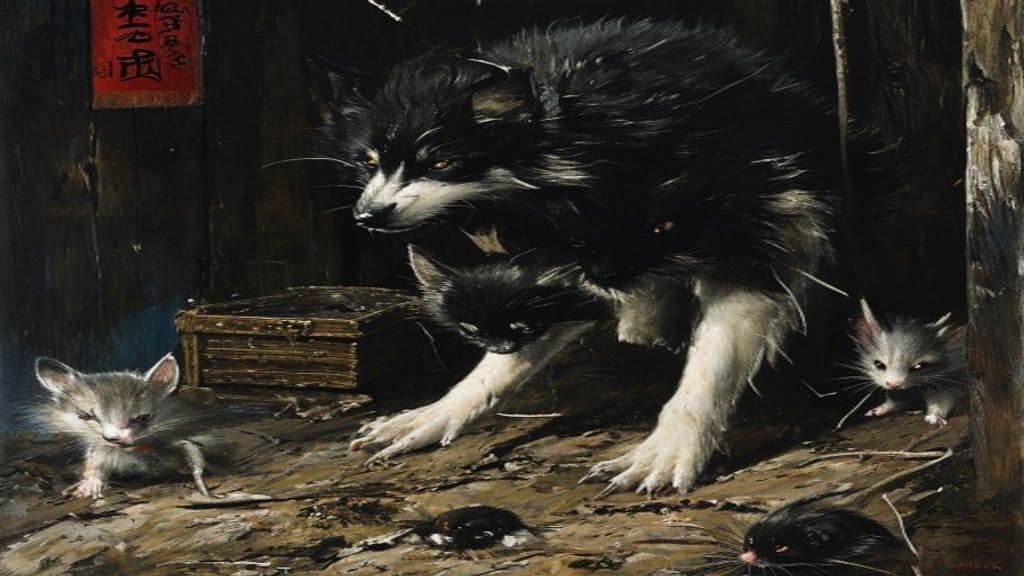
Multiple local origin accounts exist. A common folkloric origin attributes inugami to kodoku/kojutsu rites in which a dog is cruelly killed, buried, burned, or otherwise mistreated so that its grudges become a usable spirit that can be housed by a human practitioner; this kodoku practice was historically feared and is recorded as banned in the Heian period. Other regional narratives treat inugami as one variety among small familiar spirits related to kuda-gitsune or osaki and link them to legendary fragmentary origins (e.g., fractured monster-stone myths); sources therefore present kodoku as a primary folkloric production method but do not claim a single uniform origin for all inugami traditions.
Descriptions vary widely by region and text. Some accounts present an inugami as the spirit of a dog (the conceptual origin), while many local reports describe very small mammal-like creatures: mouse-sized with patches of black-and-white (Otogi Bōko), groups of many 'inugami mice' (Aishima), long-nosed house-mouse or shrew-like forms, weasel-like animals with black-and-white spots, or even bat-like bodies of about 1 shaku (certain district reports). Features sometimes noted include a split-tailed appearance and indistinct or hidden eyes. Accounts therefore record a range from tiny rice-grain–sized forms to small mammal or bat-like creatures rather than a single fixed dog-shaped apparition.
Inugami are reported to attach to people, livestock, and objects and to cause possession-like symptoms: jealousy of personality, chest pain, pain in arms and feet, sudden swaying, barking like a dog, and entering the body via the ears. They are said to follow family bloodlines, creating hereditary attachment that produces social taboos (avoidance of marriage into 'inugami' families) and discrimination. When intentionally created by kodoku, an inugami serves as a spirit-servant that will 'possess' and grant the wishes of its owner. Practitioners linked to creating or managing inugami in sources include miko, sorcerers, yamabushi, priests, and fuko.
Weaknesses
- otherNo canonical physical vulnerabilities recorded in provided sources
- conditionSocial prohibition (historical ban on kodoku) and social ostracism function as cultural constraints on creation/use
Wards
- conditionAvoiding marriage into families believed to host inugami (social warding)
- otherHistorical legal/religious prohibition on kodoku (Heian-period ban) as institutional prevention

Osaki
A class of small, pack-moving animal-spirit (a type of yokai) in Kantō-region Japanese folk belief that attaches to families or individuals, bringing material gain (gold, rice) while imposing social stigma and sometimes producing possession-like illness. The condition can be hereditary (osaki-mochi), shaping marriage and social practice in affected communities.
Kitsune
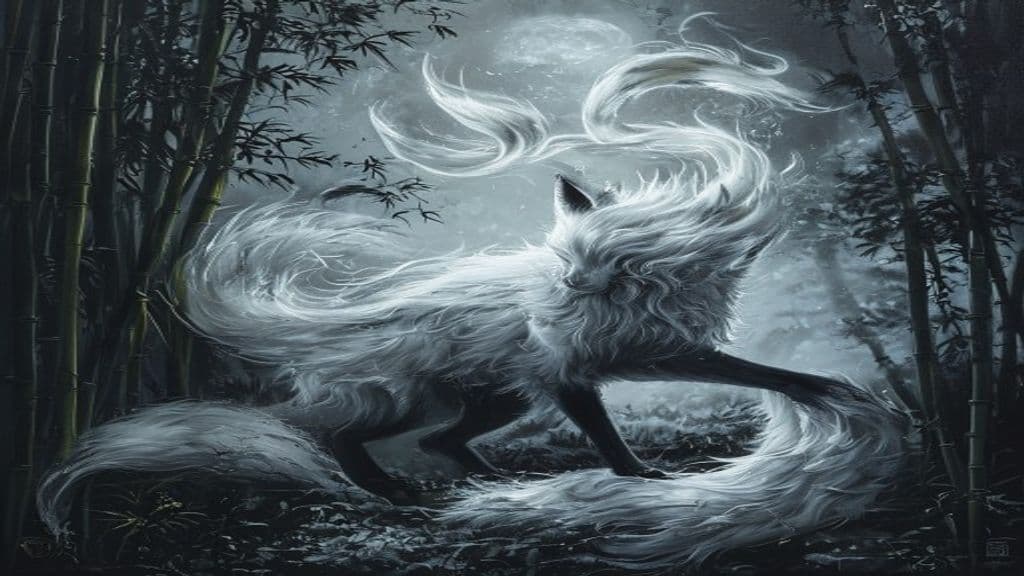
Fox spirits of Japanese mythology — intelligent, long-lived beings who gain additional tails (up to nine) as they age and grow in power. They serve as messengers of the god Inari and as powerful tricksters.
Kitsune
Fox spirits of Japanese mythology — intelligent, long-lived beings who gain additional tails (up to nine) as they age and grow in power. They serve as messengers of the god Inari and as powerful tricksters.
Akashaguma
Akashaguma is presented in the available sources as a child-like house guardian spirit in the Japanese yokai tradition, closely comparable to the regional zashiki-warashi. It is associated with domestic interiors (parlors or storage rooms) and with bringing prosperity to households where it dwells.
Azukibabaa
Azukibabaa (あずきばばあ, "bean hag") is a Japanese yōkai represented as an old-woman figure whose presence is signaled by the sound of azuki beans being handled (azukiarai). Found in regional folk narratives around Kantō and nearby prefectures, she lures or unnerves night travelers and in some localities is said to scoop up or swallow passersby.
Bakeneko
The bakeneko (ばけ猫, "changed cat") is a Japanese yōkai classed as a kaibyō (supernatural cat). Folklore presents it as a household cat that, through age, long residence, or other local conditions, acquires uncanny abilities such as shapeshifting, speech, and vengeance against cruel humans.
Betobeto-san
A Japanese yōkai manifesting as the sound of footsteps that follow lone travelers at night. Traditionally regarded as non‑harmful: walkers are advised to step aside and address it politely to have the footsteps pass.
Chōchinbi
Chōchinbi (提灯火, "paper-lantern fire") are regionally reported Japanese atmospheric spirit-lights treated as a variety of onibi. Tales describe them as lantern-like floating flames seen near footpaths, rice fields, riverbanks, and graveyards, sometimes vanishing when approached and sometimes associated with animal yōkai or resentful human spirits.
Hannya (般若)
Hannya is a traditional Japanese Noh mask type and the theatrical/folkloric embodiment of a woman transformed into a resentful, jealous spirit. The mask represents a stage of metamorphosis into an onryō-like figure, visually marked by horns and a leering mouth, and is situated at the intersection of Noh theatre, ritual dance (kagura), and Buddhist-influenced folk belief.
Hito-gitsune
A household-associated small carnivore spirit from western Japan (Chūgoku region) that attaches to certain families, providing wealth in belief but causing illness, behavioral change, social stigma, and transmission across households. It is represented in regional traditions as a marten/fox/weasel‑like possessing spirit rather than a singular individualized deity.
Ishinagenjo
Ishinagenjo is a Japanese coastal folkloric phenomenon in which fishermen hear the sound and feel the effects of a huge stone crashing into the sea though no stone is ever found. Sources treat it variously as an episode of yōkai activity (sometimes linked to sea-witch figures such as the Iso Woman) or as an illusion/perceptual error recorded in fisherfolk accounts from several coastal localities.
Isonade
A large, shark-like sea monster from Japanese regional folklore (notably Matsuura and other parts of western Japan). Its body is said to remain hidden beneath the waves, with only a huge, barbed tail fin visible; it approaches boats stealthily, can snare sailors with its hooked tail, capsize vessels, strike beaches, and is associated with fierce winds when it appears.
Japanese wolf
An endemic subspecies of gray wolf historically inhabiting Honshū, Shikoku, and Kyūshū, remembered in Japanese natural history and folklore as both a biological predator and a liminal spiritual figure associated with mountain deities and occasional protective roles toward travelers.
Kamaitachi
A class of Japanese yōkai associated with sudden cutting winds and whirlwinds that cause sharp, initially painless wounds. Narratives vary by region: kamaitachi may be imagined as weasel-like creatures riding dust devils, trios of mischievous gods, animated sickles (tsukumogami), or other local spirit causes.
Okuri-inu
The Okuri-inu (送り犬, literally "escorting dog") is a Japanese yōkai encountered on mountain paths at night that follows travellers. Regional accounts identify it as a dog or wolf (okuri-ōkami, yama-inu) or as related follower-spirits (okuri-itachi); it behaves ambivalently, sometimes protecting those who comport themselves correctly and sometimes attacking or eating those who fall or panic.
Community Record
- [1]Inugami — Wikipedia. Wikipedia: Inugamiwiki
- [2]Wikidata: Inugami (Q668694). Wikidata entry Q668694other
- [3]Archive notes and contemporaneous references cited in research notes. Research-note archive references (selected URLs provided in research material)other