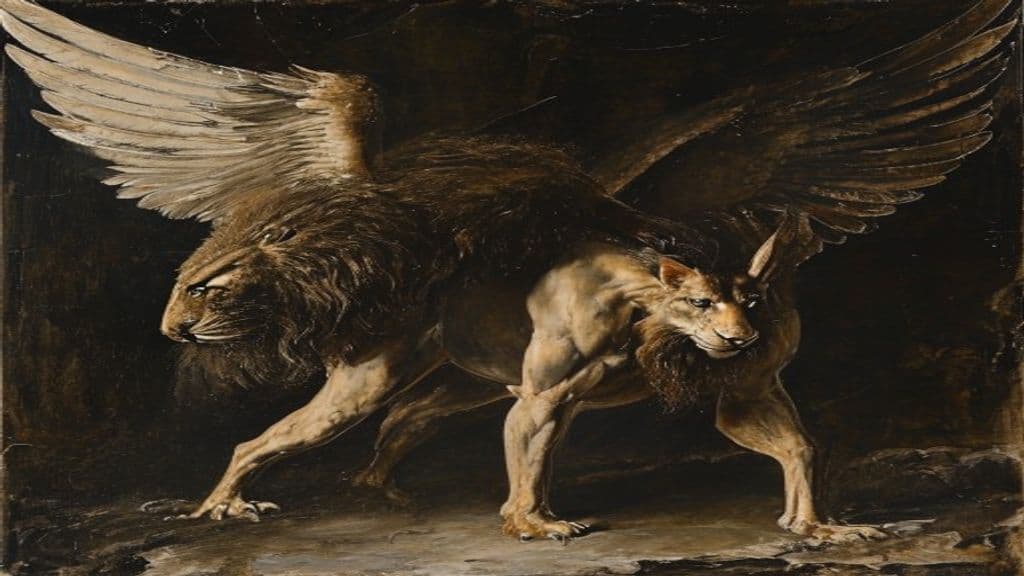
No mythic origin story is supplied in the provided sources. Ipos appears as a catalogued spirit within the grimoire tradition (not as a narrative-origin figure); the supplied materials record his rank, attributes, and appearance as entries in demonological listings such as The Lesser Key of Solomon.
Accounts record composite, hybrid forms. He is commonly depicted with the body of an angel, the head of a lion, the tail of a hare, and the feet of a goose. Less frequently he is given the same composite but with a fully leonine body, and rarely he is represented as a vulture.
Sources attribute to Ipos the power to know and reveal information across time—formulations vary: some accounts say he knows and can reveal past, present, and future; other accounts restrict this to future only or to past and future. He is also said to be able to make men witty and valiant, and to command thirty-six legions of demons.
Weaknesses
- otherNot attested in sources
Wards
- otherNot attested in sources
Iphiloche
Iphiloche is a named mortal woman in Greek mythic genealogies, attested as the bride of Megapenthes (an illegitimate son of Menelaus). She functions as a genealogical connector in classical sources and later scholia, with variant name-forms attested in the manuscript tradition.
Iphimedeia
Iphimedeia is a Thessalian princess of Greek heroic tradition whose role links mortal lineages with divine power and chthonic memory. She is best known as lover of Poseidon and mother (in some accounts) of the twin giants Otus and Ephialtes (the Aloadae), and she appears both in epic underworld catalogues and as a named focus of local cultic remembrance (tombs, paintings, honors).
Iphimedon
Iphimedon is a minor mythological mortal attested as a son of King Eurystheus of Tiryns (by Antimache) in Greek genealogical and heroic-cycle sources. He appears only in lists of the royal household and has no surviving independent myths or consistent narrative role beyond genealogical notice; one fragmentary source hints he 'fell in battle' but gives no context.
Iphinoe
Iphinoe is a personal name borne by multiple female figures in Greek myth: attested as one of the Proetid daughters afflicted with madness, as a herald who announces the Argonauts' arrival to Hypsipyle on Lemnos, and cited in modern taxonomy as the name of a nymph associated with the cave Kastria. The name therefore denotes several narrative personae rather than a single, coherent supernatural class.
Iphis
Iphis is a mythological person from a Cretan tale preserved most fully in Ovid's Metamorphoses: born female and secretly raised as male, Iphis is transformed into a man by the goddess Isis so that he may lawfully marry his beloved Ianthe. The narrative functions as a mythic exemplum addressing gender, social expectations, and divine intervention.
Iphitus of Oechalia
Iphitus (Iphitos) of Oechalia is a mortal prince in Greek myth, son of King Eurytus and brother of Iole, sometimes counted among the Argonauts. He is best known as the named victim whom Heracles kills during a fit of madness, an act that precipitates Heracles' search for purification and eventual servitude to Omphale.
Iraj (son of Fereydun)
Iraj is the youngest son of the mythical king Fereydun and the eponymous ancestral figure of the Iranians in Avestan, Middle Persian and epic Persian literature. He receives a portion of the world in his father's division, is murdered by his brothers, and his line (through Manuchehr) exacts vengeance, establishing dynastic legitimacy in Iranian legendary history.
Iram of the Pillars
A supernatural place mentioned in the Quran, associated with punishment on Judgment Day. (Note: - Power tier should be Lesser (local spirit) as Iram of the Pillars is described as a lost city, not a cosmic entity. - There's no mention of punishment on Judgment Day as its primary association; it')
Iratxoak
In Basque mythology, benevolent imps that assist with farm labor at night if treated kindly. (Note: - Power tier: Lesser (not Ancient), as Iratxoak assist with farm labor, but do not seem to have cosmic or deity-level abilities. - Appearance: The article contradicts itself by stating that the appear)
Iravan (Aravan / Kuttantavar)
Iravan (Sanskrit: Irāvān; Tamil: Aravāṇ) is a minor Mahabharata hero—son of Arjuna and the Naga princess Ulupi—who in South Indian (Tamil) religion is transformed into a village/guardian deity (often called Aravan or Kuttantavar) and is principally worshipped in the form of his severed head. In Tamil cults he functions as a propitiatory figure for fertility, healing, and village protection and as a central patron figure in ritual practices of transgender communities.
Iravati
Hindu goddess associated with the sacred river Ravi, connected to cosmological narratives. (Note: 1. Power tier should be Primordial (agreed) but the draft article does not provide a compelling argument to justify it; provide source material supporting Iravati's cosmic-level abilities. 2. The desc)
Irawaru
Figure in Māori mythology transformed into a dog by his brother-in-law Māui. (Note: 1. Power tier: Based on the source material, Irawaru's transformation is a result of Māui's supernatural powers, but there is no indication that he was a powerful regional figure (Greater) before bein)
Community Record
- [1]Ipos. Wikipedia article 'Ipos' (accessed source material summarizing grimoire attributions including The Lesser Key of Solomon; specific phrasings quoted in research notes).wiki
- [2]Ipos (Wikidata). Wikidata entry for Ipos (identifier record referenced in supplied materials).other
- [3]The Goetia: The Lesser Key of Solomon the King (1904 edition). S. L. MacGregor Mathers & A. Crowley, The Goetia: The Lesser Key of Solomon the King (1904) — cited in the supplied sources as the grimoire tradition in which Ipos is listed.literary