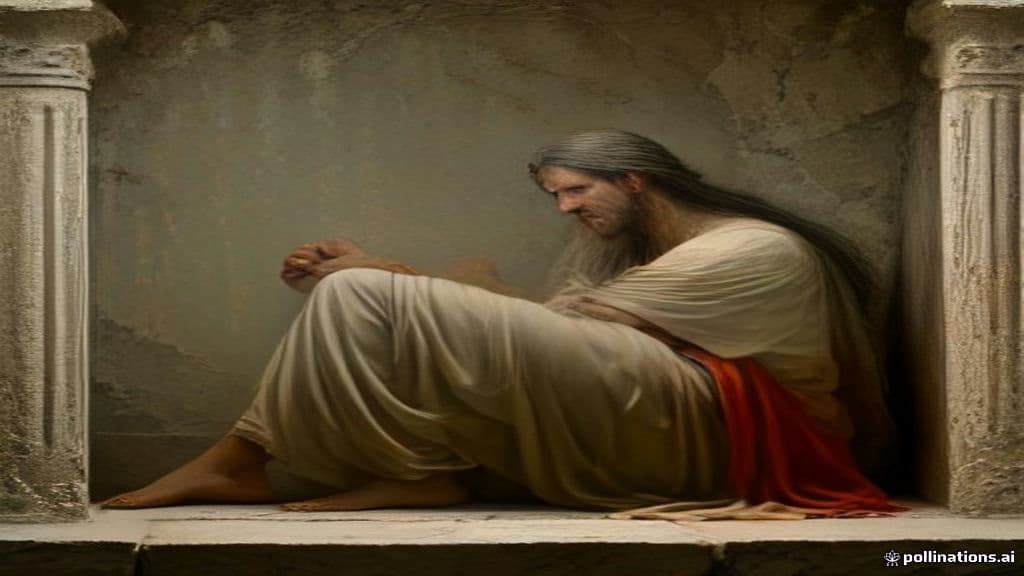
Two separate origin strands are attested in source traditions. The beggar figure appears in Homer’s Odyssey (Book 18) as Arnaeus, the low-status errand-runner of the suitors who is mockingly called Irus (a pun on the goddess Iris); this is the narrative origin of the palace-beggar character and his role in Odyssean social drama. The other Irus is attested in mythographic and dictionary accounts as a son of Actor and father (by Demonassa) of Eurytion and Eurydamas; this Irus functions as a node in heroic genealogies and is cited in classical mythographical compendia (e.g., dictionary-style treatments of Greek myth).
As presented in sources, the beggar Irus (Arnaeus) is a low-status Ithacan beggar and errand-runner for Penelope’s suitors, renowned in the epic tradition for voracity and a readiness to engage in petty violence; the suitors mockingly nickname him Irus (an ironic allusion to the rainbow-goddess Iris). Classical summaries emphasize his social dress and comportment as a beggar within the palace and his aggressive posture when goaded into confronting Odysseus. The genealogical Irus is named only as a mortal lineage figure (son of Actor, father of Eurytion and Eurydamas) and carries no physical description in the cited source excerpts.
Neither attested figure possesses supernatural powers in the provided material. The beggar Irus’s effective capacities are social and physical: he performs errands for the suitors, is noted for great voracity, and is willing to threaten or engage in fighting when incited (the confrontation with Odysseus in Book 18 is the primary narrative example). The genealogical Irus’s 'ability' is narrative: he links named figures within heroic genealogies and is recorded in mythographic sources; one fragmentary account credits an Irus with propitiating Peleus over a murder, indicating a role in mythic interpersonal settlement in some traditions (the details of that propitiation are not preserved in the excerpts).
Weaknesses
- otherno supernatural vulnerabilities attested; mortal status
Wards
- othernone attested — both figures are mortal humans and no protective rites or wards are recorded in the cited sources
Community Record
- [1]Irus (mythology) - Wikipedia. Wikipedia contributors, 'Irus (mythology),' Wikipedia, The Free Encyclopedia.wiki
- [2]The Odyssey, Book 18 (notes). mythweb.com, 'The Odyssey, Book 18 notes' (summary and commentary).literary
- [3]The Odyssey - Wikiversity. Wikiversity, 'The Odyssey' (summary and episode notes).wiki
- [4]Irus | Facts, Information, and Mythology (Pantheon.org). Pantheon.org, 'Irus' (mythographic summary).other
- [5]Who is Irus? (Ivypanda). Ivypanda summary of the Odyssey character Irus.other