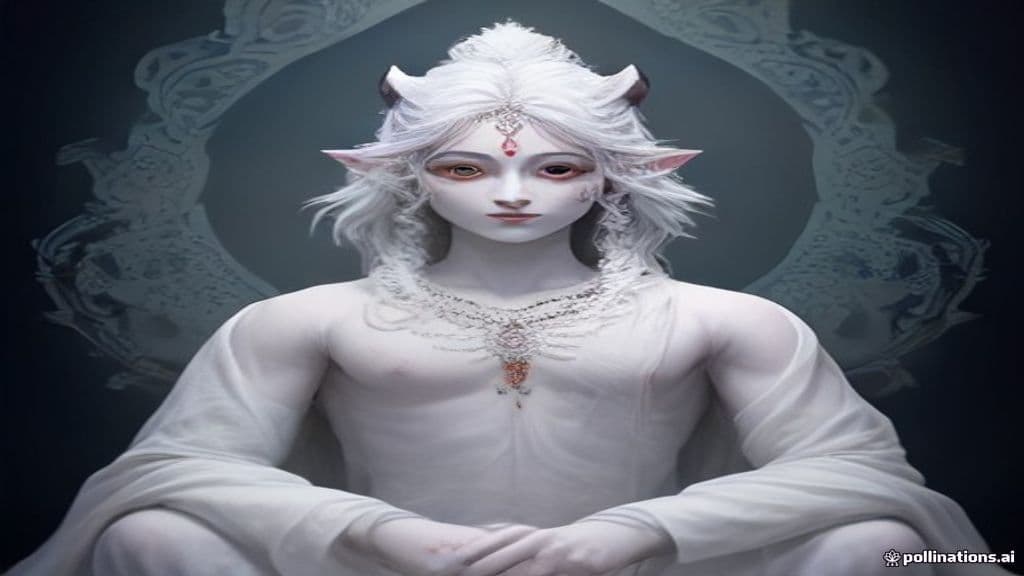
Ishana is described in Purāṇic sources and Vedic/Āraṇyaka citations as one of the fivefold aspects of Śiva (the Pañchabrahmas). In the Brahmavaivarta Purāṇa a birth-origin myth records Ishana as born from the left eye of Krishna and lists characteristic attributes; Vedic material (the Pañchabrahma mantrāṇī cited in the Taittirīya Āraṇyaka) treats Ishana as a directing lord and revealer of knowledge within the Pañchabrahma formula. Overall Ishana is portrayed as an aspect or manifestation of Śiva rather than an independently originating being.
Across sources Ishana is commonly depicted with three eyes and a tranquil, white-complexioned aspect, sometimes shown wearing a white cloth and a tiger-skin and with a jata-makuṭa (matted-hair crown) on which a crescent moon may be placed. He may be seated on a white bull or in padmāsana. Hand-attributes vary by source: two-armed depictions may carry a trident and a kapāla (skull-cup) or show a varada-mudrā; four-armed images are sometimes described with veena-playing front hands and varada and abhaya mudrās (though some scholars note inconsistencies in the veena detail). Purāṇic verses record variant and atypical iconographies (e.g., a Linga Purāṇa verse describing many limbs or heads) and when represented among the Pañchabrahmas as a face on a Liṅga, Ishana’s face is left uncarved and faces upward.
Purāṇic and Vedic/Āraṇyaka sources attribute to Ishana the bestowal of knowledge and riches (Shiva Purāṇa), guardianship over ear, speech, sound and ether (Shiva Purāṇa; Linga Purāṇa), nourishment and control of living beings (Taittirīya Āraṇyaka Pañchabrahma citation), and the role of directing lord of the northeast who may direct other gods in the Pañchabrahma formula. As one of the Pañchabrahmas Ishana is described as a source of spontaneous grace directed to all beings and worlds. He appears in Purāṇic narrative contexts (e.g., present at Daksha’s sacrifice and Parvati’s svayāmvara) and in ritual contexts his mantra(s) are invoked for consecratory and sanctifying acts.
Weaknesses
None recorded.
Wards
- mantraIshana Mantra(s) (Pañchabrahma mantrāṇī / Yajurvedic verses cited in the Shiva Purāṇa)
- ritualRecitation of Ishana-related mantras when fixing Liṅgas to pedestals, when wearing rudrāksha on the head, or when applying sacred ash (as prescribed in the Shiva Purāṇa contexts)

Shiva
Shiva (Sanskrit: Śiva) is one of the principal deities of Hinduism, central to Shaivism and pan-Hindu worship. Portrayed as a paradoxical figure—ascetic yogi, householder, warrior and cosmic agent—he is described as the auspicious One who creates, protects and transforms the universe and is commonly associated with dissolution within the Trimurti framework.
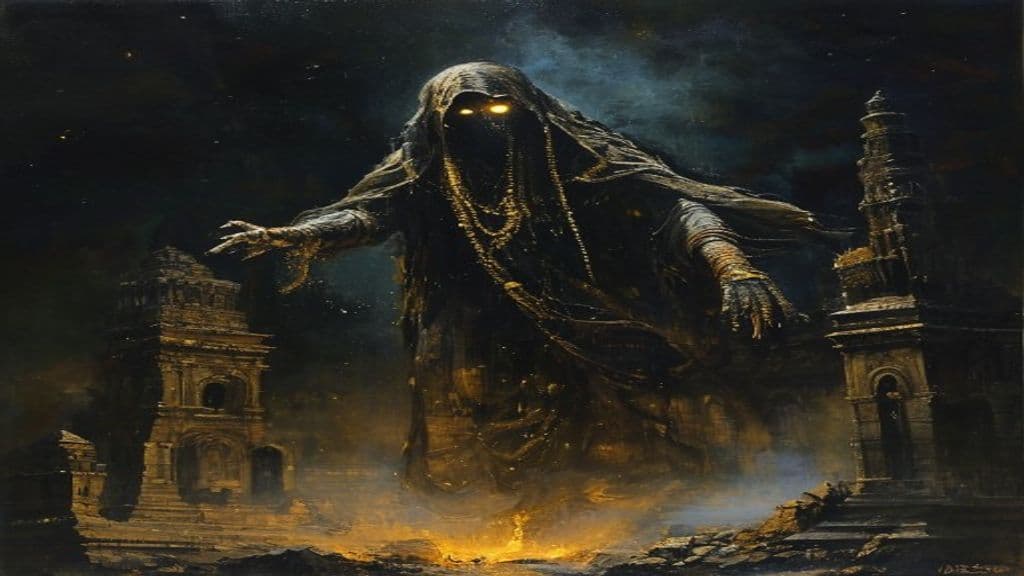
Brahmarakshas
The most learned and terrible of spirits — the ghost of a Brahmin who misused his scriptural knowledge in life and was condemned after death to be both demon and scholar, haunting places of learning.
Community Record
- [1]Ishana — Wikipedia. Wikipedia article 'Ishana' (selected summaries and citations to Purāṇic and Vedic sources as presented there)wiki
- [2]Ishana — Wikidata. Wikidata entry Q608366 (brief classification as form of Shiva and directional guardian)wiki
- [3]Ishana Rudraksa Meghananda — archival court document. Archive listing (modern administrative use of the name; not used for religious description)other
- [4]Ishana X. Jackson — archival court document. Archive listing (modern administrative use of the name; not used for religious description)other
- [5]Rajasthan Ordinary Gazette (2025-12-25) — archival notice. Archive gazette (modern administrative occurrence of the name; not used for religious description)other