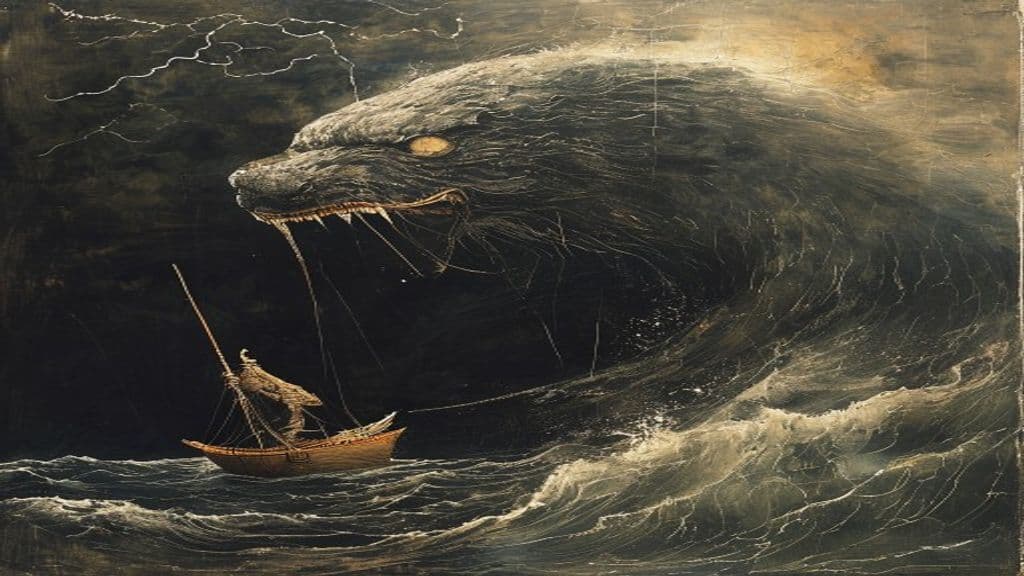
Ishinagenjo appears in coastal fisherfolk narratives rather than as a single biographical mythic character: canonical accounts describe nights—often in the month of May during the rainy season or in thick fog—when fishermen hear a tremendous splash and the crack of a huge rock hitting the sea that rocks boats, yet at dawn no rock is found. Folklorists such as Kunio Yanagita and compendia of Japanese folklore record this episode as a phenomenon often explained locally as the doing of an oceanic yōkai (for example, sometimes associated with the Iso Woman), while reference works such as Kojien present a contrasting interpretation that treats the episode as an illusion or imagined event by the fishermen. The term itself is preserved in hiragana in some modern mentions (石投げんじょ) and has been variously resolved into kanji by commentators, producing differing cultural frames for the episode.
No consistent, detailed corporeal description of an agent is attested in the cited sources. The typical report focuses on the audible and physical effect—the thunderous sound of a massive stone hitting water and resulting boat movement—without a visible stone or reliably observed creature. Where attempts are made to identify an agent, some folklore compendia suggest a sea monster or sea-witch such as the Iso Woman might be responsible, while Kojien and commentators including Kenji Murakami note the absence of documentary visual evidence and treat the sighting as imagined or illusory rather than describing any fixed appearance.
The phenomenon's central 'ability' is to produce the sensory impression and physical disturbance of a large rock falling into the sea—loud splash, cracking noise, and boat rocking—while leaving no stone or debris behind. Folkloric interpretation recorded in Yanagita and the Comprehensive Lexicon frames this as an action attributed to an oceanic yōkai (sometimes linked to the Iso Woman), whereas Kojien and related commentary interpret the episode as a perceptual illusion experienced by fishermen under adverse conditions. No additional powers, persistent malicious intent, or documented capacity to physically injure beyond frightening sailors are described in the cited materials.
Abura-sumashi
A yōkai spirit from the Amakusa region of Kumamoto Prefecture, Japan, said to inhabit mountain passes. Traditionally explained as the ghost of a person who stole oil, it appears to surprise travelers and is represented in modern media with a straw-coat body and a potato- or stone-like head.
Akashaguma
Akashaguma is presented in the available sources as a child-like house guardian spirit in the Japanese yokai tradition, closely comparable to the regional zashiki-warashi. It is associated with domestic interiors (parlors or storage rooms) and with bringing prosperity to households where it dwells.
Amanozako
Amanozako is a Japanese divine/monstrous figure described in classical summaries as a furious, contrarian kami produced from the ferocious aspect (ara-mitama) of the storm-god Susanoo; later glosses present her as an ancestor-figure for ill-tempered yōkai such as tengu and amanojaku.
Azukibabaa
Azukibabaa (あずきばばあ, "bean hag") is a Japanese yōkai represented as an old-woman figure whose presence is signaled by the sound of azuki beans being handled (azukiarai). Found in regional folk narratives around Kantō and nearby prefectures, she lures or unnerves night travelers and in some localities is said to scoop up or swallow passersby.
Bake-danuki
Bake-danuki (化け狸) are a class of yōkai in Japanese folklore: tanuki (Japanese raccoon dogs) that acquire supernatural powers, most notably shapeshifting and trickery. They appear throughout Japan with strong regional concentrations and some locally named, ritualized exemplars.
Bakeneko
The bakeneko (ばけ猫, "changed cat") is a Japanese yōkai classed as a kaibyō (supernatural cat). Folklore presents it as a household cat that, through age, long residence, or other local conditions, acquires uncanny abilities such as shapeshifting, speech, and vengeance against cruel humans.
Betobeto-san
A Japanese yōkai manifesting as the sound of footsteps that follow lone travelers at night. Traditionally regarded as non‑harmful: walkers are advised to step aside and address it politely to have the footsteps pass.
Biwa-bokuboku
A tsukumogami yōkai originating in Japanese folklore: an anthropomorphic instrument‑spirit modeled on the biwa that becomes animate after long use or long neglect. It is nocturnal, often described as singing and plucking while lamenting neglect, and may meet other tsukumogami for noisy gatherings.
Chōchinbi
Chōchinbi (提灯火, "paper-lantern fire") are regionally reported Japanese atmospheric spirit-lights treated as a variety of onibi. Tales describe them as lantern-like floating flames seen near footpaths, rice fields, riverbanks, and graveyards, sometimes vanishing when approached and sometimes associated with animal yōkai or resentful human spirits.
Hannya (般若)
Hannya is a traditional Japanese Noh mask type and the theatrical/folkloric embodiment of a woman transformed into a resentful, jealous spirit. The mask represents a stage of metamorphosis into an onryō-like figure, visually marked by horns and a leering mouth, and is situated at the intersection of Noh theatre, ritual dance (kagura), and Buddhist-influenced folk belief.
Hito-gitsune
A household-associated small carnivore spirit from western Japan (Chūgoku region) that attaches to certain families, providing wealth in belief but causing illness, behavioral change, social stigma, and transmission across households. It is represented in regional traditions as a marten/fox/weasel‑like possessing spirit rather than a singular individualized deity.
Hyakki Yagyō
An idiom and folkloric motif in Japanese tradition describing a mass nocturnal procession of supernatural creatures (yōkai and related beings) that march through human streets at night. Depictions and stories vary: sometimes an orderly parade, sometimes a chaotic riot, and encounters are commonly described as dangerous to humans.
Community Record
- [1]Ishinagenjo — Wikipedia. Wikipedia, 'Ishinagenjo' entry (summary describing fisherfolk episode, locales, and scholarly attributions)wiki
- [2]Wikidata: Ishinagenjo. Wikidata entry identifying Ishinagenjo as a folkloric phenomenon in Japanother
- [3]Comprehensive Lexicon of Japanese Folklore / Kunio Yanagita (as cited). Summaries citing Kunio Yanagita and the Comprehensive Lexicon that treat the phenomenon as the doing of an oceanic yōkai or Iso Woman.folk
- [4]Kojien dictionary & Kenji Murakami (as cited). Kojien's reading of the term as 石投尉 ('stone-throwing old man') and commentary (as cited) arguing the episode may be an illusion; Kenji Murakami notes lack of documentary visual evidence.academic