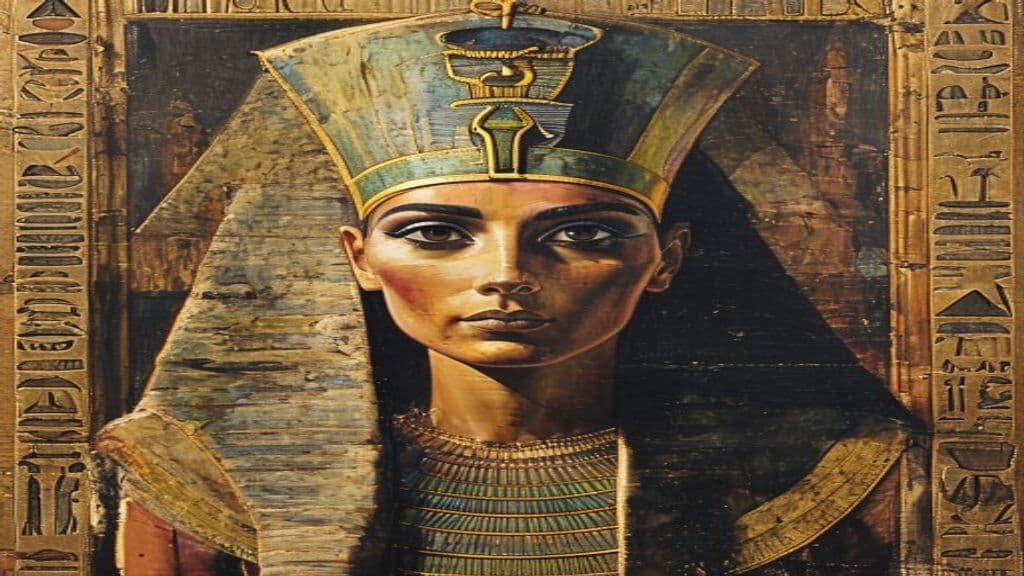
Isis appears in ancient Egyptian religious texts from the Old Kingdom onward (first attested in Pyramid Text passages associated with the end of the Fifth Dynasty) as a member of the Ennead of Heliopolis. Within the Osiris cycle she develops a central, active role: together with Nephthys she seeks out the dismembered body of Osiris, reassembles it, and by her actions enables his restoration, after which she gives birth to and protects Horus. This set of traditions about Isis and Osiris became the mythic prototype for Egyptian funerary practices (including mummification) and evolved through the New Kingdom and later periods into wider temple cults and Hellenistic/Roman adaptations.
In Egyptian art Isis is usually portrayed as a human woman wearing the throne-sign hieroglyph on her head, the hieroglyph that spells her name; this throne emblem functions both as an identifying attribute and as part of the name-writing. Over time and in different contexts her depiction shows variation: during the New Kingdom she sometimes adopts Hathor's headdress (a sun disk flanked by cow horns), and in Hellenistic and Roman iconography syncretic portrayals incorporate attributes borrowed from related goddesses and Mediterranean artistic conventions. Despite variations, the female anthropomorphic figure bearing the throne-emblem (and later, at times, the Hathor disk-and-horns) remains a consistent identifying motif in surviving representations.
Ancient Egyptian tradition and later belief attribute to Isis a wide-ranging set of powers and roles. She is the active agent in the Osiris myth who reassembles and helps restore Osiris and who produces and protects his son Horus; she is described as a divine mother and protector of the pharaoh and as a helper of the dead entering the afterlife. Texts and tradition report that her magical skill was highly renowned—later sources say her magic was greater than that of other gods—and she was invoked in healing spells for ordinary people. Over centuries Isis absorbed traits from other goddesses (notably Hathor) and, in Hellenistic and Roman contexts, acquired additional protective and civic functions (for example, festival roles and associations like the Navigium Isidis) as her cult spread beyond Egypt.

Community Record