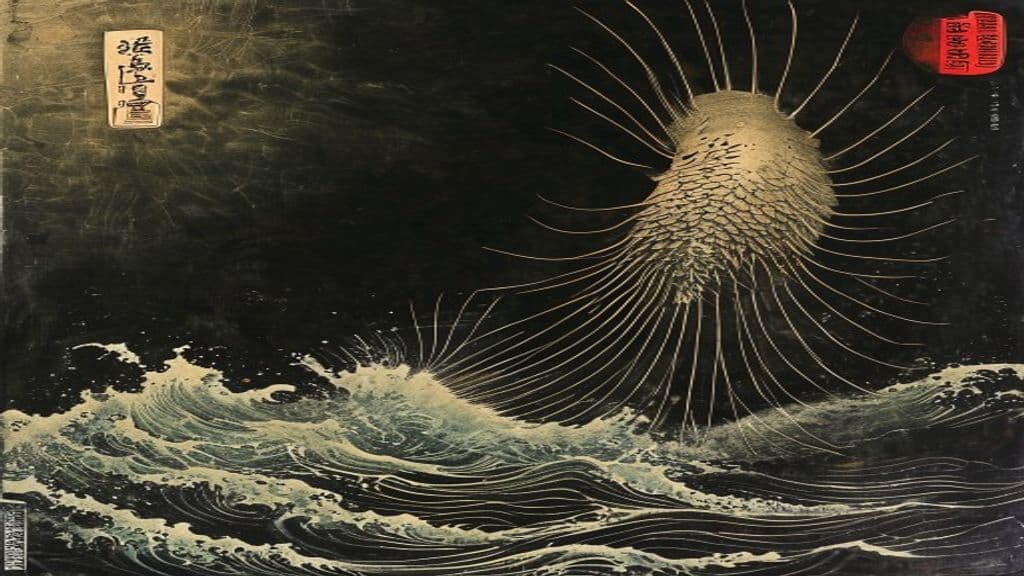
The Isonade appears in Japanese folkloric compilations (notably the Ehon Hyaku Monogatari tradition as summarized in modern references) as a monstrous sea-being rather than the product of a cosmogonic myth. The sources do not supply a creation or ancestral origin; instead the Isonade functions in regional story cycles as an explanation or personification of sudden maritime danger—hidden perils beneath otherwise placid seas and violent winds that arise with little warning. The primary textual tradition cited describes it as a dangerous sea creature encountered off western coasts, with no preserved origin narrative or genealogy in the cited summaries.
According to the Ehon Hyaku Monogatari summary recorded in modern references, the Isonade's body "has never been seen," because it remains hidden beneath the waves; only its "huge tail fin which is covered in small barbs" is visible. Secondary descriptions in the same tradition characterize it as enormous and shark-like, but the consistent, cited detail is that the creature is concealed under the sea and reveals chiefly a barbed, hooked tail that projects above the water.
Cited accounts describe the Isonade as approaching boats stealthily and using its hooked, barbed tail to snare sailors and drag them into the sea, "where it devours them" (per the summarized source). It may capsize boats with its tail, and it can strike the beach with its tail and kill people on shore. The creature's appearance is linked in the sources with fierce winds, making it both a direct physical threat through its tail and an agent associated with violent maritime weather. These behaviors are reported in the Ehon Hyaku Monogatari summary as preserved in the referenced modern entries.
Akashaguma
Akashaguma is presented in the available sources as a child-like house guardian spirit in the Japanese yokai tradition, closely comparable to the regional zashiki-warashi. It is associated with domestic interiors (parlors or storage rooms) and with bringing prosperity to households where it dwells.
Azukibabaa
Azukibabaa (あずきばばあ, "bean hag") is a Japanese yōkai represented as an old-woman figure whose presence is signaled by the sound of azuki beans being handled (azukiarai). Found in regional folk narratives around Kantō and nearby prefectures, she lures or unnerves night travelers and in some localities is said to scoop up or swallow passersby.
Bakeneko
The bakeneko (ばけ猫, "changed cat") is a Japanese yōkai classed as a kaibyō (supernatural cat). Folklore presents it as a household cat that, through age, long residence, or other local conditions, acquires uncanny abilities such as shapeshifting, speech, and vengeance against cruel humans.
Betobeto-san
A Japanese yōkai manifesting as the sound of footsteps that follow lone travelers at night. Traditionally regarded as non‑harmful: walkers are advised to step aside and address it politely to have the footsteps pass.
Chōchinbi
Chōchinbi (提灯火, "paper-lantern fire") are regionally reported Japanese atmospheric spirit-lights treated as a variety of onibi. Tales describe them as lantern-like floating flames seen near footpaths, rice fields, riverbanks, and graveyards, sometimes vanishing when approached and sometimes associated with animal yōkai or resentful human spirits.
Hannya (般若)
Hannya is a traditional Japanese Noh mask type and the theatrical/folkloric embodiment of a woman transformed into a resentful, jealous spirit. The mask represents a stage of metamorphosis into an onryō-like figure, visually marked by horns and a leering mouth, and is situated at the intersection of Noh theatre, ritual dance (kagura), and Buddhist-influenced folk belief.
Hito-gitsune
A household-associated small carnivore spirit from western Japan (Chūgoku region) that attaches to certain families, providing wealth in belief but causing illness, behavioral change, social stigma, and transmission across households. It is represented in regional traditions as a marten/fox/weasel‑like possessing spirit rather than a singular individualized deity.
Inugami
Inugami (犬神) are Japanese household-associated dog-spirits that appear in western Japan. In folklore they may be intentionally created by kodoku/kojutsu rituals or become hereditary household possessors that attach to people, animals, or objects and produce illness, jealousy, or social stigma.
Ishinagenjo
Ishinagenjo is a Japanese coastal folkloric phenomenon in which fishermen hear the sound and feel the effects of a huge stone crashing into the sea though no stone is ever found. Sources treat it variously as an episode of yōkai activity (sometimes linked to sea-witch figures such as the Iso Woman) or as an illusion/perceptual error recorded in fisherfolk accounts from several coastal localities.
Japanese wolf
An endemic subspecies of gray wolf historically inhabiting Honshū, Shikoku, and Kyūshū, remembered in Japanese natural history and folklore as both a biological predator and a liminal spiritual figure associated with mountain deities and occasional protective roles toward travelers.
Kamaitachi
A class of Japanese yōkai associated with sudden cutting winds and whirlwinds that cause sharp, initially painless wounds. Narratives vary by region: kamaitachi may be imagined as weasel-like creatures riding dust devils, trios of mischievous gods, animated sickles (tsukumogami), or other local spirit causes.
Okuri-inu
The Okuri-inu (送り犬, literally "escorting dog") is a Japanese yōkai encountered on mountain paths at night that follows travellers. Regional accounts identify it as a dog or wolf (okuri-ōkami, yama-inu) or as related follower-spirits (okuri-itachi); it behaves ambivalently, sometimes protecting those who comport themselves correctly and sometimes attacking or eating those who fall or panic.
Community Record
- [1]Isonade (Wikipedia entry summarizing Ehon Hyaku Monogatari description). Wikipedia: Isonade, summary of Ehon Hyaku Monogatari descriptionwiki
- [2]Isonade (Wikidata). Wikidata: Q2337784other