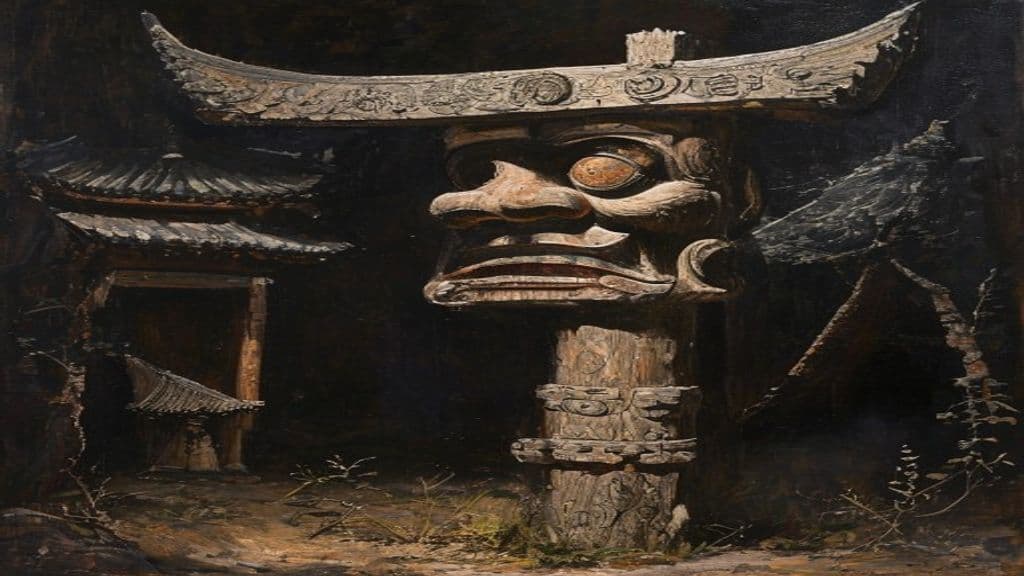
In Korean folklore, a jangseung is not an entity in and of itself, but rather a physical object that serves as a guardian or tutelary deity for a village.
A jangseung is typically a wooden totem pole, often with carvings or figures on it, serving as a visible boundary marker for villages and a deterrent to potential threats.
As a guardian, the jangseung is believed to ward off evil spirits or demons, implying that it has both symbolic and physical significance. Its presence serves as a reminder of the importance of communal security and well-being in traditional Korean culture.
Arang (Korean folklore)
Vengeful spirit driven by a desire for justice in Korean folklore, particularly during the Joseon Dynasty. (Note: 1. Power tier should be Primordial since it is described as having a cosmic level of influence in causing fear among magistrates. 2. The description for weaknesses is missing; add that Arang's weaknes)
Dokkaebi
Dokkaebi (도깨비) are legendary supernatural beings in Korean folklore associated with nature, household objects, and trickster behavior; they can be mischievous or benevolent, rewarding virtue and punishing greed in folktales.
Goryeo Supernatural Ancestor
A supernatural entity credited with uniting the Korean Peninsula and founding the Goryeo dynasty. (Note: 1. Remove "Primordial" power tier as it implies cosmic-level abilities, which is not supported by the source material that only mentions unification. 2. Add a statement about unknown weaknesses and wa)
Gumiho (Nine‑tailed fox)
A fox‑spirit in Korean storytelling derived from wider East Asian nine‑tailed‑fox motifs. Traditionally depicted as a shapeshifting fox that can take human form (commonly female in many stories), the gumiho appears across older folktales and numerous contemporary Korean media where it functions variously as trickster, predator, or sympathetic protagonist.
Gwisin
In Korean folklore, gwisin are spirits or ghosts that are humans who have died. Sources describe the term as a class of departed-human spirit, noted as similar to yogoe or mamul and explicitly contrasted with non-human beings such as dokkaebi.
Hwanung
Divine being in Korean tradition, son of Hwanin, Lord of Heaven. Associated with human development and progress. (Note: - Power tier: Primordial may be too high given the description of abilities (institution of laws, teaching arts and medicine) which more closely align with a Greater (deity-level, but not cosmic) or A)
Imugi (proto-dragon)
Imugi (이무기; also transcribed Imoogi) is a Korean folkloric proto‑dragon — a large serpentine, aspirant creature described in modern summaries as a 'lesser dragon' that may become a true Korean dragon through a transformative act.
Inmyeonjo
A mythological creature in Korean tradition with human and bird characteristics. (Note: - Power tier: Lower than Primordial (should be Lesser or Greater) since no deity-level abilities are described. - Origin story: Remove statement since it's true that no specific origin story is mentio)
Nine-tailed Fox
A long-lived fox-spirit figure from Chinese myth (九尾狐) that appears across East Asia (e.g., kitsune, kumiho). Associated with age-linked transformation, shapeshifting into humans, ambiguous morality (trickster/seducer or occasionally honorable), and in some doctrinal sources a celestial/ritual role with talismans and jiao rites.
Janaka
Janaka is a legendary and dynastic king of Videha (capital Mithila) who functions in Indic sources as an exemplar of ideal kingship and spiritual realization—a ruler who combines political authority, patronage of Vedic learning, and non-attachment. The name is used both as a regnal title for Videha's kings and as the personal/regnal name of the famous monarch who is the adoptive father of Sītā in the Rāmāyaṇa.
Jangsanbeom (Jangsan tiger / Jangsan spirit)
The name Jangsanbeom (often rendered in English as 'Jangsan tiger' or 'Jangsan spirit') appears in a contemporary South Korean cultural product (the 2017 film The Mimic). The single provided source references only the film and does not supply traditional folkloric details about the entity; further research into primary folkloric materials is required to determine whether Jangsanbeom is an established traditional being or a modern invention for the film.
Janjanbi
Janjanbi (じゃんじゃん火) is a Japanese local tradition of onibi — animate ghost‑lights tied to human deaths and unsettled spirits. Documented variants from Nara Prefecture present janjanbi as balls of fire or hitodama that appear at specific sites, make a characteristic "jan‑jan" sound, and are woven into local rites and avoidance customs.
Community Record
- [1]