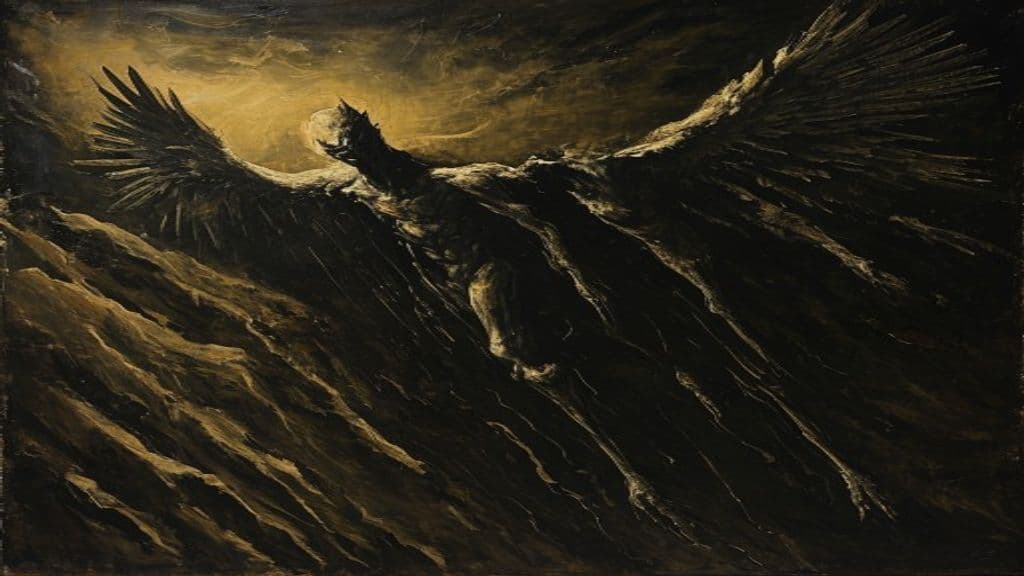
According to the Book of Genesis, Japheth is one of the three sons of Noah and is associated with the European peoples. The concept of Japhetites reflects a biblical and medieval worldview, where the world was divided into large-scale groupings based on the descendants of Noah's sons.
There is no physical description of the Japhetites provided in the source material.
The Japhetites are not described as having supernatural abilities or behaviors. They are simply considered a group of people descended from Japheth, associated with European peoples.
Jangseung (Korean tradition)
A physical object serving as a guardian or tutelary deity for Korean villages, typically made of wood and placed at village edges. (Note: * Power tier: Minor Spirit (a Greater entity would have more significant abilities) * Abilities: The jangseung is not believed to ward off evil spirits/demons, but rather serves as a deterrent and a r)
Janjanbi
Janjanbi (じゃんじゃん火) is a Japanese local tradition of onibi — animate ghost‑lights tied to human deaths and unsettled spirits. Documented variants from Nara Prefecture present janjanbi as balls of fire or hitodama that appear at specific sites, make a characteristic "jan‑jan" sound, and are woven into local rites and avoidance customs.
Jann
The weakest class of djinn in Islamic tradition, associated with desert winds and taking the form of snakes or whirlwinds, dwelling in empty wilderness and posing little threat to those who know the proper invocations.
Janus
Janus (Latin: Iānus) is the ancient Roman god who presides over beginnings, passages, thresholds, and temporal transitions. He is a liminal deity invoked at the start of rituals and is symbolically associated with gates, doorways, duality, and the ordering of time.
Japanese dragon
A class of large serpentine beings in Japanese myth that function variously as water deities, regional kami, Buddhist nāga/dragon kings, and shapeshifting supernatural creatures associated with seas, rivers, rain and related powers.
Japanese wolf
An endemic subspecies of gray wolf historically inhabiting Honshū, Shikoku, and Kyūshū, remembered in Japanese natural history and folklore as both a biological predator and a liminal spiritual figure associated with mountain deities and occasional protective roles toward travelers.
Jarella
Jarella is a fictional princess of the sub‑atomic world K'ai in Marvel Comics, best known as a beloved romantic partner and moral anchor for the Hulk. She functions in the stories as a noble, athletic leader-figure of K'ai whose people combine outwardly primitive culture with remnants of advanced technology and sorcery.
Jas de Keistamper
Jas de Keistamper is a large festival figure described as a "giant" that appears on the marketplace in Boxtel each King's Day. The available documentation treats it as a civic parade or festival figure rather than a supernatural entity.
Jason
Jason (Ancient Greek: Ἰάσων, Iásōn) is a mortal hero of Greek myth, leader of the Argonauts whose quest for the Golden Fleece establishes his place in the heroic age. He is depicted as a prince of Iolcos, son of Aeson, and husband of the sorceress Medea.
Jatasura
Jatasura (Sanskrit: जटासुर, Jaṭāsura) is a rakshasa who appears in the Mahabharata as an antagonist who disguises himself as a Brahmin, seizes weapons and abducts several of the Pandavas and Draupadi, and is ultimately slain by Bhima.
Jaun Zuria
Basque mythical figure, founder of the Lordship of Biscay with martial and territorial abilities. (Note: 1. Power tier: Greater (not Ancient) as Jaun Zuria's abilities are described as defeating regional invaders, not cosmic-level events. 2. Abilities: Clarify that his martial abilities are specifically )
Jaṭāyu
Jaṭāyu is a demigod in the Hindu epic the Rāmāyaṇa who takes the form of a vulture. He is presented as the younger son of Aruṇa and Shyeni, brother of Sampati, and fought Rāvaṇa in an attempt to rescue Sītā before dying of wounds; Rāma performs his final funeral rites.
Community Record
- [1]