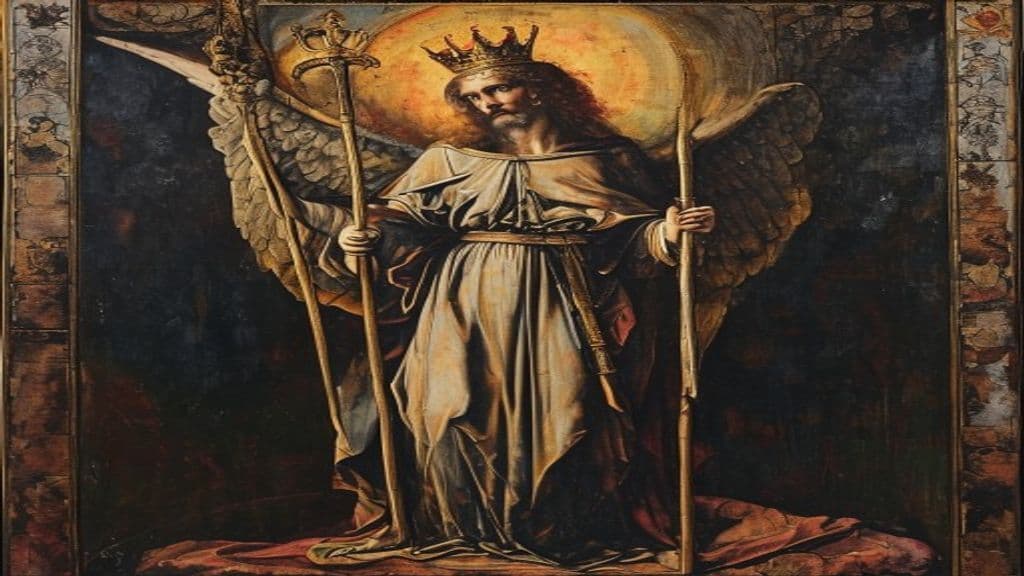
Jegudiel’s name is given in Hebrew as יַחְדִּיאֵל (Yaḥdīʾēl); sources render the name’s literal meaning as 'God is One.' He is listed as one of the seven Archangels in Eastern Orthodox tradition and appears in later devotional and iconographic systems. Some secondary summaries suggest a possible early mention of a form of the name in the non‑canonical Book of Enoch, but that attribution is presented in the sources as a suggestion rather than a definitive historical fact.
In Eastern Orthodox iconography Jegudiel is typically shown standing upright, holding a crown in his right hand and a rod, staff, or three‑thonged whip in his left. The crown and whip/staff are held as symbolic attributes in the classic depictions cited in the sources.
Sources describe Jegudiel in ministerial and patronal terms: he is associated with praise of God, described as the bearer of God’s merciful love, and is the patron of those who labor in various fields. He is invoked as an advisor and defender of people in positions of responsibility—kings, judges, and leaders—and his iconographic attributes symbolize reward for the righteous (crown) and punishment for sinners (three‑thonged whip). These roles are presented as devotional and symbolic functions within church tradition rather than as detailed descriptions of metaphysical operations.
Barachiel
Barachiel (Hebrew: בַּרַכְאֵל, Baraḵʾēl, 'God has blessed') is an archangelic figure in Jewish mystical literature and in Byzantine Catholic and Eastern Orthodox Christian devotion, traditionally associated with blessings, guardianship of family and married life, and as chief of guardian angels. Mystical texts place him over the second heaven and attended by a vast retinue of ministering angels; Christian iconography portrays him with symbols of blessing such as a white rose, rose petals, a bread basket, or a staff.
Saint George
An early Christian martyr and soldier-saint traditionally said to have died in 303 CE, venerated across many Christian traditions and later portrayed in popular legend as the dragon‑slayer and protector of communities.
Virgin Mary (Marian devotion and apparitional tradition)
A central historical and devotional figure — Mary of Nazareth — whose veneration across Christian communions and other religions has produced a widespread corpus of devotional practices, shrine cults, and reported apparitional phenomena. The sources treat her primarily as the first‑century Jewish mother of Jesus and as an object of liturgical and popular devotion rather than as a hostile supernatural monster.
Jatasura
Jatasura (Sanskrit: जटासुर, Jaṭāsura) is a rakshasa who appears in the Mahabharata as an antagonist who disguises himself as a Brahmin, seizes weapons and abducts several of the Pandavas and Draupadi, and is ultimately slain by Bhima.
Jaun Zuria
Basque mythical figure, founder of the Lordship of Biscay with martial and territorial abilities. (Note: 1. Power tier: Greater (not Ancient) as Jaun Zuria's abilities are described as defeating regional invaders, not cosmic-level events. 2. Abilities: Clarify that his martial abilities are specifically )
Jaṭāyu
Jaṭāyu is a demigod in the Hindu epic the Rāmāyaṇa who takes the form of a vulture. He is presented as the younger son of Aruṇa and Shyeni, brother of Sampati, and fought Rāvaṇa in an attempt to rescue Sītā before dying of wounds; Rāma performs his final funeral rites.
Jean le Messager
Not an attested supernatural being; rather, a recurring French-language phrase attested across bibliographic, artistic, musical, operatic and sigillographic sources. The corpus shows usages of 'Le Messager' as a title (newspaper, artwork), a role-label in opera, and as part of archival cataloguing ('Jean // le Messager'), with no evidence supporting a folkloric or cosmological entity named Jean le Messager.
Jeff the Killer
Jeff the Killer is a user-created horror character that originated within online creepypasta culture in October 2008. Presented across stories, images, and role-play, he functions as an Internet-born urban legend and meme — a violent human antagonist circulated through fan fiction, image edits, and social-media posts rather than a figure from traditional folklore.
Jehoiada
Jehoiada (Hebrew: יְהוֹיָדָע, Yəhōyāḏā‘, "Yahweh knows") is presented in the Hebrew Bible and later commentaries as a prominent priest in the kingdom of Judah who protected the Davidic heir Joash, led a coup that overthrew Athaliah, and enacted temple reforms to restore exclusive worship of Yahweh.
Jehoiarib
Jehoiarib (Hebrew: יְהוֹיָרִיב, Yehōyārîḇ, 'Yahweh contends') is the eponymous head of one of the twenty-four priestly divisions instituted under King David. In later Jewish tradition the name denotes that priestly course and its descendants, remembered especially as the course on duty at the destruction of the Second Temple.
Jehoshaphat
Jehoshaphat (Hebrew: יְהוֹשָׁפָט, Yəhōšāpāṭ, "Yahweh has judged") is presented in the biblical tradition as a historical king of Judah—son of Asa—known for judicial and religious reforms, organizing priests and Levites, and appearing in genealogical lists. Some textual traditions also preserve the name in priestly genealogies, producing scholarly disputes about whether a High Priest by this name appears in some lists.
Jehovah
Jehovah is the Latinized/Anglicized form of the Tetragrammaton (יהוה, YHWH), the personal name of the God of Israel in the Hebrew Bible / Old Testament. The form 'Jehovah' arose when the consonants YHWH were combined with the vowel points of the substitute word Adonai in medieval/early modern transliteration; scholarly consensus favors 'Yahweh' as the likely historical vocalization.
Community Record
- [1]Jegudiel. Wikipedia, article 'Jegudiel'.wiki
- [2]Jegudiel (Wikidata). Wikidata entry Q1320519, short description 'archangel of praise to God'.wiki