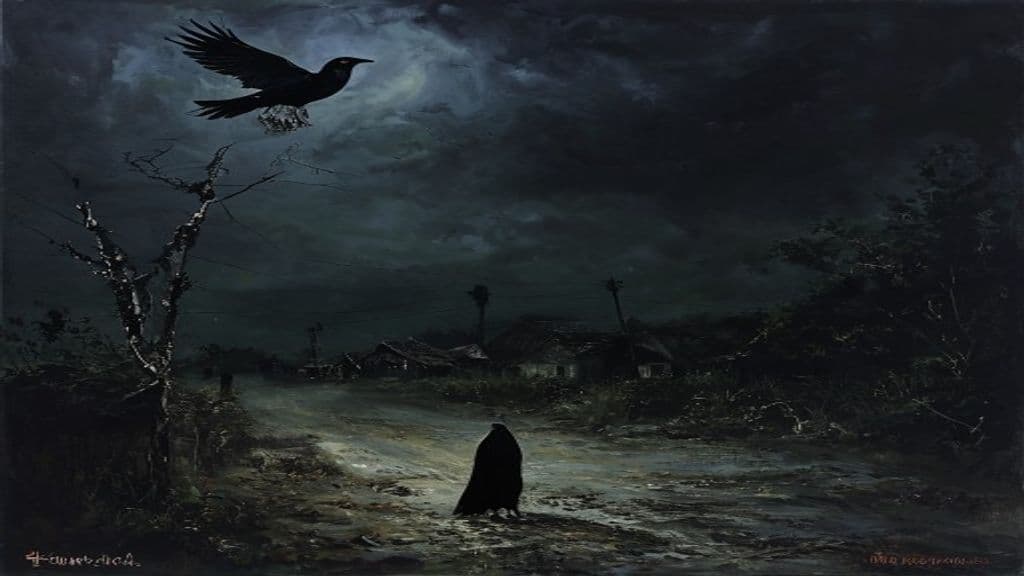
In North Indian folk cosmology, not all deaths are equal. A person who dies at their destined time — old, fulfilled, having received proper rites — passes smoothly toward the realm of the ancestors. A person who dies 'kachcha' (literally: raw, uncooked, unripe) — in an accident, by violence, by suicide, in early childhood — has life-force that does not know it is done. This incomplete energy becomes the Kachcha Kalwa.
The name 'kalwa' (crow) comes from the crow's role in Hindu death ritual — crows receive pinda (rice ball offerings) during shraddha as proxies for ancestors. A 'kachcha kalwa' is a spirit that cannot yet receive these offerings because the death was not natural and the crossing was incomplete. The entity is not malicious in origin; it is simply lost, and it reaches for what it knew — the living people connected to it.
The Kachcha Kalwa has no stable form. It is characterised more by a field of influence than a visible shape. In some accounts it appears as a black crow with human eyes, watching from overhead. In others it manifests as a shadow resembling the person who died, sometimes carrying the visible marks of the accident — a wound, a rope burn, a broken posture.
In possession states, witnesses describe the afflicted person adopting the exact physical mannerism or emotional state of the dead person in their final moments, as if replaying a recording.
The primary harm the Kachcha Kalwa causes is through attachment to those connected to the death — the survivors of the accident, close family, or anyone who witnessed the dying. This attachment manifests as a pattern: repeated accidents and near-misses in contexts that echo the original death, unexplained illness, and the persistent sense of being watched or followed.
In severe cases, possession follows the attachment — the affected person re-enacts the dead person's final emotional state, sometimes speaking their last words repeatedly. Unlike the Brahmpret, the Kachcha Kalwa is not angry. It is frightened and confused, which makes it no less dangerous.
Weaknesses
- ritualShraddha ceremony at the exact site of death
Wards
- substanceBlack thread tied at the wrist after attending an untimely death
- substanceTil (sesame) and water offered at the crossroads nearest the death site
Community Record
- [1]Untimely death and preta formation in North Indian folk belief. Parry, J. (1994). Death in Banaras. Cambridge University Press.academic
- [2]Akalmrityu (untimely death) spirits in Hindi folk tradition. Briggs, G.W. (1920). The Chamars. Milaras Mission Press, Lucknow.folk