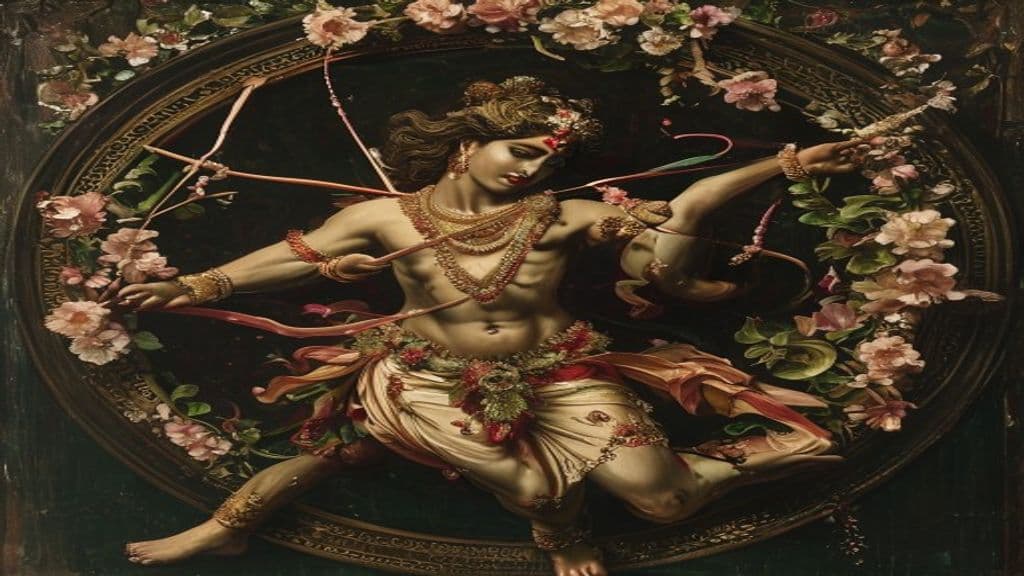
In early Vedic texts such as the Rgveda (e.g., the cosmogonic Nasadiya hymn) and the Atharvaveda, kāma functions as an impersonal formative principle—a force of desire or the motivating seed that aids creation; later literature personifies this principle as the god Kamadeva. In Purāṇic accounts the cosmological principle has become an anthropomorphic deity with biography: the Purāṇas describe him with personal relationships and myths (for example, the tale in which he is shot by Śiva's third eye and later reborn as Pradyumna, son of Kṛṣṇa and Rukmiṇī). The transformation from impersonal principle in Vedic hymns to named god in Purāṇic narrative is attested in the provided summaries.
Sources consistently describe Kamadeva as a handsome young man adorned with ornaments and flowers, traditionally armed with a sugarcane bow and arrows made of flowers. In visual art he is identified by these attributes; a specific museum archive caption notes a sculptural example in which a makara motif bearing five arrows helps identify the figure as Kamadeva, indicating that makara motifs can function as identifying elements in some sculptures.
Vedic and Atharvavedic hymns invoke kāma as a powerful principle that arouses desire in targets, frequently using arrow imagery (e.g., Atharvaveda 3.25: references to the 'arrow of kāma' and 'the arrow feathered with longing, tipped with love'). The Atharvaveda material cited shows worshippers calling on Kāma to induce attraction, to obtain desired outcomes, and to overcome rivals—i.e., practitioners appeal to his power for fertility, prosperity, success, and the arousal of love. Purāṇic narratives place him in mythic actions (notably his incineration by Śiva's third eye and subsequent rebirth), which thematically contrast desire with ascetic power.
Weaknesses
- conditionvulnerability to ascetic power (as narrated in Purāṇic tale of Śiva's third eye)
Wards
None recorded.
Community Record
- [1]Kamadeva - Wikipedia. Wikipedia entry 'Kamadeva' (summary of Vedic and Purāṇic material and iconography).wiki
- [2]Wikidata: Kamadeva. Wikidata item for Kamadeva.other
- [3]Bust of Kamadeva, the God of Love (Metropolitan Museum archive). Archive image caption noting makara motif with five arrows identifying the deity.other
- [4]Archive: 'Kamadeva' de Mihai Eminescu (recording). Archive listing referencing Kamadeva (used in supplied notes).other