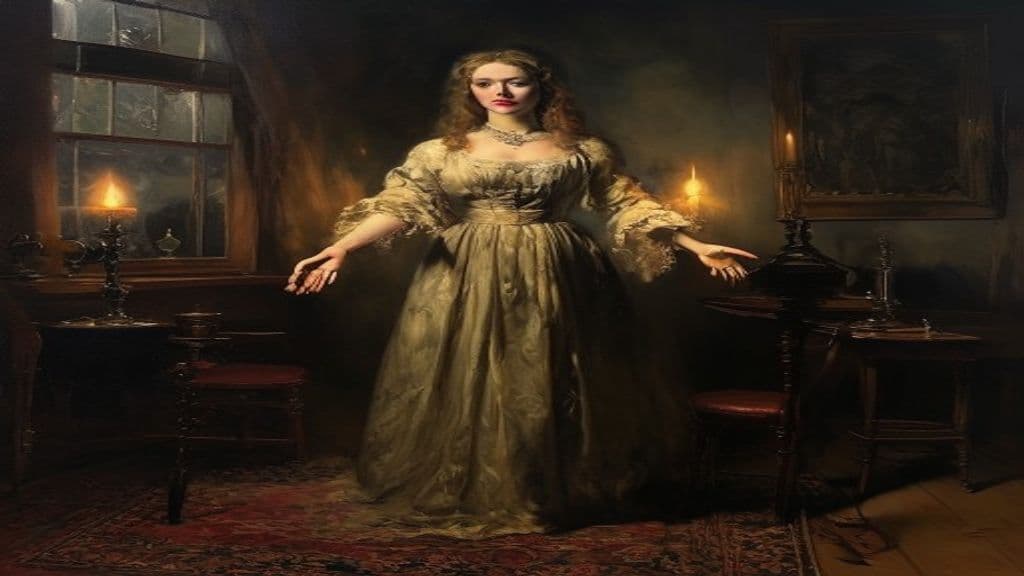
Within Spiritualist accounts of the 1870s, Katie King is the persistent spirit personality or 'control' named and produced in physical‑medium séances, particularly those involving the medium Florence Cook. Sources present this origin as a claim by Spiritualists rather than an independently corroborated historical fact; the sittings and the spirit's appearances became a focal point for mid‑1870s public debate and investigation (including inquiries by figures such as William Crookes, as reported in contemporary accounts and later summaries).
Spiritualist sources describe Katie King as a materialized female spirit figure manifesting in the séance room as a bodily presence produced through mediumship. Precise contemporaneous descriptive details (dress, exact features, height) vary across accounts and are contested; the supplied materials consistently present her as a purportedly fully materialized spirit rather than merely an unseen voice or trance control.
According to Spiritualist testimony of the 1870s, Katie King manifested by physical materialization in séance conditions and could interact with sitters and investigators as a person in the séance room. The historical record emphasizes that these claims were disputed: investigators and skeptics accused mediums and their controls of fraud, while Spiritualists maintained the independent personality and corporeal appearance of Katie King. The phenomenon therefore is documented as a produced séance manifestation that attracted scientific and legal scrutiny rather than as an established supernatural ability.
Kasanaan
Kasanaan (Tagalog: kasanaan) is a term in Tagalog/Philippine cosmology denoting a lower-world place of grief, affliction, and punishment where sinful or wicked souls suffer. It is presented in sources primarily as a locale or realm—sometimes described as a 'village in the lower world'—rather than an individual supernatural agent.
Kashvad
Legendary hero from the Persian tradition, known for his valor and military prowess. (Note: 1. Power tier: Downgrade from Ancient to Greater, as Kashvad is described as a heroic warrior with exceptional bravery and military skills, but not necessarily a deity-level being. 2. Weaknesses: Add )
Kashyapa
Kashyapa (Sanskrit: Kaśyapa; Pali: Kassapa) is a revered ancient rishi in Vedic–Hindu literature and is also recognized in Buddhist canonical lists. Portrayed as a composer of some Rigvedic hymns, head of a Soma hymn school, and a progenitor in Puranic genealogies, he functions as an archetypal ancestral seer and culture‑founder associated especially with Kashmir.
Kassapa (name-group: Buddha, ascetics, and rulers)
Kassapa appears in South and Southeast Asian sources as a personal name borne by distinct figures: a canonical Buddha (Kassapa / Kassapa Dasabala), a set of ascetic brothers (Uruvelā‑Kassapa, Nadi Kassapa, Gaya Kassapa) who led monastic followings, and historical rulers (e.g., Kassapa II of Anuradhapura, Kumara Kassapa of Pagan). The supplied material treats Kassapa as reused personal/name‑title across religious and secular contexts rather than a single supernatural spirit.
Kassite deities
Kassite deities are the named divine figures attested in Kassite-language and Mesopotamian sources of the second and first millennia BCE. They appear mainly as onomastic elements and occasional cult figures (notably Šuqamuna and Šumaliya), occupying a liminal position between Kassite ethnic identity and the Mesopotamian religious landscape.
Kataw
Kataw is a Visayan class of merfolk in Philippine folklore closely associated with sirena/sireno traditions. Some secondary sources and local summaries describe Kataw as occupying a higher social rank among aquatic beings and as associated with the rulership of an aquatic realm called Bantay Tubig, though detailed primary legends and ritual material are scarce in the supplied sources.
Kauket
Kauket (also Keket, Kaukēt, Keku) is the feminine member of the Hermopolitan Ogdoad who personifies primordial darkness, especially the darkness associated with sunset and the unformed condition preceding creation. She is paired with the male Kek and is attested in traditions tied to Hermopolis and later funerary/ western symbolism.
Kaukė (mask)
Lithuanian term literally meaning 'mask' (kaukė), attested in Sudovian/East Baltic lexical material and in archival song titles. The supplied sources do not present Kaukė as an autonomous mythic being; instead the word functions as a cultural-linguistic token for masks and masking practices, with lexical links to a verbal root kauk- ('to howl').
Kaulu (Hawaiian Trickster God)
A complex entity in Hawaiian mythology, Kaulu is a trickster god with extraordinary physical strength and magical abilities. (Note: 1. In the Abilities section, "extraordinary physical strength" should be linked to a specific source or explicitly stated as a characteristic unique to Kaulu. 2. Power tier: Downgrade to Ancient (deit)
Kaurava
Kaurava (Sanskrit: कौरव) is a genealogical designation in the Mahābhārata for descendants of King Kuru; in common usage it denotes the hundred sons of King Dhṛtarāṣṭra and his wife Gandhārī who oppose the Pandavas in the Kurukṣetra war. The term functions as a human lineage and narrative category within epic literature rather than a supernatural entity.
Kausalyā
Kausalyā is a human royal figure in the Ramayana tradition: the senior queen consort of King Daśaratha of Kosala and the mother of Rāma. In the Ayodhyā Kāṇḍa episodes cited she appears as a ritual participant and as a mother whose emotional speech and lamentation shape courtly responses to calamity.
Kaushiki
Kaushiki is a theophanic śakti in Hindu literature who issues from the sheath (kosha) of Parvati/Uma/Gauri and manifests as an independent warrior-mother deity to slay the asura kings Shumbha and Nishumbha. The same name appears in Jain literature as Kauśikīvidyā, a named vidyā (supernatural power) associated with certain Vidyadharas whose abilities are ethically conditioned.
Community Record
- [1]Katie King (spirit) — Wikipedia. "Katie King was the name given by Spiritualists in the 1870s to what they believed to be a materialized spirit." and "The question of whether the spirit was real or a fraud was a notable public controversy of the mid-1870s."wiki
- [2]Katie King and Florence Cook: Spiritualist Medium - A Spirit Which Could Frighten a Criminal Defense Lawyer. Discussion of Florence Cook's association with Katie King and reference to investigations (including William Crookes) of Cook's séances and the Katie King manifestations.other
- [3]Florence Cook and Katie King: Spiritualist Medium Part 2 - Photo Booth and Spirit Photographs. Further treatment of Florence Cook's sittings and the photographic and public controversies surrounding Katie King materializations.other