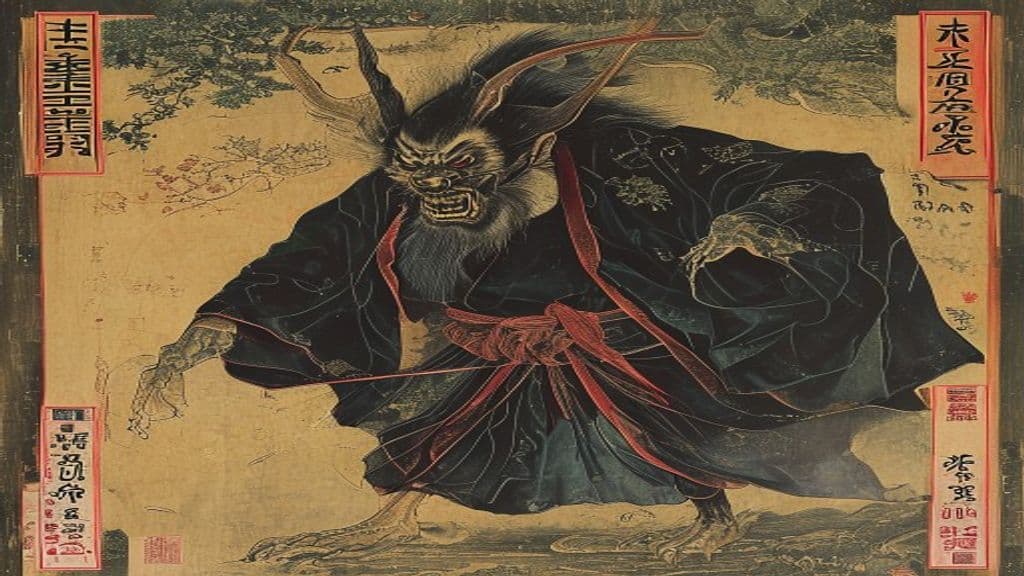
The supplied source does not provide an origin narrative for Kejōrō. Kejōrō appears only as part of Toriyama Sekien’s Konjaku Gazu Zoku Hyakki corpus of images and names; the Wikipedia summary confirms Sekien compiled images based on literature, folklore, and earlier artwork but does not confirm whether Kejōrō derives from an earlier tale or was an invention or adaptation by Sekien himself (source: supplied Wikipedia summary).
No textual description of Kejōrō’s physical appearance is provided in the supplied source. Sekien’s Konjaku Gazu Zoku Hyakki is an illustrated volume and therefore contains an image for the entry, but that plate and any caption text were not included in the provided material; consequently specific visual features cannot be asserted from the supplied source.
The supplied source does not record any powers, behaviors, or functional role for Kejōrō. There is no information in the provided material about whether the entity is harmful, benevolent, or associated with particular phenomena.
Kayra
Kayra (also Kaira; Old Turkic: 𐰴𐰖𐰺𐰀) is the supreme creator-being in Turkic mythic cosmology. Presented as the originative power who orders the world, plants the tree of life (Ulukayın), and directs fate from the seventeenth heaven, Kayra appears in some accounts as a non-human, liminal creator and a parent of other divine figures.
Ke'let
Ke'let (singular ke'le) are a category of hostile spirit-beings in Chukchi tradition that can denote cannibalistic giants/ogres, personifications of disease and death, or (in some uses) spirits summoned by shamans. A regional variant near the Pacific is called Re'kkenit (singular Re'kken), with distinctive local features.
Ke-alelo-O-Pilikua
A black lava outcropping in northern Kaua'i, Hawaii, with cultural significance within Hawaiian tradition due to its unique geological formation and association with ancestral figures. (Note: * Power tier should be Ancient (not Primordial) since there is no indication that it has cosmic powers. * Abilities statement should be corrected to reflect that no abilities are mentioned, but also c)
Kebehet
Kebehet is a minor divine figure attested in modern secondary literature on Ancient Egyptian funerary religion. She appears in discussions of the ensemble of attendant deities and personae invoked in royal mortuary ritual and the king's passage into the celestial afterlife, but primary-source details about her name, iconography, or distinct functions are sparse in the supplied sources.
Kechibi
Kechibi (けち火) are atmospheric ghost lights from the folk legends of Kōchi Prefecture (historical Tosa Province), Japan. They are local variants of onibi/funayūrei-type lights reported as human-linked luminous balls that emerge either at death or from sleeping persons and that figure in cautionary folktales about interaction with spirit phenomena.
Kehua (Māori Ghosts and Spirits)
In Māori culture, kehua are ghosts or spirits that appear as apparitions of long deceased family members to warn of upcoming danger. They hold a sacred status, implying tapu. (Note: 1. The draft states "Kehua are considered to be apparitions of long deceased family members," but Source 1 mentions it as "long deceased family members may appear." This implies Kehua could also refer)
Kelenken
Kelenken is both a Tehuelche mythic referent described in the scientific literature as “a spirit… represented as a giant bird of prey” and the name-bearing fossil taxon Kelenken guillermoi, a very large middle Miocene flightless predatory bird (a phorusrhacid) from Patagonia. The cited sources supply extensive paleontological description and taxonomy but provide only the single, brief ethnographic note that the genus name was taken from a Tehuelche spirit-image; no Tehuelche narratives or rituals are recorded in the supplied material.
Kelpie
A Scottish shape-shifting water horse that appears as a beautiful tame horse near lochs and rivers, then drowns and devours any rider foolish enough to mount it.
Keneō
Keneō (懸衣翁), literally "clothes hanging old man," is an underworld attendant in Japanese popular Buddhist tradition who sits at the edge of the Sanzu River. Described in sources as an Oni-like figure, he receives the garments of arriving souls, hangs them on a riverside branch whose bend registers the weight of sin, and participates with Datsue-ba in postmortem punishments.
Kenmet
Kenmet (Egyptian Knm.t) is a named figure attested in ancient Egyptian temple, dramatic, and decanal/astronomical texts. The attestations place Kenmet within mythic and stellar ordering contexts — as a named component associated with the divine stars and decanal schemata rather than as a fully attested cultic deity with independent biography.
Keong Emas
A princess magically transformed and contained within a golden snail shell, associated with the Panji cycle of Javanese folklore. (Note: - Power tier: Primordial (not Ancient), as it's described as a princess trapped in a magical object rather than having deity-level powers. - Abilities: Lack of information about abilities or behaviors)
Keres
In Greek myth the Keres (Κῆρες; singular Κήρ) are night-born, malevolent death-spirits associated with violent death, pestilence, and the ravaging aspects of mortality; they are often portrayed as a swarm of blood‑thirsty female spirits that hover over battlefields and seize the dead and dying.
Community Record
- [1]Konjaku Gazu Zoku Hyakki (entry/image associated with Kejōrō in Toriyama Sekien's tetralogy). Wikipedia: Konjaku Gazu Zoku Hyakki — summary of Toriyama Sekien's illustrated bestiary (accessed via supplied research notes).wiki