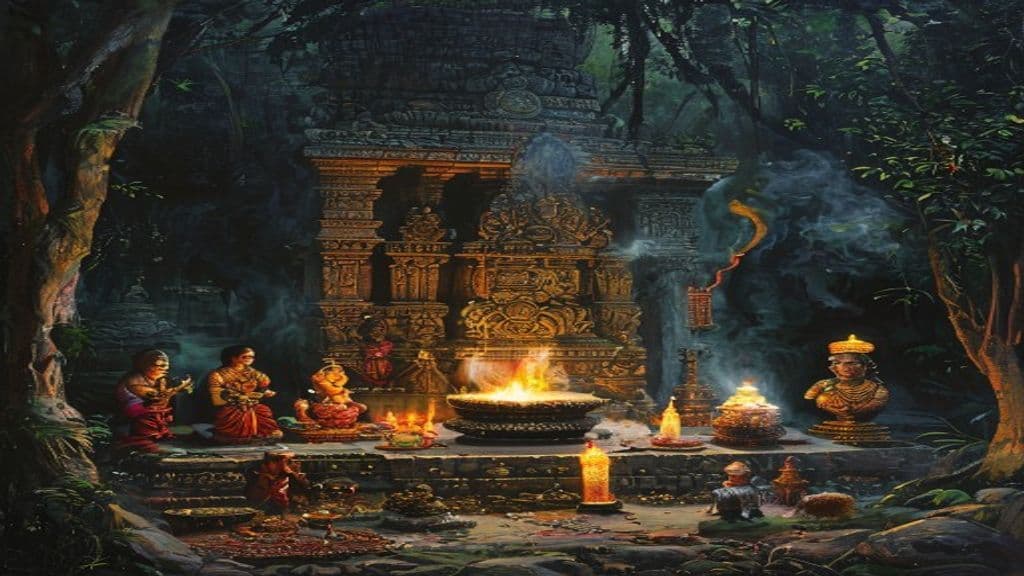
The Kharchi are the 14 ancestral deities of the Tripuri people — a pre-Hindu tribal pantheon that became associated with the Shiva tradition during the period of Tripuri royal Hindu conversion, but retained its distinct character and its own festival. The word 'kharchi' comes from 'khir' (earth) + 'chi' (worship): the earth-worship deities.
The annual Kharchi Puja, held at the Chaturdasha Devata temple in Agartala for seven days in July, is the largest festival in Tripura. The festival includes the ritual purification of the earth — an ancient earth-goddess cycle that predates the temple's present form.
The 14 Kharchi deities do not have consistent individual iconographies. They are represented collectively at the Chaturdasha Devata temple by 14 images, several of which have been identified with Shiva, Durga, and other pan-Hindu deities over centuries of syncretism — but the tribal forms predate these identifications.
In folk encounter accounts, the Kharchi are experienced as a collective presence — a sense of being watched by many eyes simultaneously, or the feeling of crossing into territory that has many guardians, not one.
The Kharchi function as territorial guardians — their authority is over the sacred geography of Tripura. Those who violate their sacred spaces experience sudden illness of a specific type: high fever with no identifiable cause, resolving when the person leaves the sacred area or makes the appropriate apology offering.
Collectively, the Kharchi are credited with the fertility and protection of the land they govern.
Weaknesses
- conditionThey are deities to be honoured, not adversaries to be overcome
Wards
- ritualObserving the Kharchi Puja ritual protocols — removing footwear, maintaining respectful behaviour in the temple precinct
Community Record
- [1]Kharchi Puja — Wikipedia. Wikipedia contributors. Kharchi Puja. Wikipedia, 2024.wiki
- [2]Tribal Religion and Cults of Tripura. Bhattacharjee, J.B. (1977). The Cachar, the Manipuri and the Tripuri. Gauhati University, Assam.academic