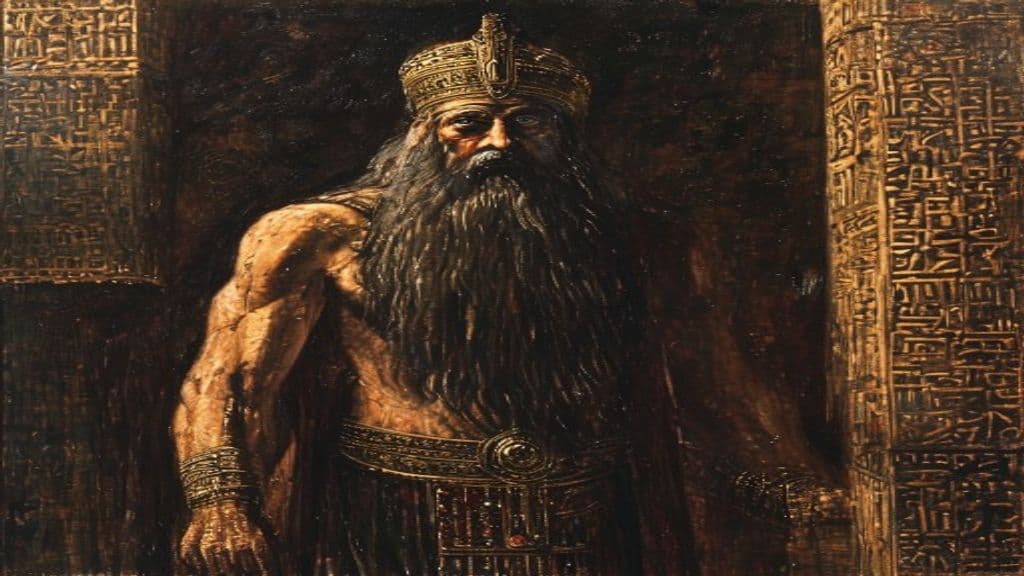
In the Babylonian creation epic Enuma Elish, Kishar is presented in the opening genealogy as the daughter of Lahamu and Lahmu (the first children of Tiamat and Abzu). She is sister and wife to Anshar and mother to Anu, placing her among the earliest divine generation that structures the cosmos. Her name and role mark her as the female, earth-related principle paired with Anshar (the sky), serving as a foundational, generative aspect of the world order rather than the subject of independent narrative deeds in the surviving text. She is attested only in the opening lines of the Enuma Elish and then disappears from the remainder of that epic; she also appears only occasionally in some first-millennium BCE texts where she can be equated with Antu.
No reliable ancient iconographic or physical description of Kishar survives in the provided primary or scholarly summaries. The Enuma Elish supplies only genealogical placement and a lexical meaning ('Whole Earth') without descriptive detail. Modern visualizations in games and fiction exist but are later appropriations and are not attested in the ancient textual record.
In the surviving evidence Kishar's role is cosmological and genealogical: as the female principle paired with Anshar she helps constitute the primordial ordering of the cosmos and the divine genealogy by being mother to Anu. The sources provided do not ascribe active mythic deeds, interventions, or ritual functions to her beyond this generative/cosmic position. Some first-millennium BCE texts occasionally equate her with Antu, indicating later theological identification, but the provided material does not detail any additional powers arising from that equation.

Community Record
- [1]Kishar — Wikipedia. Wikipedia entry 'Kishar' (summarizing Enuma Elish usage and first-millennium BCE occurrences)wiki
- [2]Anshar — Wikipedia. Wikipedia entry 'Anshar' (lexical context: Anshar glossed as 'whole sky', paired with Kišar)wiki
- [3]Wikidata: Kishar. Wikidata item for Kišar (identifier and cross-references)other
- [4]Archive: Morning in Tiamat Sulcus (planetary nomenclature reference). Archival item showing modern reuse of the name 'Kishar' (planetary feature naming context); provided as evidence of modern cultural afterlife, not ancient attestation.other