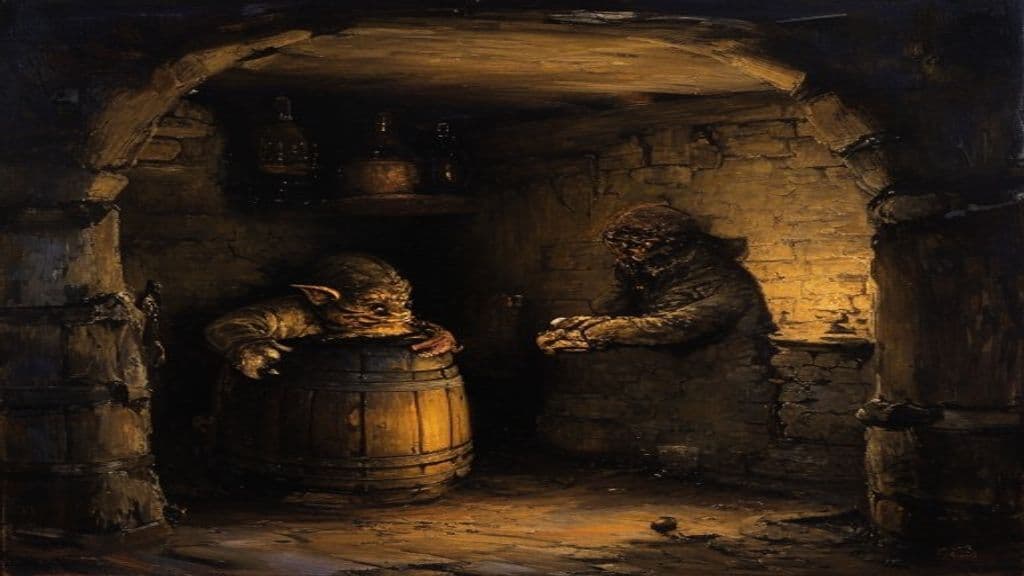
Kobolds are among the oldest attested Germanic spirits, appearing in medieval German literature as household spirits closely analogous to the Scandinavian nisse. A kobold would enter a home of its own choosing and attach itself permanently. Some kobolds haunted mines (Berggeist) where they led miners astray or warned them of danger. The word 'cobalt' derives from the miners' belief that kobolds had poisoned the ore.
Appears as a small humanoid, sometimes like a child, sometimes an old man, often in nondescript clothing. Mine kobolds might look like small miners. They preferred to stay invisible and were primarily detected by sounds — tapping, footsteps, laughter.
Household kobolds helped with chores, warned of danger, and brought prosperity. Mine kobolds could lead miners to rich veins or cause cave-ins. When angered, a kobold could sour milk, hide tools, trip people, start fires, and refuse to leave.
Weaknesses
- conditionConsistent neglect eventually drives him off (but not without mischief)
Wards
- ritualRegular food offerings left in his corner
- conditionTreating the household industriously
Alp
A German nightmare demon — often the projected spirit of a living person — who sits on sleeping victims' chests causing terrifying dreams, sleep paralysis, and wasting illness.
Baldr
Baldr (Old Norse Baldr; Old English Bældæġ; Old High German Balder/Palter) is a god in Germanic mythology. In the Norse branch he is named as a son of Odin and Frigg and as a member of the Aesir, attested alongside brothers such as Thor and Váli in the supplied sources.
Deutsche Mythology
A collection of mythological narratives representing the collective myths, legends, and beliefs of ancient Germanic cultures. (Note: 1. Power tier: Primordial (Deutsche Mythology as a collective mythological narratives does not have supernatural abilities and behaviors attributed to it; rather, it contains those of individual Germa)
Erlking
A sinister Germanic spirit of forest and mist who takes children — appearing to them as a welcoming figure while adults see nothing, the child dying in its parent's arms.
Fairy
A class of anthropomorphic supernatural beings found across multiple European folk traditions, fairies are magical, liminal entities variously described as spirits, an older race, or enchanted people; their depiction ranges from human-sized to diminutive and their attributes and moral alignment vary by region and period.
Fulla
Fulla (Old Norse Fulla; Old High German Volla/Folla) is a named goddess (ásynja) in the Germanic tradition, attested as Frigg's trusted attendant and confidante in Old Norse sources and as a named singer in the Old High German Merseburg horse-healing charm.
Germanic Dragon
A large, serpentine creature from Germanic mythology that hoards gold and shares characteristics with cosmic beings. (Note: 1. Power tier should be Ancient instead of Primordial, as the source describes them sharing characteristics with "other dragons in European mythology", implying a level below cosmic. 2. Remove "venomo)
Household deity
A household deity is a deity or spirit that protects the home and its members, cared for inside domestic spaces and integrated into everyday household ritual. The category spans distinct cultural instantiations — hearth goddesses, ancestral family kami, and animistic house-spirits — and is characterized by reciprocal relations of offering and protection rather than cosmic sovereignty.
Jötunn (Jotun / Giant)
A jötunn (Old Norse jǫtunn; plural jötnar) is a class of powerful non-human beings in Norse/Germanic myth that exist alongside gods, dwarfs, elves, and humans. They commonly dwell across boundaries (e.g., Jötunheimr) and appear ambivalently as adversaries, kin, spouses, and participants in cosmological narratives.
Lindworm
The lindworm is a European serpent/dragon‑like monster attested across Northern, Western and Central Europe. Varieties range from limbless giant forest serpents in Scandinavian lore to two‑limbed or winged dragonic forms in Central European art and legend; it appears in both treasure‑guardian and cursed‑bridegroom narrative cycles.
Little people
A cross-cultural folkloric category of diminutive supernatural or semi-supernatural beings found worldwide. They occupy liminal places near humans (woods, mounds, anthills, mines, shorelines) and range from helpful household spirits to mischievous tricksters or dangerous guardians of places and resources.
Lorsch Bee Blessing
A Christian prayer invoking a benevolent entity to bring good health to honey bees and their hives, reflecting Germanic folklore's appreciation for nature and balance. (Note: 1. Power tier should be reassessed, as the entity's influence on bee health and guidance may indicate a Greater power level. 2. The source material does not support the claim that the Lorsch Bee Bless)
Community Record
- [1]Deutsche Sagen. Grimm, Jacob & Wilhelm. 1816–1818. Deutsche Sagen. Berlin.folk
- [2]Encyclopedia of Norse and Germanic Folklore. Lecouteux, Claude. 2013. Encyclopedia of Norse and Germanic Folklore, Mythology, and Magic. Inner Traditions.academic