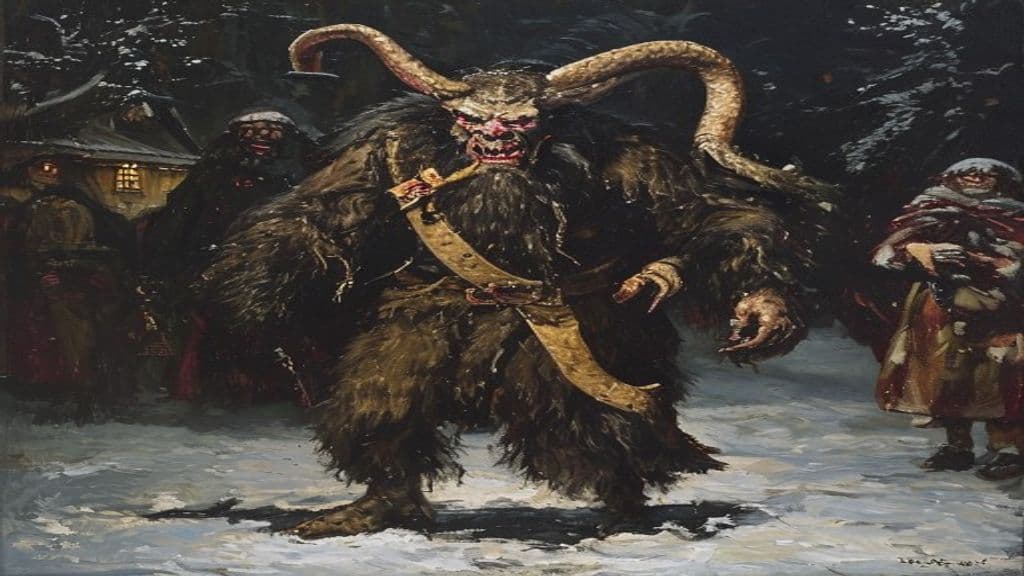
Sources situate Krampus within Alpine seasonal masquerade traditions associated with Percht/Perchten figures and note earliest documentary attestations in early modern Europe; by the 17th century a punitive companion role was established in which Krampus was paired with Saint Nicholas to carry out punishments a saint would not be expected to perform. Some informants and scholars describe Krampus as deriving from pre-Christian or 'pagan' masked‑devil traditions later assimilated into Christian festival time, but the supplied sources present this as an interpretive position rather than a single uncontested origin narrative. Political and social interventions in the 20th century (for example, prohibitions in the 1930s and anti‑Krampus propaganda in the 1950s) document contested modern histories of suppression and revival.
Krampus is typically depicted as a horned, anthropomorphic man covered in brown or black hair, often shown with one grotesque human foot and one cloven goat's hoof. Features commonly include long pointed fangs and a very long, snake- or dragon-like tongue. Costuming in processions frequently uses carved wooden masks, animal furs, chains and bells, and carries props such as a bundle of birch branches (Rute), a whip, and occasionally a sack or basket strapped to the back (motifs in older accounts describe naughty children placed in a sack).
In folklore Krampus acts as the punitive counterpart to Saint Nicholas: he visits on the evening of 5 December (Krampusnacht), threatens or punishes badly behaved children with birch rods (Rute), and in older traditional motifs is said to carry off or threaten to carry off naughty children in a sack or basket (older accounts include motifs of drowning, eating, or transport to Hell as part of the repertoire). In public Krampuslauf/Perchtenlauf processions, masqueraders wearing Krampus costume use theatrical antics—thrashing chains, ringing bells, brandishing birch bundles—to frighten audiences and enact social correction. The chains are commonly interpreted in the sources as symbolic (thought to represent the binding of the Devil by the Christian Church).
Weaknesses
- conditionsocial controls (good behavior as prevention)
- otherinstitutional suppression (historical prohibitions and public campaigns)
Wards
- conditionbeing a well-behaved child (cultural preventive measure)

Companions of Saint Nicholas
A family of regionally variable folkloric figures who accompany Saint Nicholas across territories formerly in the Holy Roman Empire and culturally influenced areas. Acting as a punitive or corrective foil to the gift-giving saint, these companions threaten, punish, or carry away disobedient children in seasonal performances and visits around Saint Nicholas Day (December 6). Individual regional forms range from cloak‑and‑staff servant types to goat- or devil-like figures.
Koschei the Deathless
Koschei (also Koshchei, Kashchei), commonly called "the Deathless" or "the Immortal," is an archetypal male antagonist in Russian and wider Slavic folklore. He functions in folk narratives as a legendary villain whose name and legend persist into modern cultural works and references.
Kothar-wa-Khasis
Kothar‑wa‑Khasis is the principal divine craftsman of the Ugaritic pantheon, attested in Late Bronze Age Ugaritic myths and ritual texts. Rendered as “skilled and wise” (or a hendiadys “wise craftsman”), he functions as architect, smith, musician and maker of ritual implements whose works serve other gods in mythic narratives.
Kotharat
A collective of Northwest Semitic goddesses attested in Bronze Age texts (chiefly at Ugarit, Mari and Emar) associated with conception, pregnancy, birth and the blessing of marriages; conventionally treated as a heptad and etymologically linked to a Semitic root meaning 'skill' or 'to achieve.'
Koto-furunushi
A Japanese tsukumogami: an aged koto that becomes animate and plays enchanting music. Described as a harmless yōkai that rewards long care with benevolent musical animation and may mourn neglect.
Koyash
Koyash is the personified Sun and a solar deity in Turkic and related Turco‑Mongolian cosmologies. Regarded as one of the visible Tenger (heavenly beings), Koyash functions as a life‑giving intermediary whose rays connect Tengri to living spirits and who participates in cosmic creation.
Kraken
A legendary enormous sea monster from northern European (particularly Norwegian) maritime tradition, conceived as a deep‑water, tentacled hazard blamed for pulling down ships; later writers and naturalists often equated it with very large cephalopods (giant squid) or with other medieval sea‑monster names such as the hafgufa.
Krasue
A nocturnal Southeast Asian female spirit typically depicted as a floating, disembodied woman's head with internal organs trailing beneath the neck. The figure forms part of a regional cluster of related body-detaching female spirits and is presented in local traditions as a transformed or cursed human who leaves the living body by night to seek food.
Kreios
Kreios (also attested Crius or Krios) is a figure in classical Greek mythology identified in the supplied sources as one of the Titans, offspring of Uranus (Sky) and Gaia (Earth). The available material provides only genealogical identification and an etymological gloss that the name means "ram."
Krishna
Krishna (Sanskrit: Kṛṣṇa) is a major Hindu deity presented in the supplied sources both as the eighth avatāra of Vishnu and, in many traditions, as the Supreme Being (Svayam Bhagavān). He appears in a range of roles—child, cowherd, lover, charioteer, teacher and divine hero—and his life episodes (Krishna-līlā) are central to bhakti devotion, performance arts, and pilgrimage traditions.
Kriwe
A chief priest in the old Baltic religion, associated with the neo-pagan movement Romuva. (Note: 1. Power tier should be Primordial since it's a chief priest and the article implies a strong connection to the old Baltic religion. 2. The abilities and behaviors of Kriwe are not explicitly stated, )
Krodhavasa
Krodhavasa (Sanskrit: Krodhavaśā) is a mythological ancestress in the Puranic/Daksha–Kashyapa genealogies, wife of the sage Kasyapa and mother of a class of ferocious creatures called the Krodhavashas. Her name, derived from krodha (anger, wrath), is used etiologically to explain the ferocious temperament and sharp-toothed nature of certain animals, birds, and fish in epic–Puranic literature.
Community Record
- [1]Krampus. Wikipedia article 'Krampus' (sections on origin, appearance, Krampusnacht, Perchtenlauf, modern history).wiki
- [2]Wikidata: Krampus. Wikidata entry for Krampus (label and basic classification).other
- [3]Archive: A Style Experiment. Archive listing referencing Krampus in modern media and discussions.other
- [4]Archive: #469 avec Evelyne Ferron!. Archive media item referencing Krampus and related winter monsters in contemporary discussion.other
- [5]Archive: Christmas Spirit (and Monsters and Other Fun). Archive item discussing Christmas monsters including Krampus in popular contexts.other
- [6]From Bavaria to Milwaukee: A Christmas devil’s long march into local German-American traditions. Article tracing migration and local traditions of Bavarian/Germanic Krampus figures into diaspora contexts.other
- [7]Krampus Stirs Controversy in Holiday Parades. Blog post noting modern controversies in holiday parades involving Krampus.other
- [8]INTRODUCTION (scholarly bitstream). Scholarly introduction discussing Perchten and related Alpine masquerade traditions and their integration with Christian festivals.academic