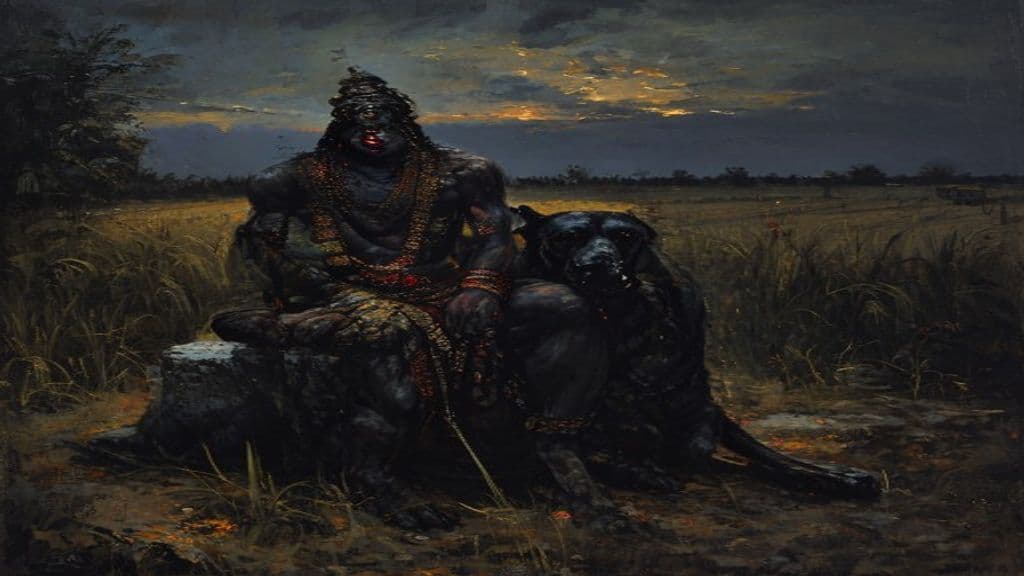
The Kshetrapala — literally 'field protector' or 'territory guardian' — appears in Kautilya's Arthashastra (c. 300 BCE) as a deity to be honoured before beginning agricultural work, and recurs in Shaiva tradition as an aspect of Bhairava, the fierce boundary-keeping form of Shiva. Where Bhairava guards the cosmic boundary, Kshetrapala guards the local one: the sima stone where cultivated land ends and wild territory begins.
In North Indian villages the Kshetrapala's shrine is traditionally located at the village boundary — not inside the settlement but at its outermost limit, facing outward. This placement is intentional: he is the first line of encounter for whatever approaches the village. When Rajasthani and UP villages were re-settled after conflict or famine, the first act of re-establishment was restoring the Kshetrapala shrine. Everything else — crops, animals, households — depended on his permission.
The Kshetrapala is depicted as dark-skinned, fierce-eyed, and armed with a gada (club). His vehicle is the dog — the same animal that accompanies Bhairava and that was considered by the Vedic tradition to be the guardian of the threshold between living and dead. He may wear a garland of bones and carries the authority of a judicial figure rather than the malice of a predator.
Unlike ghosts and demons, Kshetrapala is approached as a deity — with offerings, not avoidance. His expression is one of intense authority. When communities describe 'seeing' him, they describe a large dark figure with red eyes standing at the village edge at dusk, watching the approach road.
Kshetrapala's power is territorial and judicial. Within his domain — the village fields and their boundary — he has absolute authority. Those who violate boundaries without permission, steal from fields, trespass on fallow ritual land, or neglect his annual worship suffer illness of a specific pattern: fever, vomiting, skin conditions, and afflictions of the lower body associated with contamination.
He also blesses. Communities that maintain his shrine and perform the pre-plowing propitiation report protection of crops from pests, animals from predators, and the household from outside malevolent forces. He is simultaneously the ward and the entity warranting placation — his shrine at the village boundary is the primary protection against all other malevolent entities entering from outside.
Weaknesses
- conditionHe is not an adversary to be overcome — he is a deity to be propitiated
Wards
- ritualKshetrapala IS the ward — his properly maintained shrine at the village boundary serves as the primary protection for the community
- substanceMustard oil lamp lit at his boundary stone on Amavasya evenings
Community Record
- [1]Arthashastra — field guardian deity in agricultural ritual. Kangle, R.P. (trans.). (1972). The Kautiliya Arthashastra. University of Bombay.academic
- [2]Village boundary deities of Rajasthan. Srivastava, S.K. (1974). The Tharus: A Study in Cultural Dynamics. Agra University Research Institute.academic
- [3]Kshetrapala in the Shaiva tradition. Lorenzen, D.N. (1991). The Kāpālikas and Kālāmukhas. Motilal Banarsidass, Delhi.academic