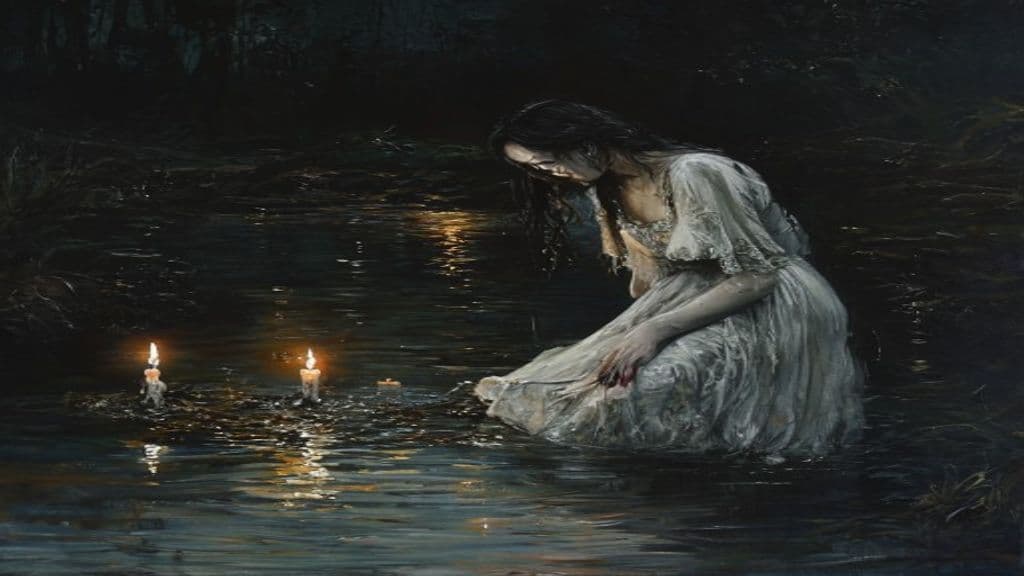
The most common tale tells of a beautiful woman named María who, betrayed by her husband for a younger woman, drowned her own children in a river in rage. Refused entry to heaven until she finds their souls, she wanders the waters forever, weeping.
The tale predates the Spanish conquest, with scholars linking her to the Aztec goddess Cihuacōātl, who was said to appear weeping at night before the fall of Tenochtitlán.
A tall woman in a flowing white dress, hair covering her face. When the hair parts, her face is either a beautiful grieving woman or a fleshless skull. Always wet, always weeping.
Her cry — ¡Ay, mis hijos! — draws children to her and freezes adults in place. She drowns children she finds near water, believing each to be one of her lost ones. Cannot be reasoned with; recognises nothing but her grief.
Weaknesses
- ritualPrayer for her soul and for the souls of her children — forces her to pause
Wards
- symbolCrucifix and holy water at the doors of homes with children
- conditionDo not go near rivers alone at night in regions she haunts
La Llorona sites along Panama's rivers and the Canal Zone (generalized)
Aggregation of references to the La Llorona legend as it might be associated with riverbanks and waterways in Panama and the historic Canal Zone. Provided sources do not supply site-level documentation, eyewitness reports, coordinates, or Panama-specific ethnography; the entry notes the association as folkloric and unverified for Panama in these materials.
Panama (no site-level sources found)
La Llorona Bridge (Puente de La Llorona) — Cartago (unverified site-specific association)
La Llorona is a widespread Hispanic-American folktale about a weeping woman who haunts bodies of water; some Costa Rican locales associate bridges and rivers with her legend. The supplied sources describe the figure and her attributes generally but do not verify a specific, documented Puente de La Llorona in Cartago.
Costa Rica
La Llorona Bridge (unverified attribution to Granada)
A purported site named 'La Llorona Bridge' is sometimes mentioned in relation to La Llorona folklore. The supplied sources do not verify the existence or location of a specific bridge in the Granada, Nicaragua area; the association remains unconfirmed and based on general La Llorona folkloric descriptions.
uncertain

La Llorona Bridge (Poptún / Guatemala River locales) — unverified folkloric toponym
A folkloric toponym applied to bridges or watersides where the figure of La Llorona is said to appear; sources supplied document the general La Llorona legend (mourning woman who roams waters) but do not verify a specific bridge, coordinates, or documented site at Poptún or along the Guatemala River.
unspecified / Central America (Guatemala sometimes claimed in oral tradition)

La Llorona sites along the Rio Grande valley (New Mexico)
Folkloric locations along the Rio Grande in New Mexico associated with the Hispanic American figure La Llorona, a weeping female ghost traditionally said to roam riverbanks mourning drowned children. The entry documents cultural and folkloric associations rather than a single, discrete haunted site.
United States
Community Record
- [1]La Llorona: Weeping Ghosts of the Americas. Leddy, Betty. 1948. La Llorona in Southern Arizona. Western Folklore 7(3).academic
- [2]Chicano Folklore. West, John O. 1988. Mexican-American Folklore. August House.folk