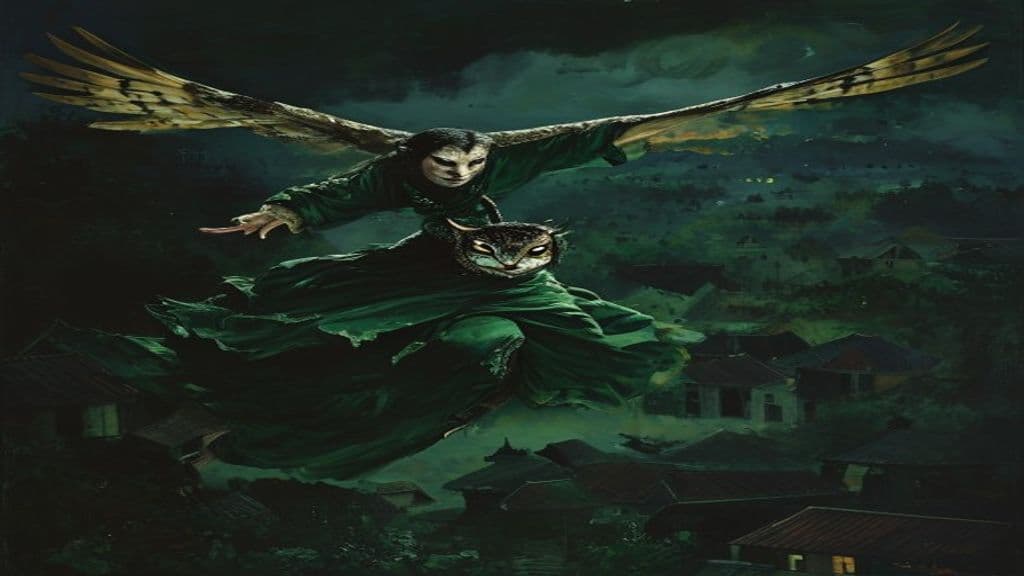
The Langsuir is the original, fully-transformed form of which the Pontianak is a variant. She is the spirit of a woman who died hearing that her child was stillborn — her grief and shock were so extreme that she transformed. She can fly like an owl and attacks infants. She can be domesticated if her long nails are cut and the hair stuffed into the hole in her neck — she will then live normally as a human woman. One tale records a Langsuir who married and lived in a village undetected until allowed to dance, at which point she flew away.
A beautiful woman with extremely long black hair and long nails, wearing green robes. She can fly silently like an owl. The telltale sign is the hole in the back of her neck, through which she feeds. Her hair conceals this hole.
Flight. Could feed on infants' blood through the neck-hole. Could be tamed through nail-cutting and hair-stuffing rites. Could live undetected among humans if tamed. Was dangerous again if allowed to dance.
Weaknesses
- ritualCutting her nails and stuffing her hair into the neck-hole tames her
- substanceSalt
Wards
- ritualProper burial rites for women who die in childbirth (prevents transformation)
- substanceThorny branches at windows
Hantu
Hantu is a Malay and Indonesian lexical and conceptual category for spirits and invisible beings that includes ancestral souls, animistic nature spirits, and, in modern usage, ghosts or demons. The term covers many named subtypes (e.g., Hantu Raya, Hantu Tinggi) whose forms and roles vary across local traditions.
Hantu Penanggal (Penanggalan)
A nocturnal vampiric entity in Malay ghost myth, the penanggalan appears as a floating disembodied woman's head with trailing organs and entrails and is said from a distance to twinkle like a ball of flame.
Hantu Pocong
A Southeast Asian folkloric ghost understood as a dead body wrapped in an Islamic burial shroud (kain kafan), commonly associated with improper funerary procedure or unresolved death-related matters. Representations range from a hopping wrapped corpse in popular media to esoteric readings that interpret the phenomenon as residual energetic or liminal-layer disturbance.
Jin (Malay/Javanese spirit)
No information about a Malay or Javanese spirit called 'jin' is present in the provided source. The supplied material discusses Malaysian Malay ethnicity and does not contain data on supernatural beings, their appearance, abilities, rituals, or cultural role.
Orang Bunian
The 'invisible people' of Malay tradition — a sophisticated parallel civilization of beings sharing the world with humans but normally unseen, who can abduct or adopt humans who stray into their realm.
Penanggalan
A Malay vampire consisting of a detached human head with dangling organs that flies at night to feed on the blood of infants and new mothers, then soaks its organs in vinegar to reattach.
Pontianak (Kuntilanak)
A Southeast Asian female vengeful spirit common in Malay‑language traditions, often portrayed as the restless ghost of a woman who died in traumatic circumstances; she commonly appears as a beautiful woman who may reveal a monstrous form and is associated with banana and banyan trees.
Toyol
A malevolent fetal spirit used as a supernatural familiar in Malay and Javanese black magic — typically stolen or purchased from a dukun, fed blood, and set to steal from neighbors.
Lampus / Lampos
Lampus (Ancient Greek: Λάμπος) is not a single mythic being but a personal name applied across a range of classical Greek mythic figures — human and animal — whose name evokes 'brightness' or 'shine.' Attestations in classical mythographic and epic materials include royal mortals, hounds, and named horses associated with dawn and sun deities and with heroes.
Landvættir
Landvættir are place-bound spirits or 'land-beings' in Old Norse and Icelandic tradition whose favor was linked to the fertility and safety of particular locales. Attested in saga literature, law codes, and later folk practice, they are localized guardians or presences dwelling in stones, hills, skerries, and other landscape features and were addressed by offerings and social regulations.
Langsuyar
A female revenant in Malay and related archipelagic traditions said to be the ghost of a woman who died in connection with pregnancy or childbirth. The langsuyar is described variously as a beautiful long‑haired woman or as a floating head with trailing entrails; she is vampiric in behavior, associated with night‑birds and certain trees/ferns, and managed by corpse‑preparations, charms, and exorcistic measures.
Lanka (Hindu tradition)
A city-state and island fortress capital in Hindu epics, ruled by the Rakshasa king Ravana. (Note: - Power tier: Lower than Greater (Lanka is a city-state and island fortress capital, not a powerful regional entity) - Abilities: Specify that Lanka's ruler Ravana has no supernatural powers beyond hu)
Community Record
- [1]Malay Magic. Skeat, Walter William. 1900. Malay Magic. Macmillan.academic
- [2]Malay Poisons and Charm Cures. Gimlette, John D. 1923. Malay Poisons and Charm Cures. J. & A. Churchill.academic