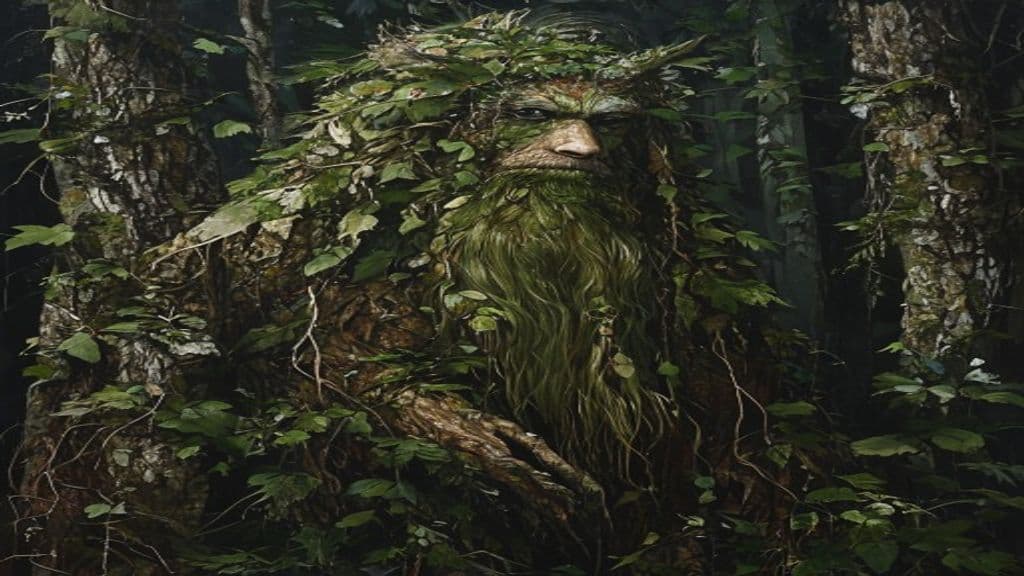
In pre-Christian Slavic worldview the Leshy functions as a tutelary or guardian-being of the forest: an embodied, agentive presence resident in woodlands. Regional name-variants (Lesnik, Lesovik, Borovoi, Gayevoi, etc.) encode local forest types and roles; scholarly summaries sometimes note a possible relation to older Slavic nature deities (one suggestion links Leshy to the god Porewit), but the primary attestation frames Leshy as the localized personification or master of the woods rather than a single standardized mythic genealogy.
Descriptions vary widely; Leshy is often shapeshifting and elusive. When pictured he is phytoanthropomorphic (tree- or plant-like: bark-coloured skin, clothing like leaves, long tangled green hair like branches, beard of lichen) or appears as animals or hybrids (bears, wolves, owls, hares, frogs, crows, dogs, cats, half-man half-goat with horns and hooves). Size ranges from giant to human; eyes may be unusually coloured (pale, green, lead-blue) and physical peculiarities (missing nostril/ear/eye, limp, blue blood/skin) are reported in some accounts.
Leshy is credited with shapeshifting (into people, plants, animals), altering his size and stature, and filling his domain with his presence. He governs hunting and the forest: misleading or misguiding wanderers, producing strange noises and humming, whipping people with twigs, splitting trees, abducting children (notably those mistreated by kin), and traveling with animal familiars. His behaviour is morally ambivalent and described as responsive to human conduct toward the forest—protective or punitive depending on respect shown to woodland and its rules.
Weaknesses
- conditionhuman respect for the forest (moderating factor)
Wards
- ritualeuphemistic address / avoidance of direct naming
Community Record
- [1]Leshy - Wikipedia. Wikipedia: Leshywiki
- [2]Leshy - Wikidata. Wikidata: Q1056876wiki