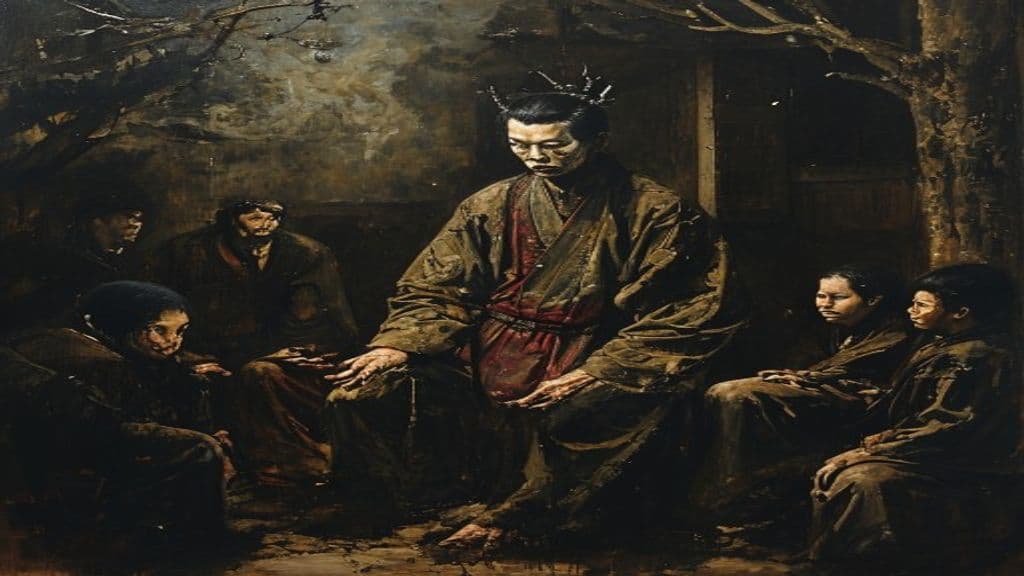
Life replacement narratives have a similar core story despite originating from different regional traditions. They are not supernatural entities per se but rather a type of shamanic narrative or mythological story that serves as a core part of Korean regional traditions of mythology.
These narratives take the form of stories, myths, and chants during religious rituals. They do not have physical presence or appearance.
Life replacement narratives convey meaning and provide comfort during religious rituals. They have a transformative effect on those who hear them as they exist in multiple versions and are chanted during rituals.
Leđan (Slavic tradition)
An ancient and magical city from Croatian mythology and folklore. (Note: 1. Power tier: downgrade to Greater (since Leđan is described as an "ancient" city, but its magical nature and lack of explicit abilities suggest it may be less powerful than Ancient). 2. Appearance: )
Lha
Lha is a Tibetan term used in Buddhist and related Himalayan contexts to denote local or regional deities and divine presences that have been incorporated into the ritual and popular religion of Tibet and neighbouring areas. The category overlaps with indigenous spirits and classical Buddhist beings (devas, yakshas) and functions within ritual life as objects of veneration, territorial sacralization, and protective or beneficent cult practice.
Libat
Libat is the Mandaic name for the planet Venus and one of the Seven (šuba) planetary beings who form part of Ruha's entourage in the Mandaean World of Darkness. Treated both as the astronomical Venus and as an agentive supernatural being, Libat is associated with love and reproduction yet is often framed negatively as a demonic power (daiuia) and sometimes identified with Ruha or her epithets such as Amamit and ʿstira/Estira.
Libya (daughter of Epaphus)
A mythic eponymous ancestress in Greek and Roman genealogical tradition: a daughter of Epaphus whose name personifies the land/ethnonym Libya. In some variant sources she is said to be beloved of Poseidon and, in those accounts, mother of progenitors such as Agenor and Belus. Surviving testimonia treat her primarily as an etiological genealogical figure rather than an active cultic or supernatural agent.
Lichas (Spartan)
A mortal human figure in Greek tradition, associated with ancient Sparta. He demonstrated leadership and diplomatic skills during the Peloponnesian War. (Note: 1. Power tier should be Primordial, as Lichas is described as a mortal human figure in Greek tradition with significant impact on historical events. 2. Abilities description can be expanded to include)
Lieaibolmmai
Lieaibolmmai (also Leibolmai, Liejbbeålmáj, Leib-Olmai) is a Sami forest deity who rules wild animals and is petitioned by hunters for good fortune. He is associated specifically with alder trees and appears to humans in the form of a bear.
Ligeia
Ligeia is the central female figure of Edgar Allan Poe's 1838 short story "Ligeia." Within the story she is portrayed as an extraordinary, raven‑haired intellectual whose intense will and metaphysical learning are suggested as enabling a possible postmortem return; the narrative, however, leaves open psychological explanations (opium‑induced vision, unreliable narrator) and does not present her as a codified folkloric being.
Likho
An anthropomorphized embodiment of bad luck and evil fate in Slavic folktales. Likho appears in narratives as a detachable, transferable force of misfortune—often depicted as a one‑eyed old woman or as an evil male forest goblin—and features in proverbs and cautionary tales that teach avoidance, cunning, or the perils of greed.
Likhoradka
A female spirit in Slavic (particularly Russian) popular belief who personifies fever and sickness. Traditionally portrayed as an agentive being that can possess people or bring disease by touch or kiss; the term likhoradka later lexicalized in modern Russian to mean 'fever'.
Lilaea
Lilaea (Ancient Greek: Λίλαια / Lilaia) is attested in classical and modern reference sources as (1) a Naiad — a freshwater nymph of a named spring in Phocis, daughter of the river-god Cephissus — and (2) separately, as the name of a Maenad recorded on a vase painting. The name is also preserved in toponyms (the ancient polis and modern village Lilaea/Lilaia) and in later namesakes (asteroid 213 Lilaea).
Lilin
Lilin are a class of nocturnal spirit-beings in Jewish and Near Eastern magic and mythic literature, linked etymologically and functionally to Mesopotamian lilû/lilītu traditions and associated with Lilith. They appear in ritual texts and incantation bowls as hostile night spirits that sexually interact with humans, cause terror or affliction, and are subject to binding, sealing, or legal-style annulment rites.
Lilith
Lilith is a feminine night‑spirit in Jewish mythic, magical, and folkloric traditions associated with harmful nocturnal activity, especially threats to sleeping people and infants. The figure appears both as a class of night‑spirits (lilit/lilītu) in Near Eastern demonologies and as an individualized dangerous woman in later medieval Jewish narratives and amulets.
Community Record
- [1]