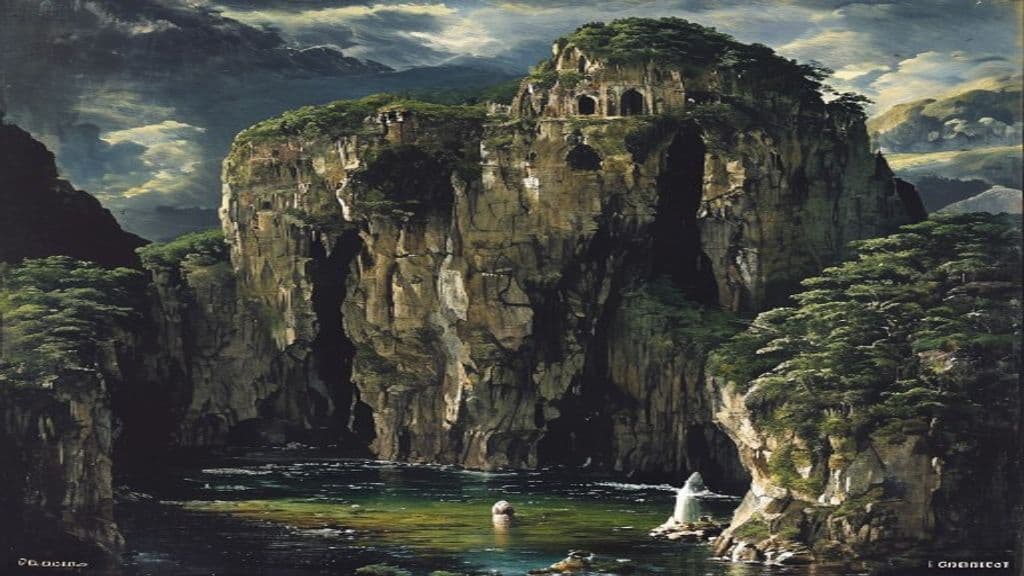
The familiar image of the Lorelei as a siren‑like woman was popularized in early 19th‑century literature: Clemens Brentano's 1801 ballad and Heinrich Heine's 1824 poem shaped the modern motif of a beautiful female figure associated with the rock. The place-name itself — from Rhine dialect lureln ('murmuring') + Old German ley ('rock') — predates these poems and long carried reputational associations with dangerous currents and echoes; older local legends (for example, tales of dwarfs in caves) also existed around the site. Thus the literary femme fatale was grafted onto a preexisting hazardous toponym and repertory of place‑legends rather than emerging wholly apart from the named landscape.
As a place: the Lorelei (Loreley) is a 132-metre-high (433 ft) steep slate rock on the right bank of the River Rhine at Sankt Goarshausen in the Rhine Gorge; the summit area includes the Loreley Amphitheatre (built in the 1930s) and the site lies within the culturally significant Upper Middle Rhine Valley. As a legendary woman (per cited literary accounts): she is typically pictured in the Heine image as a beautiful woman sitting on the cliff, combing her golden hair and singing; Brentano's ballad likewise refers to a 'beautiful Lore Lay' though without extensive corporeal detail. The supplied sources provide no consistent, older corporeal description beyond these literary depictions.
In the literary tradition recorded in the supplied sources, Lorelei's attributed agency is mainly persuasive/disruptive rather than cosmically transformative: Heine's poem depicts her as unwittingly distracting boatmen by sitting on the cliff, combing her hair, and singing, resulting in shipwrecks; Brentano's ballad accuses her of bewitching men, leading to their deaths and to her tragic fall, after which the rock is said in the poem to retain an echo of her name. The sources emphasize that the rock's dangerous currents, acoustic murmuring, and echo are the material causes of accidents and that the female figure operates as a poetic, personified explanation rather than a documented supernatural force independent of the landscape.
Weaknesses
- otherno attested weaknesses in supplied sources
Wards
- otherno documented wards in the supplied sources; practical avoidance (nautical caution) is the implied preventive measure
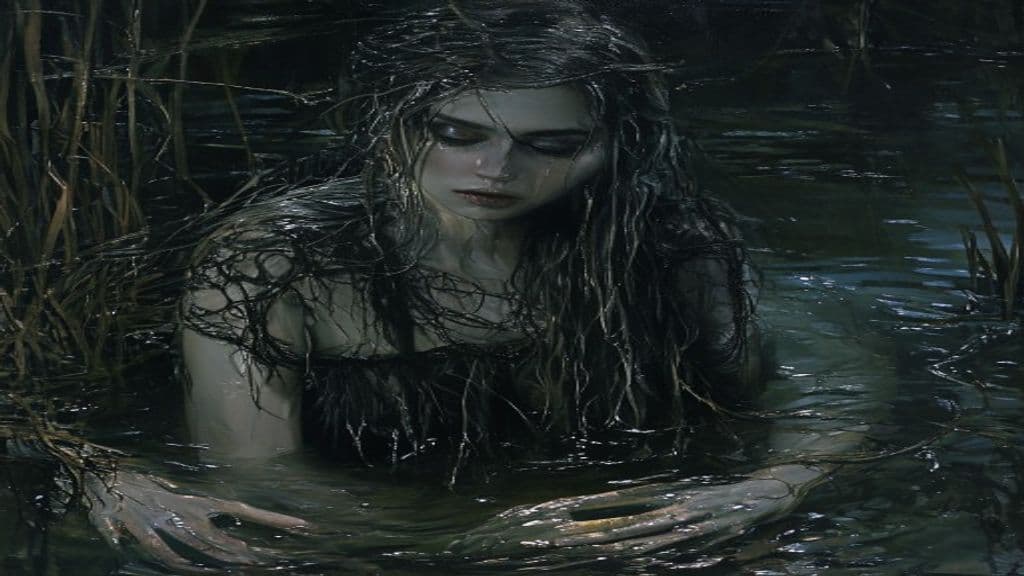
Loki
A complex figure in Old Norse myth: son of a jötunn and the female figure Laufey, resident among the Æsir, a shape‑changing trickster whose cunning alternately aids and undermines the gods and who is bound for his role in Baldr's death before breaking free to fight at Ragnarök.
Long Horse (Trevor Henderson)
A fictional creature created by Canadian horror artist Trevor Henderson, depicted as a horse-skull-headed entity with an apparently infinite, highly flexible neck. Unlike many horror creations, it is commonly portrayed in fandom sources as benevolent and protective toward humans.
Longma (龍馬)
The longma is a mythological Chinese dragon-horse: a horse-bodied, dragon-scaled creature (sometimes winged) that appears as a portent, most famously bearing the Hetu (Yellow River chart) from the river to culture-heroes and sage-rulers. It functions as a liminal, quasi-divine sign linking rivers, Heaven, and legitimate rulership in classical Chinese sources.
Longnü (Buddhist Tradition)
Companion and acolyte of the bodhisattva Guanyin, associated with salvific aspects. (Note: 1. Power tier should be Ancient, as she is an acolyte and companion of a bodhisattva, implying significant spiritual authority. 2. Add sensory cues (e.g., sound of gentle waves or soft chanting) that )
Lono
Lono is a major Hawaiian akua (deity) associated with fertility, agriculture, rainfall, music, and a season of ritualized peace. He is counted among four principal pre-creation gods in Hawaiian cosmology and is central to the Makahiki festival and seasonal ritual life.
Lord Drinian
Lord Drinian is a human nobleman and sea-captain in C. S. Lewis's Narnia. He serves as captain of the Dawn Treader under King Caspian X, later becoming a trusted advisor and attendant in the king's later years.
Lorsch Bee Blessing
A Christian prayer invoking a benevolent entity to bring good health to honey bees and their hives, reflecting Germanic folklore's appreciation for nature and balance. (Note: 1. Power tier should be reassessed, as the entity's influence on bee health and guidance may indicate a Greater power level. 2. The source material does not support the claim that the Lorsch Bee Bless)
Lost Comet
A technical astronomical designation for a previously observed periodic comet that was not detected at its most recently predicted perihelion return. The status reflects observational, dynamical, or physical causes that prevented recovery rather than supernatural agency.
Lotis
Lotis is a named nymph in Greek mythology attested in modern reference works and represented in visual art, most notably in scenes pairing her with the fertility god Priapus. Surviving references in the supplied sources identify her as a mythic female nature-being but provide no extended ancient narrative, ritual tradition, or etymology.
Loucetios
Gallic god associated with Mars, lightning, and war; worshipped in the Rhine-Moselle region. (Note: 1. Power tier: Primordial is unlikely, given the lack of information about his abilities or behaviors; a more plausible tier would be Greater (powerful regional). 2. Abilities: No direct information a)
Louhi
Louhi is a major supernatural ruler figure in Finnish mythology presented as the Mistress or ruler of Pohjola, an otherworldly northern realm; she is associated with death, disease, and the origin and control of calamities, and appears in traditions as a queenly or witchlike sovereign who can shapeshift into bird-forms.
Loup garou
A loup garou is a human afflicted with or capable of transforming into a wolf or a wolf–human hybrid (a werewolf). Sources treat it as a folkloric condition or being tied to specific persons rather than a separate species; modern fiction often depicts transformations tied to the full moon and transmissible by bite or scratch.
Community Record
- [1]Lorelei - Wikipedia. Wikipedia: 'Lorelei' article (accessed via provided research notes)wiki
- [2]Lorelei - Wikidata. Wikidata entry Q785391 (referenced in supplied material)other
- [3]Clemens Brentano, early 19th-century ballad (as discussed in sources). Discussion of Brentano's ballad in Lorelei article (summary in supplied notes)literary
- [4]Heinrich Heine, 'Die Lore-Ley' (1824) (as discussed in sources). Discussion of Heine's poem and its image in Lorelei article (summary in supplied notes)literary
- [5]Archive references mentioning the name 'Lorelei' (legal documents). Archive item referencing individuals named Lorelei (not folkloric content)other
- [6]Archive reference (sample). Archive item referencing individuals named Lorelei (not folkloric content)other