In Egyptian cosmology Maat is the ordering-power established at the moment of creation to oppose Isfet (chaos). In some traditions the sun-god Ra is said to have 'set his daughter Maat in place of isfet' so that the creator-gods could bring order from primeval chaos; sources indicate that filial attributions and genealogies vary by period, with statements of Maat as daughter of Ra appearing in some later traditions rather than as a single universal origin across all periods.
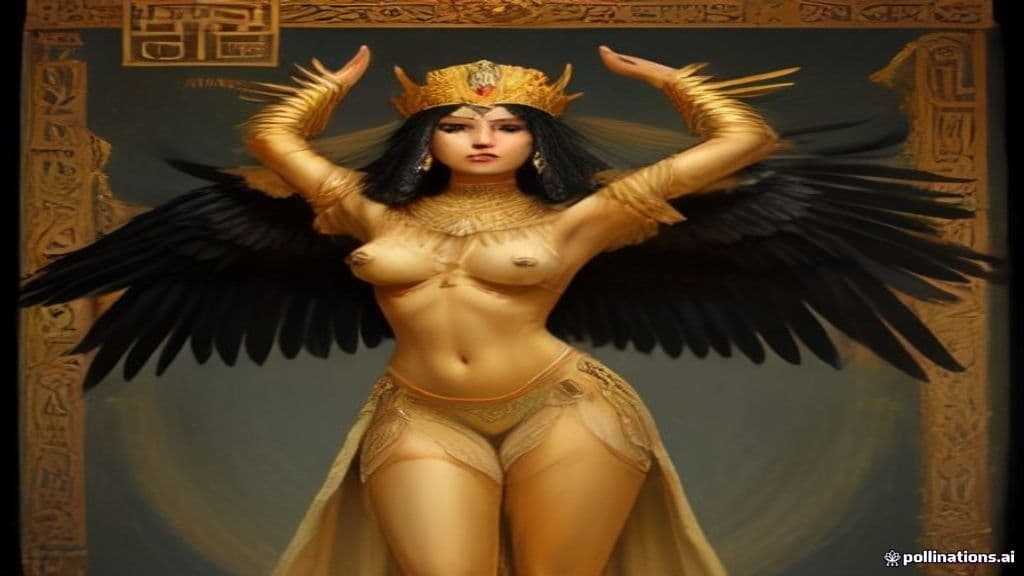
Maat is typically personified as a young woman, commonly depicted wearing an ostrich feather on her head and often shown with wings attached to her arms. The ostrich feather functions prominently as the emblem used in funerary judgment (the Weighing of the Heart); the precise original symbolic meaning of the feather is described as uncertain in the sources. In royal imagery pharaohs are often shown bearing emblems of Maat to signify their role in maintaining order.
Maat functions as the normative and ordering principle that underlies and 'regulates' the stars, seasons, and the actions of mortals and deities; she is the conceptual force that prevents the universe from reverting to chaos (Isfet). Her role is largely ontological and judicial: she provides the standard by which justice is applied in society and by which the deceased are judged in the Duat (the heart is weighed against Maat's feather). In ideology and ritual contexts Maat grounds law, royal legitimacy, and ethical expectations rather than acting as a combative agent. She is frequently associated with deities of measure and record—most notably Thoth (occasionally paired as a masculine counterpart), while in other traditions Thoth is paired with Seshat.
Weaknesses
- otherNo traditional weaknesses recorded; Maat is an ordering principle not a hostile entity
- conditionOpposition by Isfet (jzft) — conceptual opposite: injustice, chaos, violence
Wards
- ritualUpholding correct ritual, law, and moral conduct — institutional practice (vizier as 'Priest of Maat')
- otherThere are no texts prescribing wards against Maat; sources emphasize sustaining Maat rather than warding it off
Community Record
- [1]Maat. Wikipedia contributors, 'Maat,' Wikipedia, The Free Encyclopedia.wiki
- [2]Egyptian Texts : Maat and the Golden Age. Attalus: Egyptian texts (selection) discussing Maat and related texts.other
- [3]Wikidata: Q37007369. Wikidata entry for Maat.other