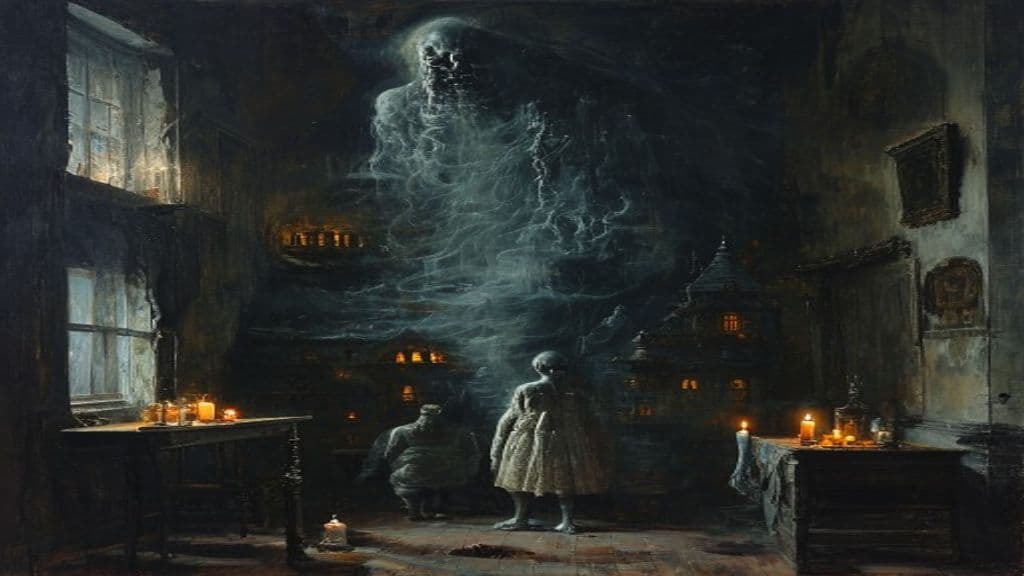
In North Indian folk cosmology, pretas exist on a spectrum. At the lower end: a spirit with a single, minor unresolved grievance, easily appeased with a straightforward shraddha. At the upper end: the Mahapreta, a spirit whose death accumulated multiple grievances simultaneously — wrongfully killed, improperly cremated, mourned inadequately, and whose survivors failed to perform the annual shraddha for multiple years.
The term 'Mahapreta' is used in folk speech to distinguish from ordinary pretas the way 'Brahmpret' distinguishes a Brahmin's ghost — it marks a qualitatively more powerful and more difficult entity. Freed and Freed's ethnographic work in UP villages documented the Mahapreta category as a live classification used by villagers to explain when ordinary ghost-removal methods failed.
The Mahapreta does not have a fixed appearance — this is itself a marker of its power. Lesser pretas tend to appear in the form of the person who died. The Mahapreta shifts form: appearing as the deceased one night, as a monstrous enlarged version the next, and as a vague sense of dread without any visible form after that.
In the most extreme accounts, the Mahapreta does not appear at all — its presence is known only through the accumulated harm it causes to the family.
Unlike a standard preta that targets the specific people or grievances connected to its death, the Mahapreta operates at the level of the entire family lineage. It can afflict multiple generations simultaneously, cause the family's land to become unproductive, and is described in Bihar exorcism traditions as capable of directing lesser spirits toward specific targets.
It requires a specialist exorcist (ojha or sokhaa) rather than a regular Brahmin priest. A Brahmin can perform shraddha for an ordinary preta, but an ojha is needed to diagnose and address a Mahapreta.
Weaknesses
- ritualOjha-conducted investigation and multi-day exorcism ritual
Wards
- ritualAnnual shraddha performed without exception during Pitru Paksha
Agiya Baital
The fire-form of the Vetala — a cremation ground spirit of UP and Bihar that manifests as a wandering flame rather than a corpse-inhabitor, leading night travellers off roads and into marshland or flames with a dancing fire that seems always just ahead.
Bhunni
The female guardian-spirit of agricultural fields in Bihar and eastern UP — her presence ensures fertile soil and good harvest, but she is territorial and punishes those who plough without permission, steal crops, or use chemical methods that poison the soil she inhabits.
Brahmpret
The ghost of a Brahmin who died before fulfilling his dharmic obligations — more powerful than any ordinary preta, the Brahmpret retains Sanskrit learning, ritual authority, and the capacity to curse. The most feared ghost-class in North Indian villages.
Dayan (Daayan, Ḍāin, Ḍāini)
A North and East Indian folkloric figure: a malevolent female revenant or vengeful spirit commonly associated with women who died in traumatic or unresolved circumstances. Dayans are described in popular sources as powerful life-draining entities with distinctive physical markers and as a label that also functions in social witch‑hunt practices.
Doyen
The Bengali witch — closely related to the North Indian Dayan but with Bengali-specific characteristics including the ability to steal livers, which the witch must periodically consume to maintain her powers. Doyen accusations continue to drive violence against women in rural Bengal and tribal districts of Jharkhand.
Jokhini
A female supernatural predator of Assamese folklore — the Jokhini appears as a beautiful woman to lure men, but also as a hideous crone to devour them. She is associated with the dense forests of the Brahmaputra valley and is one of the most feared night entities in Assamese village belief.
Kachcha Kalwa
North Indian spirit of those who died 'raw' — violently, accidentally, or before their destined time. Unable to rest, the Kachcha Kalwa attaches to survivors and causes a trail of accidents, illness, and misfortune until properly appeased through rites at the site of death.
Kshetrapala
Fierce guardian deity of fields, village boundaries, and agricultural territory — an aspect of Shiva or Bhairava who punishes trespass with epidemic illness and crop failure. Every North Indian village once had a Kshetrapala shrine at its boundary stone; his is the first rite performed before plowing season.
Mamdo Bhoot
The ghost of a Muslim person in Bengali Hindu folk belief — 'Mamdo' deriving from 'Mahmood.' The Mamdo Bhoot occupies a unique place in Bengal's supernatural taxonomy: a cross-religious ghost in a deeply syncretic tradition, with its own distinctive characteristics and ward practices that follow the ghost's religious tradition rather than the observer's.
Masaan
Cremation ground spirit of North India — born from improperly conducted last rites, the Masaan haunts funeral pyres and can possess the living, causing wasting illness. Referenced in classical Ayurvedic texts and the subject of the acclaimed 2015 film.
Muhnochwa
The 'face-scratcher' of Uttar Pradesh — in 2002 a mass panic gripped hundreds of villages as people reported waking with facial scratches from an invisible entity, triggering mob violence and one of modern India's most documented supernatural hysteria events.
Nathiya
Ghost of a young bride who died before her first Diwali as a wife — still wearing her wedding nose ring (nath), she haunts the marital home she never truly inhabited, causing illness in subsequent brides and making the household unwelcoming to new marriages.
Community Record
- [1]Ghosts: Life and Death in North India. Freed, R.S. & Freed, S.A. (1993). Ghosts: Life and Death in North India. Anthropological Papers of the American Museum of Natural History, 72.academic