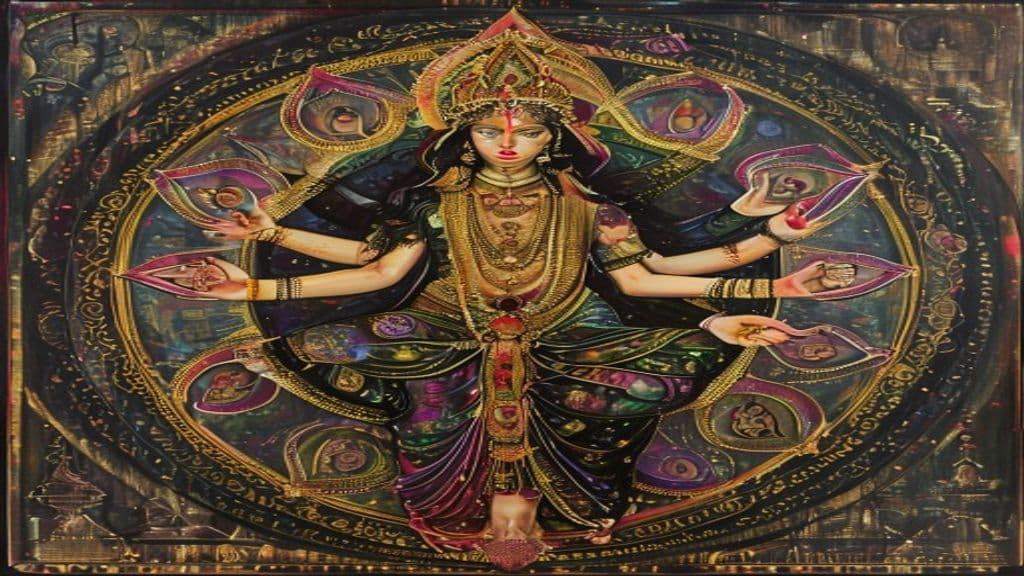
The Mahavidyas emerge as a composite ten‑goddess grouping in the post‑Puranic development of Shaktism (commonly dated in secondary sources to around the early post‑Puranic period, ca. 6th century CE). Their consolidation as a canonical set reflects a syncretic process across tantric yogini cults and interactions with Shaiva, Vaiṣṇava and Buddhist tantric currents; different schools alternately treat them as distinct goddesses or as ten aspects/forms of a single supreme goddess (e.g., Mahākālī or Tripura Sundarī). The formation of the ten‑goddess schema is thus a product of diverse textual and ritual traditions rather than a single originating mythic event.
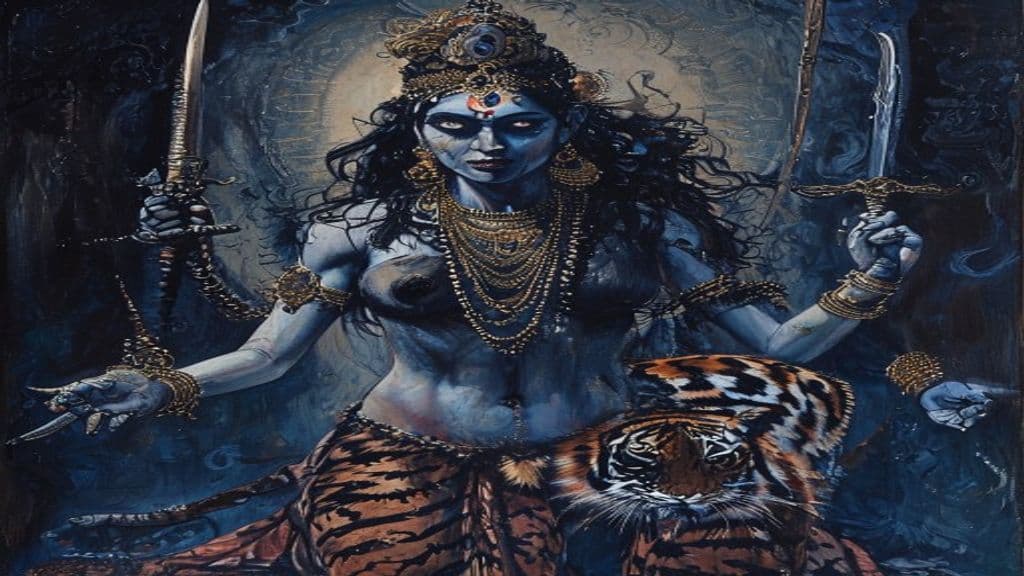
Each Mahavidya has a distinct iconography emphasizing an extreme or exemplary aspect of the Divine Mother. Canonical lists commonly give the ten as Kali, Tara, Tripura Sundarī (Śodashi/Lalita), Bhuvaneśvarī, Bhairavī, Chhinnamastā, Dhumavatī, Bagalamukhī, Matangi, and Kamalatmika. Sources summarize key images: Kali—pitch‑black, three eyes, dishevelled hair, protruding red tongue, fangs, four arms (sword/trishula/demon head/bowl), garland of skulls and tiger‑skin attire; Tara—light blue, three eyes, moon on crown, snake at throat, tiger‑skin, garland of skulls, four hands holding a lotus, scimitar, demon head and scissors, left foot resting on the reclining Śiva; Tripura Sundarī—molten‑gold complexion, three eyes, calm demeanour, red/pink garments, four hands holding a goad, lotus, bow and arrow, seated on a throne; Bhuvaneśvarī—fair/golden, three eyes, red and yellow garments, four hands (goad and noose, two open hands), seated on a celestial throne; Bhairavī—fiery red, three eyes, matted hair with crescent, skull garland and severed‑hand belt, snakes as ornaments, two hands holding a rosary and book; Chhinnamastā—red, self‑decapitated and holding her severed head, four hands (sword, severed head, lasso, drinking bowl), three blazing eyes, crowned, garland of skulls, mounted on a copulating couple; Dhumavatī—smoky dark brown, wrinkled, gray hair, widow’s white clothes, frightening mien conveying anger and misery, seated in a horseless chariot with a crow emblem, one hand bestowing boons/knowledge and another holding a winnowing basket. (Descriptions for Bagalamukhī, Matangi and Kamalatmika are acknowledged in the canonical list but fuller iconographic details were not provided in the available excerpts.)
In tantric contexts each Mahavidya functions as a salvific and transformative power: they embody modes of esoteric knowledge (vidyā) and confer specific powers, knowledge or modes of liberation associated with their aspect. Tara is described as a guide and protector offering knowledge that grants salvation; Kali is characterized as the devourer of time and, in some kālikula systems, the ultimate form of Brahman with worship practices that include cremation‑ground sādhanā. Dhumavatī personifies misfortune, widowhood, hunger and restlessness and simultaneously serves as a source of harsh knowledge. Specific correspondences (astrological, mantra, yantra) and particular ritual powers vary by lineage and text.
Adi (asura)
Adi is attested in modern reference works as the name of an Asura who 'appears in the Matsya Purāṇa.' Beyond this single-line citation in secondary sources, no descriptive material about the figure is provided in the supplied research notes.
Adi Shakti
Adi Shakti (also Adi Parashakti, Mahadevi, Adya Shakti) is the primordial feminine power in Hindu/Shakta theology, regarded as the ultimate reality (Para Brahman) and the source from which all goddesses and gods manifest. She is both an impersonal cosmic principle (Mulaprakriti) and a focus of devotional invocation in temples, mantras, and pilgrimage sites such as Shakti Peethas.
Adi Vinayaka
Adi Vinayaka (Ādi Vināyaka; also called Nara Mukha Vinayaka) is a named iconographic and devotional form of the Hindu god Ganesha portraying the deity with a human head, described in sources as the form before the episode of decapitation by Shiva. It is rarely worshipped and appears in a small number of South Indian shrines and in devotional/musical repertoires.
Aditi
Aditi is a major Vedic goddess in Hindu tradition who personifies the boundless, infinite cosmic principle and functions as the maternal matrix from which many celestial deities (the Ādityas and other groups) are born. In the Vedic hymns she is invoked as a protective liberator who guards petitioners, provides wealth and safety, and frees devotees from hindrances such as sin and sickness.
Agni
Agni is the Vedic personification of fire in Hindu tradition: a sacred, mediating principle that manifests as terrestrial fire, atmospheric lightning, and celestial sun, and that receives and conveys sacrificial offerings. Prominent in the Rigvedic corpus, Agni functions as sanctifier, witness of rites of passage, and a transformational inner principle in later Upanishadic literature.
Ahalya
Ahalya is a mytho-legendary woman of South Asian (primarily Hindu) narrative tradition, described as created by the god Brahma, married to the sage Gautama, seduced (or tricked) by Indra, cursed by her husband, and ultimately redeemed by Rama. Her tale is a locus for themes of creation, desire, curse/penance, and redemption and she is counted among the ritual-mnemonic panchakanya.
Aindri (Indrani / Shachi / Paulomi)
Aindri (commonly rendered in sources as Indrani, also called Shachi or Paulomi) is a Hindu goddess presented as the queen-consort of Indra. She is depicted in the available material as a courtly queen associated with beauty, pride and kindness who also appears in at least one account as an active martial participant in the devas' battles with asuras.
Akhilandeswari
Akhilandeswari (Akhilandeshwari) is a major South Indian manifestation of the Hindu Goddess Adi Parashakti/Parvati, venerated as the presiding goddess of the Jambukeswarar Temple in Thiruvanaikaval. In temple tradition she is portrayed as a penitent/student of Shiva and figures in local legends, ritual schedules, and festivals that emphasize both maternal and fierce aspects.
Akshayavata
In Hindu mythology, Akshayavata is a sacred banyan tree and/or lake that symbolizes eternal life. It is mentioned in both Hindu and Jain traditions and associated with the Puranas. (Note: - The power tier should be "Greater" or at least "Ancient", as it is associated with the Puranas, which are considered ancient texts. - No specific physical description is provided, but that doesn't m)
Alakshmi
Alakshmi is an inauspicious female supernatural figure in Hindu tradition, presented as the negation or shadow-counterpart of the prosperity-goddess Lakshmi. She personifies poverty, grief, jealousy and social discord and is managed in domestic ritual and festival practice.
Alamelu
Alamelu (also Alamelu Manga / Alarmel Mangai) is a South Indian devotional name for the goddess Padmavati, identified in sources as an avatar of Lakshmi and the consort of Venkateswara; the name is also used widely as a female personal name and in titles of cultural works in Tamil and Telugu contexts.
Amrita (Buddhist tradition)
In the context of Indian religions, particularly within Hinduism and Buddhism, Amrita is a divine elixir that grants immortality and eternal life. (Note: - Power tier should be Ancient (deity-level), not Primordial. - Origin story appears accurate but lacks specificity on when Amrita was first mentioned in the Rigveda; add more detail. - Abilities are )
Community Record
- [1]Mahavidya. Wikipedia: Mahavidya (overview, canonical list, dating and role in Shaktism)wiki
- [2]Mahavidya (Wikidata). Wikidata: Mahavidya (summary statements linking Mahavidya to tantric/Shakta contexts)other
- [3]Tara Mahavidya Sadhana Siddhi (Gujarati Book 2) — Sharad Chandra Purohit (archive listing). Archive.org listing for a Tara sādhanā manual (indicates extant ritual manuals for individual Mahavidyas)other
- [4]Śrī Tripurārahasyam (Māhātmya Khaṇḍam) - Sanskrit Text With English Translation (archive listing). Archive.org listing for Tripurārahasyam mahātmya (connected to Tripura Sundarī tradition)other
- [5]Kali (archive excerpt). Archive excerpt referencing Kali as foremost of the Mahavidyas and noting cremation‑ground sādhanāother
- [6]Tara (Mahavidya). Wikipedia: Tara (Mahavidya) (attributes and salvific role)wiki
- [7]Dhumavatī: The Crone Mahavidya (overview). Online essay summarizing Dhumavatī iconography and thematic associationsother
- [8]Dasha (Ten) Mahavidya – Part I - RESEARCHUT. Online summary of the ten Mahavidyas and associated themes (used for canonical ordering and brief iconographic notes)other
- [9]StackExchange: In which scriptures can we find the original stories of the Mahavidyas?. Community Q&A pointing to tantric textual sources (Kokilārṇava Tantra, Tripurārahasyam) and indicating diversity of textual witnessesother
- [10]StackExchange: What correspondences of Grahas to different Mahavidyas are correct?. Community Q&A noting that astrological and other correspondences vary by tradition and textother
- [11]Bagalamukhi Reconsidered. Essay discussing Bagalamukhī (acknowledged in canonical list though full iconography not reproduced in the provided excerpts)other
- [12]Dasa Mahavidya – The Ten Great Wisdoms | Rati Mehrotra. Popular overview summarizing the ten Mahavidyas and their thematic importother